Get Full Government Meeting Transcripts, Videos, & Alerts Forever!
Get email alerts on the Education Budget topic
No spam. Unsubscribe anytime.
Kenai Peninsula school leaders warn of fiscal gap for FY25, begin talks on consolidations and public input
Summary
School Board President Kelly and district officials told the Kenai Peninsula Borough Assembly during a joint work session that the district expects to draw down most of its unassigned fund balance to cover FY25 operations and is exploring program reductions and possible school consolidations.
School Board President Kelly and district officials told the Kenai Peninsula Borough Assembly during a joint work session that the district expects to draw down most of its unassigned fund balance to cover FY25 operations and is exploring program reductions and possible school consolidations.
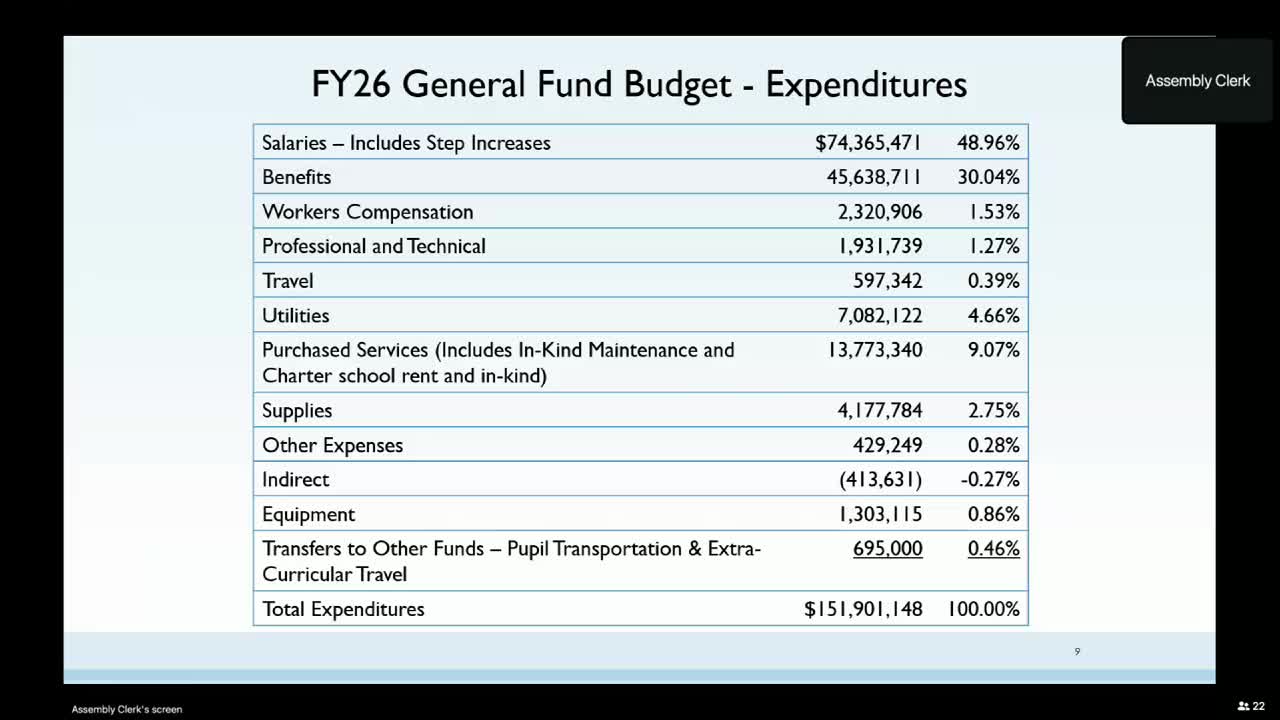
Board and district staff outlined that the FY25 budget would rely on roughly $6,000,000 in fund balance and left an unassigned balance of about $1,700,000 at the end of FY24, figures district staff presented during the meeting. Superintendent Holland said the district revised its budget in December to account for higher-than-anticipated health-care and contracted special-education services and later imposed a hiring freeze in January after discovering overspending in special-education grant accounts.
The district has opened a public-facing budget simulation tool called Balancing Act to collect input on revenue and reduction options. The district reported 354 respondents to date and said analytics from that tool will be presented to the board and the finance committee at a March 3 meeting. "We're gonna take input up, until the March 3 board meeting where the board and the finance committee will meet and start doing different projections," a district staff speaker said during the session.
Officials described three revenue scenarios for increasing the Base Student Allocation (BSA) that were placed in the Balancing Act tool. Those scenarios included a $0 increase, roughly $640 (per-student) increase, and a $1,000 (per-student) increase; participants were asked to focus on the mid-tier option in order to produce more actionable trade-off information for the board. Board members and assembly members diverged on whether the tool should include the $1,000-per-student option. Mayor Machekke said the public should "absolutely use the number that gets us balanced and then put the pressure on policy makers," arguing the highest BSA figure should be shown so the public can clearly see what fully funding schools would require. School Board President Kelly and other board members urged respondents to prioritize the $640 option in the tool, saying the $1,000 option makes balancing the district budget more difficult without an assurance of sustained state funding.
Assembly members and school leaders discussed the range of per-student increases that would be required to return to parity with inflation. Participants cited several figures in the meeting: about $1,200 would largely balance the budget under current assumptions, while roughly $1,400 would create a modest cushion, though speakers characterized these as estimates rather than guarantees. "Well, a thousand doesn't quite get us there," a district official said; later the same official noted a calculation that put break-even near $1,200 and a more cautious cushion near $1,400.
The group also discussed the district's in-kind maintenance allocation, which district officials said is approximately $9,600,000 and is allocated by the borough. Board members and assembly members warned that continuing to operate under-capacity buildings consumes classroom dollars and that a status-quo budget does not address long-term enrollment declines. School Board President Kelly said the board had begun a difficult conversation about consolidation and closure scenarios and that the initial list disproportionately included schools in Homer because of local capacity and utilization patterns. "We do need to stop the bleeding of continually operating schools that are under capacity," Kelly said.
Assembly members urged planners to account for multi-year population projections when considering closures, citing Anchor Point as an example of a previously under-enrolled site that later regained enrollment after local housing changes. Officials also noted that some schools with high needs populations require more space per student, which affects utilization calculations.
On facility use and local revenue opportunities, assembly members and board members discussed rental and community use policies. The board pointed to Administrative Regulation AR 13-30 (building-use/facility-use policy) as governing when outside groups may use school facilities and said insurance requirements and custodial/utility costs are common barriers. Board members cited an example where the district negotiated a memorandum of understanding and discounted rates for water-safety programming to allow continued community access while covering associated costs.
Officials discussed other funding and policy matters that affect the district budget. Speakers referenced the Alaska REEDS Act as a recent policy-change effort the district has implemented and said the law’s gains should be paired with funding. District staff and Assembly members also discussed how state-level measures — including governor-proposed bills — do not always include a BSA increase and how the state share projection for FY26 can decline if adjusted average daily membership (ADM) projections fall. Dr. Harpole explained that a projected drop in adjusted ADM reduces the state bucket in FY26 even where the borough’s percentage of contributions would be slightly higher.
School leaders also raised concerns about assessment narratives. District staff noted that national and state assessments (NAEP and AK STAR) are sometimes cited in ways that obscure Alaska’s unique cost and rural conditions and that grade-to-grade alignment problems have been found in state assessment implementation. The district highlighted local growth examples, including a school the speaker identified as Saldan Elementary, which the speaker said has shown strong growth on district report cards.
Next steps identified in the session included a March 3 finance-committee review of Balancing Act analytics, continued public input via the tool (the district intends to leave it open past that date if necessary), and follow-up reporting on where Connections (the district’s program for homeschooled students) enrollment is increasing. The district also noted the hiring freeze in special education and said more detailed staffing and expenditure scenarios will be prepared for board review.
The meeting recorded no formal motions or votes on the budget or consolidation steps during this session; participants described planning and decision-making steps the board will take in committee and subsequent public meetings.