Get Full Government Meeting Transcripts, Videos, & Alerts Forever!
Get email alerts on the Comprehensive Plan Update topic
No spam. Unsubscribe anytime.
Skagit County Planning Commission reviews draft comprehensive plan update; climate vulnerability assessment and housing options draw detailed questions
Summary
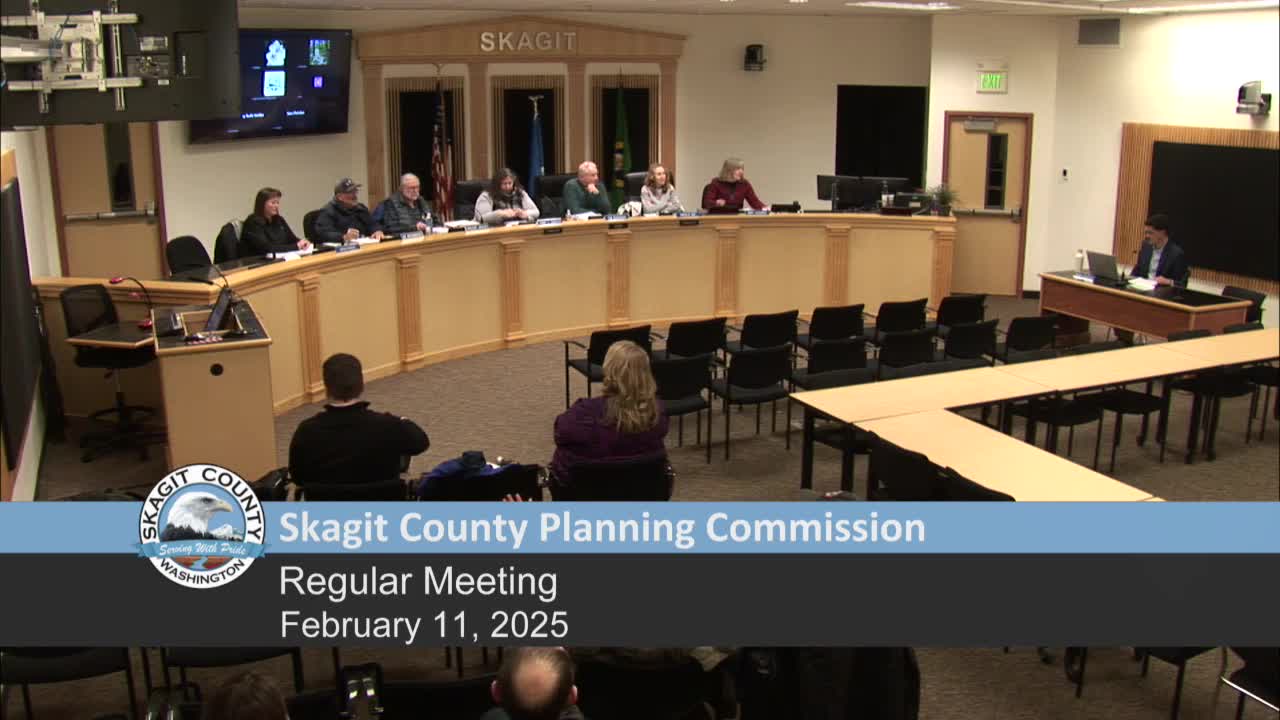
The Skagit County Planning Commission held a work session Feb. 11 to review the county’s 2025 periodic comprehensive plan update, including a newly drafted climate element with a required vulnerability assessment and proposed housing-policy changes aimed at limited denser housing in select rural village areas.
The Skagit County Planning Commission held a work session Feb. 11 to review the county’s 2025 periodic comprehensive plan update, including a newly drafted climate element with a required vulnerability assessment and proposed housing-policy changes aimed at adding limited housing capacity in certain rural village areas.
The draft plan, consultants said, will be released to the public on Feb. 13 with a public comment period running through March 13 and a public hearing in March; the commission will forward recommendations to the Board of County Commissioners with the goal of final action by late May–June 2025. "We're trying to make sure that you have all of the information that you need to feel comfortable in making a recommendation to the Board of County Commissioners," consultant Clay White told commissioners.
Why it matters: The periodic update is a statutorily required review under the state Growth Management Act and will guide land-use, housing, transportation and natural-resource policies for the next planning cycle. The addition of a standalone climate element—covering greenhouse gas (GHG) policies and resiliency—plus potential changes to housing policy and limited development regulations, could shape where and how the county accommodates growth while also responding to state law changes.
What presenters said Consultants from Kimley‑Horn presented the draft schedule, public-engagement summary and the policy approach for the update; Heidi Rouse outlined the climate vulnerability assessment and related recommendations. The assessment evaluated climate stressors—drought (including reduced snowpack), flooding, wildfire and sea-level rise—against county assets such as infrastructure, farms, roads and services. Rouse described the assessment as “future looking” and said it ranks hazard–asset pairs by sensitivity, adaptive capacity and likelihood to identify where the county should “accept risk” or “take action.”
Rouse summarized recommended policy directions including: protecting assets in floodplains (by reviewing current flood mapping and considering future conditions), strengthening resiliency for agriculture, enhancing wildfire protection (with context-sensitive approaches for different community types), expanding transportation options to reduce vehicle miles traveled and support evacuation, promoting native and resilient plantings, and encouraging community solar and building electrification. Consultants emphasized coordination with state and regional partners and pursuing federal, state and private funding to implement pilots and projects.
Commissioners pressed for specificity on how the vulnerability assessment would inform policy. Commissioner Day asked whether "take action" pairings are distinct from existing ordinances such as the county Critical Areas Ordinance and Shoreline Master Program; consultants said the assessment factors in existing protections and that "take action" indicates current measures will not be adequate over the planning horizon and will require policy or regulatory changes, further study, or project prioritization.
Defining "assets" and tradeoffs Commissioners repeatedly asked what the county means by "assets" (the assessment’s term). Rouse said the term—used in state guidance—includes people, community functions, infrastructure, farms and other elements, and that the assessment supplemental materials list and describe county-specific assets. Commissioners raised conflicts the policies could produce—e.g., tree planting to reduce urban heat islands versus defensible-space requirements in wildland‑urban interface areas—and were told such tensions are expected and can be addressed through staged policies, targeted study and public engagement.
Public engagement and evidence Consultants described extensive outreach: two community surveys, four open houses, stakeholder interviews (including agricultural and forestry advisory groups), and a month-by-month release of preliminary drafts that generated targeted comments. The team reported 90 comments on the preliminary climate and GHG draft and fewer comments on elements such as capital facilities. The consultants said the full draft package will include a clean version, a redline, a policy matrix (current policy / proposed revision / reason for change), and a short policy summary to help reviewers identify major changes and their bases (state law, technical studies or public comment).
Housing proposals and rural capacity The presentation reviewed state-driven housing requirements and local options for meeting county housing targets. Consultants explained that housing assigned to lower AMI bands (0–50% AMI) is expected to be accommodated primarily in cities because multifamily housing typically needs urban services (sewer, water, transit). Skagit County’s unincorporated allocation—roughly 700 units over 20 years for households between 50–100% AMI—led the team to consider limited, targeted options in certain "limited areas of more intense rural development" (LAMIRDs), particularly near Clear Lake and Big Lake, where some infrastructure exists.
Options discussed include: allowing modestly higher densities in those limited areas (consultants mentioned scenarios of roughly 3–4 dwelling units per acre in constrained situations), promoting accessory dwelling units (ADUs) and manufactured housing, and permitting duplexes or triplexes in designated rural village residential zones. Consultants and staff stressed that these options would be designed to preserve rural character and comply with state requirements.
Commissioners questioned whether those measures would actually achieve affordability goals. Several commissioners noted that ADUs in rural locations tied to landowner costs may not reach the lower AMI bands; consultants agreed and said the policy package aims to provide capacity without causing sprawl, while acknowledging that some affordability outcomes depend on private-market decisions and would likely require additional programs or incentives.
Schedule and next steps Staff said the full draft would be published online the week of Feb. 13 with multiple document views and the policy matrix, and that the planning commission will have two briefings in February, a joint meeting with the Board of County Commissioners later in the month and a March public hearing (with deliberation in April). After the commission’s recommendation the county will proceed to development-regulation briefings and hearings, including a future update of the Critical Areas Ordinance. Staff noted the outcome of the annual docket: the commission’s 2024 recommendations were upheld by the county, with one exception (a Bayview Ridge light‑industrial buffering amendment that the county denied).
Votes at a glance - Motion: Approve minutes of Jan. 14, 2025. Outcome: Approved (voice vote recorded as "aye"); mover and seconder were stated but not named in the verbal transcript; vote was by voice with no roll‑call tally provided.
Key remaining questions and follow-up items Commissioners requested: (1) clearer definitions of "assets" and how asset prioritization will be conducted; (2) evidence and page‑specific clarifications within the vulnerability assessment supplemental tables (staff asked commissioners to submit specific pages or questions by email so consultants can respond); (3) further detail on how proposed rural options would mesh with transit and infrastructure planning; and (4) how the recommended policies would translate into an implementable work program and funding strategy.
The consultants and staff said they will provide the full draft documents, the policy matrix and the engagement summary online for review and will respond to commission questions in writing where needed. Commissioner discussion and public engagement in March will form the formal record that the commission will use when making its recommendation to the Board of County Commissioners.
Ending The meeting then moved to departmental updates and other business; staff reiterated the Feb. 13 public‑comment start date and March 13 close date for the draft comprehensive plan.