Get Full Government Meeting Transcripts, Videos, & Alerts Forever!
Get email alerts on the Property Tax Acquisition Value topic
No spam. Unsubscribe anytime.
Revenue Committee advances HB 282 after amendment narrowing residential acquisition-value language
Summary
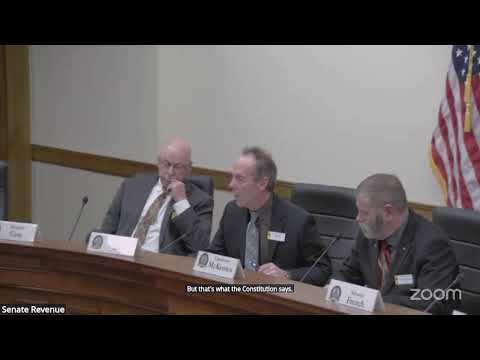
At a meeting of the Senate Revenue Committee, members voted 3-2 to advance House Bill 282, the acquisition-value property tax measure, after adopting an amendment that narrows the bill’s residential definition and removes a fixed 35-acre “associated land” provision.
At a meeting of the Senate Revenue Committee, members voted 3-2 to advance House Bill 282, the acquisition-value property tax measure, after adopting an amendment that narrows the bill’s residential definition and removes a fixed 35-acre "associated land" provision.
The amendment replaced a four‑family cap with a three‑family cap for qualifying dwellings and deleted language tying acquisition-value treatment to “up to 35 acres” of associated residential land. Committee members and Department of Revenue officials engaged in extended discussion about how acquisition value would be administered for parcels that include outbuildings, agricultural land and mixed uses. Representative Locke, the bill sponsor, and Brenda Henson, director of the Department of Revenue, described the amendment as an effort to provide consistent language for assessors; several senators raised constitutional and administrative concerns.
Representative Locke, the bill sponsor, said the amendment was intended "to bring that residential property definition more consistent with what the department has recommended" and to focus the bill on "the residential house structures that were associated with the residents and the land." He told the committee assessors should decide, at the local level, which portions of a parcel are treated as associated residential land rather than applying a statewide 35‑acre rule.
Brenda Henson, director of the Department of Revenue, told the committee the bill is not an exemption bill but a rule about valuation: "This definition relates to what property should be valued using acquisition value and be valued using this historical information that we've got in the bill. And outside of that, we're gonna continue to value just like we always have." Henson warned that administering acquisition value raises questions when a sale price covers a house, outbuildings and larger acreage: "When I buy something, I buy the whole property. How are we going to apply this language to this acquisition value?"
Multiple senators pressed for administrative clarity about outbuildings and how assessors would allocate sale price among residential improvements, agricultural land and other uses. Senator French asked whether associated residential land would include outbuildings such as a garage or horse barn; Henson and Representative Locke said assessors, guided by department rules to be developed, would make those determinations. Representative Locke said the bill includes a process for new construction and that the Department of Revenue would need to promulgate rules to provide additional clarity before implementation.
Opponents argued the change would conflict with constitutional requirements for uniform assessment. Senator Case said he would "speak against this bill" and described it as "irresponsible and chaotic," arguing Article 15, Section 11 of the state constitution requires uniform valuation and that acquisition value would create unequal tax burdens based on when property was purchased. Senator Pappas echoed concerns about making a large change without broader study or an interim task force, citing California’s experience with Proposition 13 as a cautionary example.
Senator Ryan and others said the bill is a large change but supported advancing it for further debate. After discussion, the committee voted on the amendment by voice; the amendment passed. On a roll call to advance HB 282 as amended, the committee recorded three ayes (Senator French, Senator Eyde and Chairman McEwen) and two noes (Senator Case and Senator Pappas). The committee chair announced, "House Bill 282 is passed to committee, and we'll head up to the floor."
Votes at a glance
- Amendment (changes: reduce maximum qualifying dwelling from four families to three; remove fixed "up to 35 acres" associated land language): adopted by voice vote. - Final committee vote on HB 282 as amended (advanced to floor): Ayes — Senator French, Senator Eyde, Chairman McEwen. Noes — Senator Case, Senator Pappas. Tally: 3 yes, 2 no.
The committee discussion highlighted unresolved administrative questions about how acquisition value would be applied to mixed parcels, whether outbuildings are included in the residential component, and how assessors will implement the change. Representative Locke and the Department of Revenue said further rulemaking and guidance would be needed; opponents said the change raises constitutional and equity issues that require more study before adoption.