Get Full Government Meeting Transcripts, Videos, & Alerts Forever!
Get email alerts on the Public Safety Power Shutoffs topic
No spam. Unsubscribe anytime.
Yucaipa officials defend not using temporary stop signs after Edison power shutoffs; 35 citations issued
Summary
Yucaipa city officials said Southern California Edison initiated public-safety power shutoffs that left much of the city without power, and the city declined to place temporary stop signs at intersections because of legal and safety concerns.
Yucaipa city officials said Southern California Edison initiated public-safety power shutoffs that left much of the city without power, and the city declined to place temporary stop signs at intersections because of legal and safety concerns.
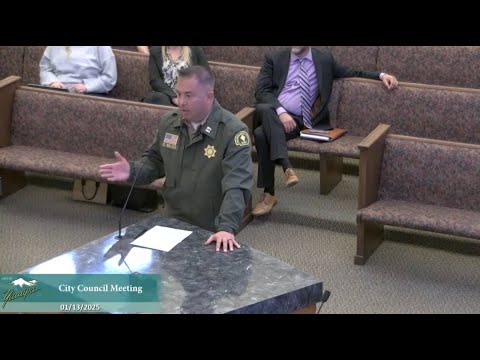
The sheriff's office said the shutoffs were Edison's decision and that deputies and other public-safety staff increased enforcement at intersections without working signals. "The decision to initiate these power shutoffs were not made by the sheriff's department or the fire department or the city, and nor were we consulted on them," a Sheriff's Department representative said. The department reported issuing 35 citations over a roughly two-and-a-half-day period and recorded five traffic accidents during the outage, three with no injuries and two reporting only minor injuries.
City officials and the city attorney cited the Manual on Uniform Traffic Control Devices and a state appellate decision in explaining why temporary stop signs were not placed. "If we cannot ensure that a traffic signal will be on flashing red upon the restoration of power, [temporary stop signs] should not be used," the city attorney said, summarizing the manual's guidance and referencing the court decision Chowdhury v. City of Los Angeles as precedent on liability.
Officials said additional factors weighed against placing temporary signs during the strong-wind event: potential for signs to become dislodged, create debris, give conflicting messages if not removed promptly, and become a hazard. "There was a host of issues that we thought were valid that we needed to bring up as we had these discussions," the Sheriff's Department representative said, noting past local practice of not deploying temporary stop signs after power losses at individual intersections.
The sheriff's office said many motorists contacted during the outage acknowledged they were required by law to treat inoperative signals as four-way stops, and deputies targeted motorists who failed to stop. "Almost everyone during this event that we contacted or spoke to acknowledged that they knew that the law required them to stop at an intersection with inoperable lights and treat it like a 4 way stop," the Sheriff's Department representative said.
City staff described other operational responses taken during the event. Public works crews cleared roadways of downed limbs, and the city increased staffing from police and fire. The city manager posted an explanatory video during the outage, officials said.
On questions about declaring a local emergency, the city attorney told the council that a local declaration alone would not have unlocked state or federal funds for businesses or residents; a state declaration would be required for broader financial assistance. "A declaration of local emergency would not have done a thing to help our businesses or our residents" without a state declaration, the city attorney said.
Officials described volunteer and community partnerships that provided limited support during the outage. Southern California Edison set up an information and charging point at the Mentone library, officials said; the city had power at some facilities such as the senior center and WIPAC and is considering using city facilities for short-term charging and sheltering in future events. The city also noted ongoing collaboration with the local CERT (Community Emergency Response Team) and the ministerial association of churches for potential warming centers.
The city said it has applied for a California Highway Patrol grant for reflective tape to improve traffic-signal visibility at night and expects, if approved, that installation could be completed within about 45 days. Officials added they will continue to reassess practices as public-safety power shutoffs become more frequent.
The remarks occurred over the council meeting's discussion of the outage response; no formal council vote on the temporary-sign policy was recorded in the transcript.
For motorists: city officials reiterated the existing legal standard that when traffic signals are inoperative drivers must treat the intersection as a four-way stop and urged caution and slower speeds during outages.