Get Full Government Meeting Transcripts, Videos, & Alerts Forever!
Get email alerts on the Early Childhood Reading topic
No spam. Unsubscribe anytime.
Wyoming education committee approves cleanup changes to early‑reading assessment statute
Summary
The Senate Education Committee on Jan. 15 approved Senate File 13, a set of technical and reporting changes to Wyoming’s early‑childhood reading assessment and intervention statute, after presentations from the Department of Education and public testimony; the bill passed on a voice roll call, 5–0.
CHEYENNE — The Senate Education Committee voted Jan. 15 to pass Senate File 13, a package of technical amendments the Wyoming Department of Education (WDE) proposed to clarify how schools screen and report on early‑reading interventions for children through grade 3.
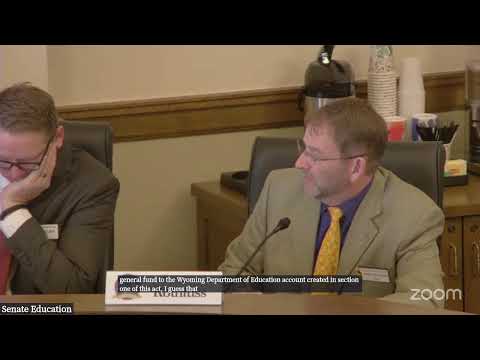
Senator James Rothfuss, sponsor, described SF 13 as “some cleanup legislation that was brought to us through the WDE on behalf of their… working group that has been looking at assessment intervention for early childhood reading over the past few years.” The committee passed the bill after brief discussion and public testimony.
The bill makes several targeted changes. Shelley Hamill of the Wyoming Department of Education said the measure would (1) clarify screening language to allow use of “one or more instruments” rather than implying districts must pick a single screener; (2) remove a provision that required a separate “group reading plan” to be provided to parents (the department and stakeholders said that forced districts to redact other students’ names when sending plans home); and (3) remove specified reporting fields — including a student‑teacher ratio and a running list of specific categories of personnel used in interventions — that practitioners said were not feasible to report accurately at a district or building level.
Hamill told the committee: “Right now there are 6 screeners that districts can choose from that meet the criteria that was identified through a stakeholder committee.” She said districts currently report aggregated results on form 626 and the proposal would add a field indicating whether results came from a screener or an assessment when districts choose to use an assessment.
Stakeholders who testified supported the bill’s collaborative development and its practical clarifications. Brian Farmer, executive director of the Wyoming School Boards Association, told the committee the bill was “the result of both our department and their stakeholder group that they brought together to share solutions.” Bill Winnie, a Sublette County resident, called the bill “a good start” but urged continued attention to instructional‑facilitator roles statewide. Tristan Green, chief financial officer for Albany County School District No. 1, and Patricia McCoy of Moms for Liberty of Laramie County both spoke, raising concerns about paperwork burdens, parental notification, and how performance targets apply across diverse student populations.
Committee members discussed the language removing the group‑reading‑plan provision and several senators said the intent is to preserve group interventions while ensuring that the plan a parent receives is individualized for their child. Senator Rothfuss and others said the statute’s existing 85% proficiency target was not part of this bill and would be addressed separately.
The committee voted to move SF 13 by voice roll call. The motion to move the bill was made by Senator Brandon and seconded by Senator Rothfuss. Roll call recorded the committee as having five ayes and no no votes; the clerk announced “You have 5 ayes,” and the bill was advanced.
What the bill does and next steps
- Changes are intended as cleanup: clarifying allowed use of multiple approved screeners; ensuring individualized reading plans are the documents provided to parents; and removing reporting fields stakeholders said produced unreliable snapshots. - SF 13 passed the Senate Education Committee and will move forward to the floor for consideration.
Speakers named in this article spoke during the SF 13 discussion or public comment and are quoted or paraphrased as indicated.
Ending
The committee’s action on SF 13 reflects stakeholder work coordinated by the WDE; the committee and several witnesses said a separate, more extensive rewrite of screening provisions is also under consideration this session.