Get Full Government Meeting Transcripts, Videos, & Alerts Forever!
Get email alerts on the Wastewater Infrastructure topic
No spam. Unsubscribe anytime.
Stockton municipal utilities staff outline projects; wastewater upgrade nearly complete
Summary
City of Stockton municipal utilities leaders told the Water Advisory Group their $248 million upgrade of the regional wastewater treatment plant is nearly complete and now uses activated-sludge aeration and ultraviolet disinfection to meet stricter discharge requirements.
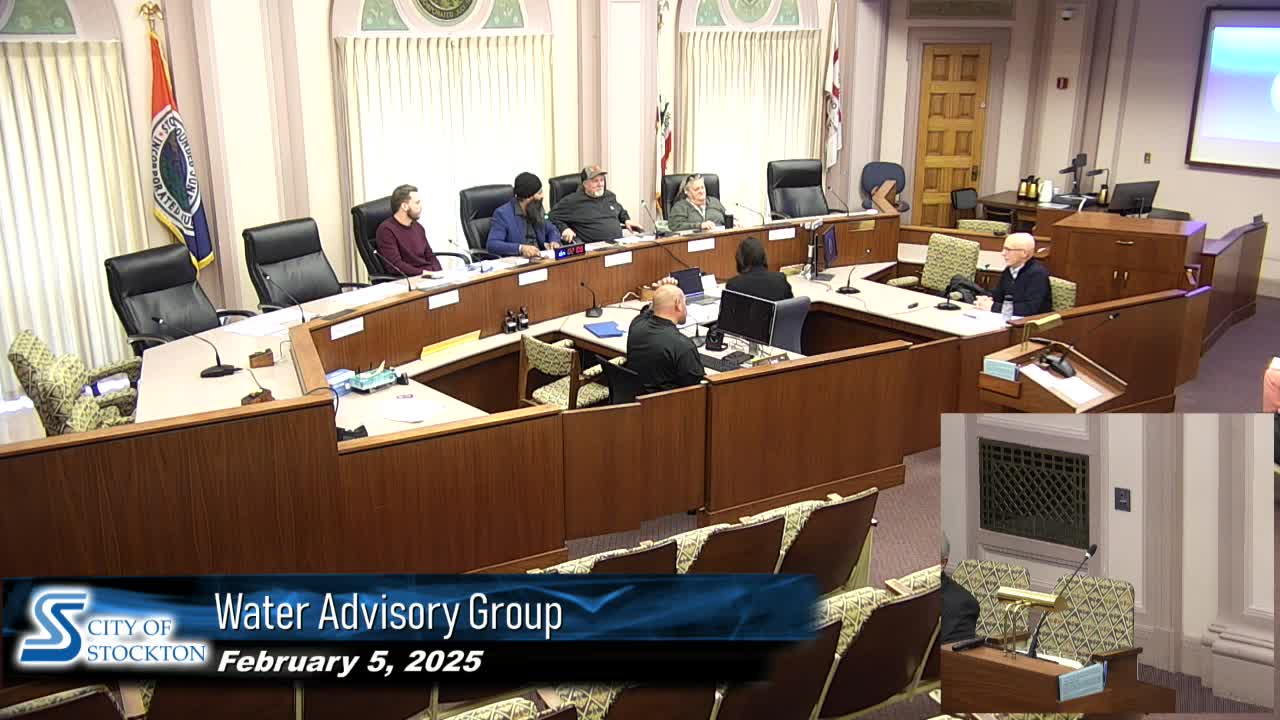
City of Stockton Municipal Utilities Department leaders briefed the Water Advisory Group on staff roles and major infrastructure projects on Oct. 27, 2025, highlighting a nearly complete upgrade to the regional wastewater facility, progress on an automated meter project and a planned groundwater recharge program.
Mel Bridal, director of municipal utilities, told members the Regional Wastewater Control Facility modifications project — since rebranded in signage as the City of Stockton Wastewater Recovery Center — is effectively 99% complete and reached technical compliance in June 2024. Bridal said the project replaced the plant’s older secondary-treatment equipment with an activated-sludge system, added ultraviolet disinfection, and moved filtration and tertiary processes to the same site to improve efficiency and regulatory compliance.
“The project basically consists of removing the biotowers and secondary clarifiers, building new aeration basins and secondary clarifiers, installing a new filtration system and ultraviolet disinfection, and a final discharge pump station,” Deputy Director Ali Gergozlu said during a facility overview. Gergozlu described the treatment train in plain terms: a headworks (screens) to remove large debris; grit chambers; primary sedimentation to remove settleable solids; a biological secondary process (now activated sludge) to remove dissolved organic matter; filtration; and UV disinfection before discharge to the San Joaquin River.
Project timeline and funding
Officials said the project’s construction phase began in September 2019 after earlier design approvals in 2019. The total project budget was set at $248 million; Bridal said actual expenditures were lower than that budget. Funding sources described in the meeting record include a U.S. Environmental Protection Agency WIFIA loan of $108 million, a State Revolving Fund (SRF) loan of $46.8 million, and a $10 million grant from the California Department of Water Resources. Bridal said ratepayer funds covered remaining costs and emphasized the city pursued low-cost financing to minimize rate impacts.
Facility capacity, byproducts and reuse
City staff described plant and system capacities and byproducts in the briefing. The city’s drinking-water treatment plant has a 30 million-gallon-per-day capacity; the wastewater treatment plant capacity is 55 million gallons per day. Gergozlu explained sludge handling uses anaerobic digesters: organic sludge is held at elevated temperature for roughly 15 days, producing methane that the plant uses in cogeneration engines to produce electricity and heat for plant operations.
“We use that methane gas as a fuel source to run our cogeneration engines to produce electricity,” Gergozlu said. Staff also described five disc filters (each described in the briefing as having 14,000,000 gallons capacity) and four ultraviolet disinfection channels (18,000,000 gallons capacity each) that are part of the upgraded filtration and disinfection systems.
Operational programs and other projects
Several additional city projects and programs were presented:
- Automated meter infrastructure (AMI): staff said the AMI project will provide near-hourly meter reads to better detect customer-side leaks and measure system water loss; a customer portal and alerting systems were discussed as future possibilities if the city implements customer-facing features. - Groundwater recharge: staff described design work on a groundwater recharge project intended to capture winter Delta flows in recharge ponds to replenish the aquifer for later use by wells during drought. - Public outreach and education: Vanessa Piccinini, municipal utilities public outreach manager, described school programs (including a classroom aquarium program that brings salmon eggs from Mokelumne Hatchery to classrooms), community events and water-quality reporting resources on the city website. - Waterway maintenance: staff described a new work boat used to remove debris from the Stockton Channel and McLeod Lake; staff reported 76 trips and over 20,000 pounds of garbage collected in the boat’s first year of operation.
System footprint and service area
Officials said the municipal utilities system serves roughly 325,000 Stockton residents. The department oversees roughly 900 miles of gravity sewer, about 40 miles of pressurized sewer, 28 sanitary pump stations, 77 stormwater pump stations and a network of water wells and reservoirs. Staff identified multiple surface-water sources for the city’s drinking-water supply, including the Delta, Mokelumne, Calaveras and Stanislaus rivers, as well as groundwater and conveyances from Woodbridge Irrigation District and Stockton East Water District.
Tours and next steps
Staff said tours of the treatment plant can be arranged but must comply with the Brown Act (either by agendizing a tour or by limiting attendance to small groups). Bridal encouraged advisory group members to bring questions and recommendations to future meetings. The presentation concluded with a request for continued advisory input as the department completes remaining contract closeout work and transitions the facility into normal operations.
What officials did not decide
The advisory group received the briefing as information. No new regulations, rate changes or contract awards were adopted during the meeting. Several members asked clarifying questions about operations, staffing certifications and system capacities; staff provided answers and said recruiting remains a challenge for highly certified treatment and distribution operators.