Get Full Government Meeting Transcripts, Videos, & Alerts Forever!
Get email alerts on the Public Safety Emergency Services topic
No spam. Unsubscribe anytime.
Committee hears 'Keith's Law' to create voluntary special-needs registry for first responders
Summary
Witnesses and first-responder advocates told the Community Revitalization Committee House Bill 144 ("Keith's Law") would create a voluntary registry with critical medical and behavioral information for 911 dispatch and responders; Ashtabula County described a local system already in use.
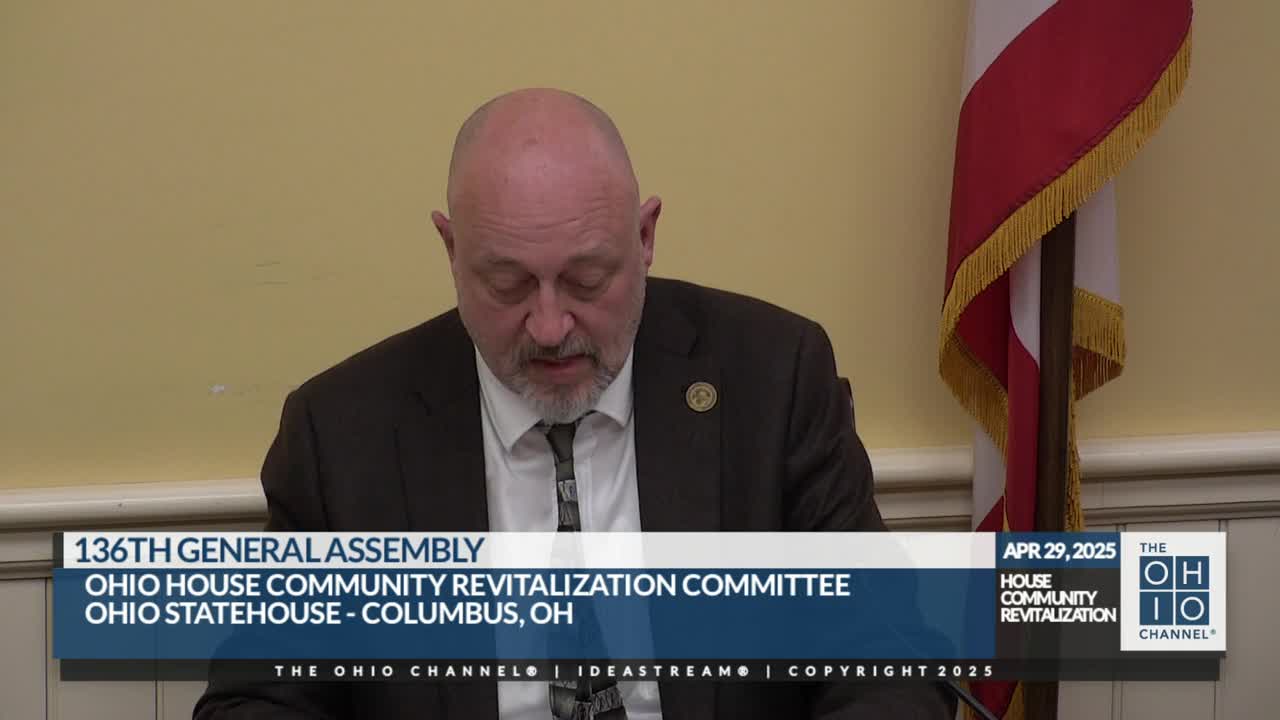
The Community Revitalization Committee took testimony on House Bill 144, commonly referred to as "Keith's Law," which would establish a voluntary special-needs and mental-health registry for use by 911 dispatchers and first responders.
"Wouldn't it be more helpful if the information is already there?" asked Keith Jesse, an advocate who testified in support of the bill, describing scenarios in which people with disabilities or mental-health conditions call 911 while panicked.
Jim Kemmerly, an investigative agent with the Ashtabula County Board of Developmental Disabilities and a former law-enforcement officer, described local experience with an emergency registry that he said shows the proposed statewide approach could prevent tragedies. Kemmerly recounted a widely reported incident and said, "We'll never know what the outcome would have been had those responding officers known more about Victor," referring to a nonverbal, disabled teenager shot during a police encounter in another state.
Kemmerly described Ashtabula County's system: individuals or guardians voluntarily complete a form with identifying details, diagnoses, sensory and communication needs, triggers, calming techniques and likely locations a person might gravitate toward. Information entered into the county's computer-aided dispatch (CAD) system appears as an alert whenever the individual's name or address is used in a call-for-service entry. "The response from first responders has been phenomenal," he said, and Ashtabula's Board reported completing roughly 300 registry forms for about 700 residents served by the board.
Committee members asked about capacity, data flow and privacy. Witnesses said the CAD-based approach makes the information visible to law enforcement, fire departments and EMS and that the registry would relieve counties that currently collect information locally. Sponsors said a state-level repository—testimony referred to "ODD"—would distribute records to counties so local emergency dispatch centers could implement them.
Advocates described how the registry can change responses in routine encounters. Representative Bridal Garrett, who said she has cerebral palsy, told the committee, "With bill 144, they would, they would know that when I walk, I'm unsteady. I'm not drunk. But it's a part about my disability." Testimony included national and state disability statistics presented by advocates: a witness cited an estimate of about 1.3 billion people worldwide (roughly 16%) living with disability and referenced NAMI and CDC figures about people with mental-health conditions in Ohio.
Supporters asked the committee to advance the bill. No vote was taken; the hearing record includes multiple proponent witnesses and written testimony on file.