Get Full Government Meeting Transcripts, Videos, & Alerts Forever!
Get email alerts on the Provider Rates Workforce topic
No spam. Unsubscribe anytime.
Providers warn cuts to E&M, home- and community-based services would worsen workforce crisis
Summary
Health providers and advocates told the subcommittee that recommended reductions to physician E&M reimbursements, a 1% provider rate rollback and a 2% reduction to home- and community-based services would risk access and worsen a strained behavioral-health and LTSS workforce.
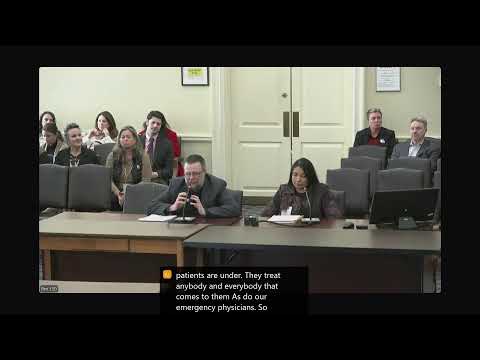
Multiple provider associations and community advocates urged the Health and Social Services Subcommittee to reject analysis recommendations that would reduce provider rates included in the governor’s FY26 Medicaid allowance.
Drew Vedder of MedChi and the Maryland Academy of Family Physicians said maintaining evaluation-and-management (E&M) reimbursement above Medicare matters to keep primary care participation for Medicaid patients in support of the state’s AHEAD primary-care reforms. Anne Braun had noted DLS recommends reducing a $12,200,000 E&M enhancement in FY26; health‑system witnesses told the committee that cutting E&M rates would reduce provider participation and access for Medicaid patients.
Behavioral-health representatives stressed that a seemingly modest 1% reduction is consequential. Nicole Greiner of the Community Behavioral Health Association said, “Pay is the number 1 factor in addressing this crisis,” and warned that further cuts would accelerate staff losses and program closures when the sector already faces severe shortages.
Home- and community-based services advocates including Teresa Titus Howard of The Coordinating Center and Dana Kaufman said DLS’s recommended 2% cut to HCBS provider rates risks forcing providers to reduce staff, expand caseloads and push more people into institutional care. Kaufman told the panel that past underfunding and pandemic impacts mean the sector remains fragile and that rate reductions would likely increase state costs if clients shift to higher-cost settings such as hospitals or nursing homes.
Why it matters: Provider rate changes directly influence whether Medicaid recipients can find care in the community. Witnesses said rate reductions could increase emergency room visits, hamper the state’s ability to move people from institutions to home- and community-based care, and impede AHEAD primary-care goals.
MDH’s Ryan Moran pushed back on some DLS recommendations to cut provider increases, saying last year physicians were the only Medicaid provider group to face a cut while other sectors received increases; the FY26 enhancement restores E&M to “over 100% of Medicare” to reverse that reduction. Moran emphasized the department’s concern that reducing rates now could threaten network adequacy.
Public testimony at the hearing and multiple committee questions underscored the workforce problem and urged the General Assembly to prioritize funding rather than preemptively cutting programs that advocates said already show measurable benefits.