Get Full Government Meeting Transcripts, Videos, & Alerts Forever!
Get email alerts on the Holocaust Remembrance topic
No spam. Unsubscribe anytime.
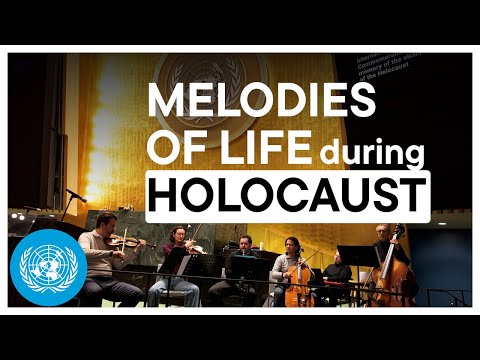
‘Melodies of Life’ project presents Holocaust-era songs at United Nations Assembly Hall
Summary
A presenter at the United Nations Assembly Hall described "Melodies of Life," a project documenting Jewish melodies composed or sung in ghettos and camps between 1933 and 1945, and said the program aims to preserve those songs and their stories as survivors age and to combat antisemitism and indifference.
A presenter at the United Nations Assembly Hall described "Melodies of Life" as Jewish melodies written or sung between 1933 and 1945 in ghettos and camps that gave hope and played a critical role in survival during a program of remembrance.
The presenter said the project documents who wrote the songs and the conditions in which they were created so those stories do not disappear as survivors die. "The melodies of life, they had to come in the situation and culture of remembrance in Germany because the survivors are dying," the presenter said.
The presenter, who described themselves as a third-generation Holocaust survivor, said the project grew from a personal family history. They said their grandfather was the only survivor from his family and recounted a letter by the presenter’s relative, identified in the talk as Salome Oxluch. Quoting that letter, the presenter said, "if we read that letter, it means that I'm not alive anymore. And please take a revenge." The presenter said the Melodies of Life project is their response: "The whole Melodies of Life project is actually my answer and our answer to the revenge question. It's a transformation of the revenge."
The program, the presenter said, seeks to "bring back the voices behind" the songs and to explain the role of music in survival: "Because when we play those melodies, we bring back the voices behind them. We bring back those stories of those people who wanted to survive." The presenter added that the concerts attract diverse audiences and that performances have taken place in Germany and elsewhere: "What is very interesting in our concerts in Germany and in the world, we have a very wide of community that comes to listen. We have Christians, Jews, Muslims, all together."
Addressing the wider significance of staging the program at the United Nations, the presenter said the Assembly Hall is a symbol of common humanity and that listening together can inform present-day action: "This hall, this place, is a symbol of something which is bigger than 1 person... And when we are here, all together, listening to them, it doesn't matter from which religion we are. Jews, Christians, it doesn't matter. We are all connected."
The presenter framed the project as part of broader efforts to counter antisemitism, racism and indifference through cultural remembrance and education. No formal actions, votes, or policy decisions were recorded during the presentation.