Get Full Government Meeting Transcripts, Videos, & Alerts Forever!
Get email alerts on the Reentry Healthcare topic
No spam. Unsubscribe anytime.
Transitional Health Care team proposes reentry-lobby program for Marion County Jail
Summary
Founders of the Transitional Health Care model outlined a proposal to staff and support the Marion County Jail reentry lobby, saying their approach reduced recidivism and emergency responses in prior implementations. The Criminal Justice Planning Council heard the presentation and requested follow-up meetings and MOUs; no adoption vote was taken.
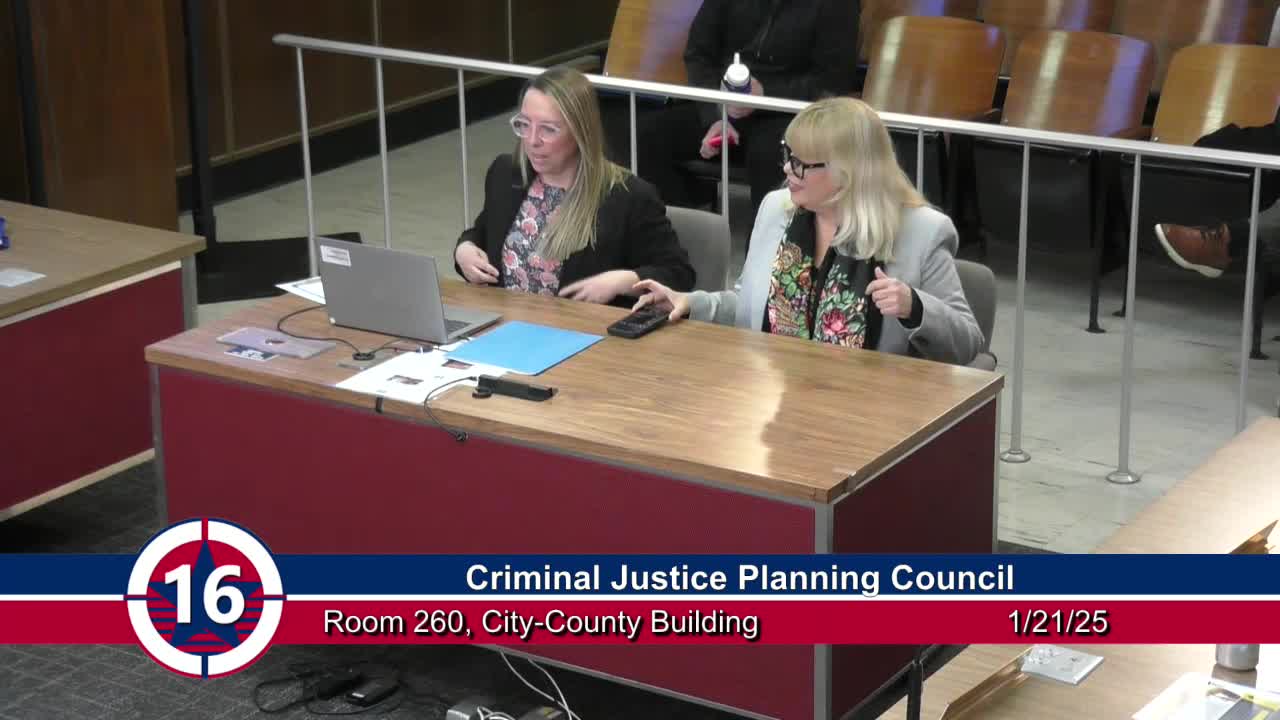
On Jan. 21, 2025, Miranda Williams and Christina Daniel, founders of the Transitional Health Care model, presented to the Criminal Justice Planning Council at the City-County Building proposing to implement their reentry-focused health program in the Marion County Jail reentry lobby.
Williams and Daniel told the council their model addresses social determinants of health at the point of release and aims to reduce returns to custody by keeping people connected to medical and behavioral-health care in the community. "We are here today to make that proposal," Williams said in opening remarks. She said the model was built while the presenters worked at the Indiana Department of Correction (DOC) and that it "decreased their return back to prisons."
The presenters described several outcomes from prior work. A pilot with insurer CareSource produced a 31% return rate after three years for cohorts served under their model, which the presenters said was "7% lower than the average Department of Correction recidivism rate." They also said one Grant County case avoided roughly $15,000 in monthly jail medical costs by supervising an individual in the community and connecting the person to Medicaid-funded care. Williams summarized the operational goal: "The key to transitional health care is communication between site medical and program directors with us kind of as the middle man leading to the community. When that continuum of care is broken, you can be sure that people will return."
Program components the presenters offered to Marion County included: a validated needs assessment and triage tool, memoranda of understanding (MOUs) with community providers, staff training on social determinants of health, on-site liaison or technical assistance in the reentry lobby, and mechanisms for rapid activation of insurance and medication access at time of release. They said they had used releases of information (ROIs) to enable record-sharing in prior implementations: "They would sign a a release of information so we could share their medical records, with community vendors and also to follow-up with them," Daniel said.
Council members and guests pressed for specifics on confidentiality, case selection and operational limits. A judge on the council asked how the program tracked correlations between recidivism and types of convictions; the presenters said their DOC analysis used medical and behavioral-health coding rather than offense categories and that high utilizers included people with serious mental illness and substance-use disorders. The Marion County prosecutor and the IMPD chief both raised questions about how protected health information would be routed to courts, prosecutors and law enforcement when needed. The presenters repeatedly emphasized HIPAA compliance and said their process included ROIs and policy work to limit disclosure to the minimum necessary.
Council discussion emphasized coordination and governance rather than immediate adoption. Members noted that the reentry lobby is managed by the Office of Public Health and Safety (OPHS) and that any contract or MOU would require review by the sheriff’s legal counsel and OPHS. The sheriff asked that the presenters schedule a meeting with the sheriff’s legal counsel who handles medical vendor agreements and urged a jail visit to view the lobby and medical operations before any contract decisions.
No formal action was taken on the proposal. Council members asked the presenters to provide completed needs-assessment materials, to meet with the sheriff’s legal team and OPHS, and to arrange a site visit. The council’s chair also requested follow-up on the FSSA task force report and any underlying Medicaid claims analysis the presenters referenced.
Votes and other formal business at the meeting included routine procedural motions: the council moved and accepted minutes from a prior meeting by voice vote; the body approved a nomination to fill the board’s vice-chair vacancy, naming Marion County Prosecutor Ryan Meares as vice chair by voice vote; and the council later moved to adjourn. These votes were recorded by voice with no roll-call tallies given in the transcript.