Get Full Government Meeting Transcripts, Videos, & Alerts Forever!
Get email alerts on the Environmental Investment Plan topic
No spam. Unsubscribe anytime.
Task force declines to recommend November 2025 climate bond after EIP briefing; staff to deliver narrowed project list
Summary
After a staff briefing on the Environmental Investment Plan and options for using general‑obligation bonds to fund climate and resilience projects, the 2026 Bond Election Advisory Task Force voted not to recommend a November 2025 bond.
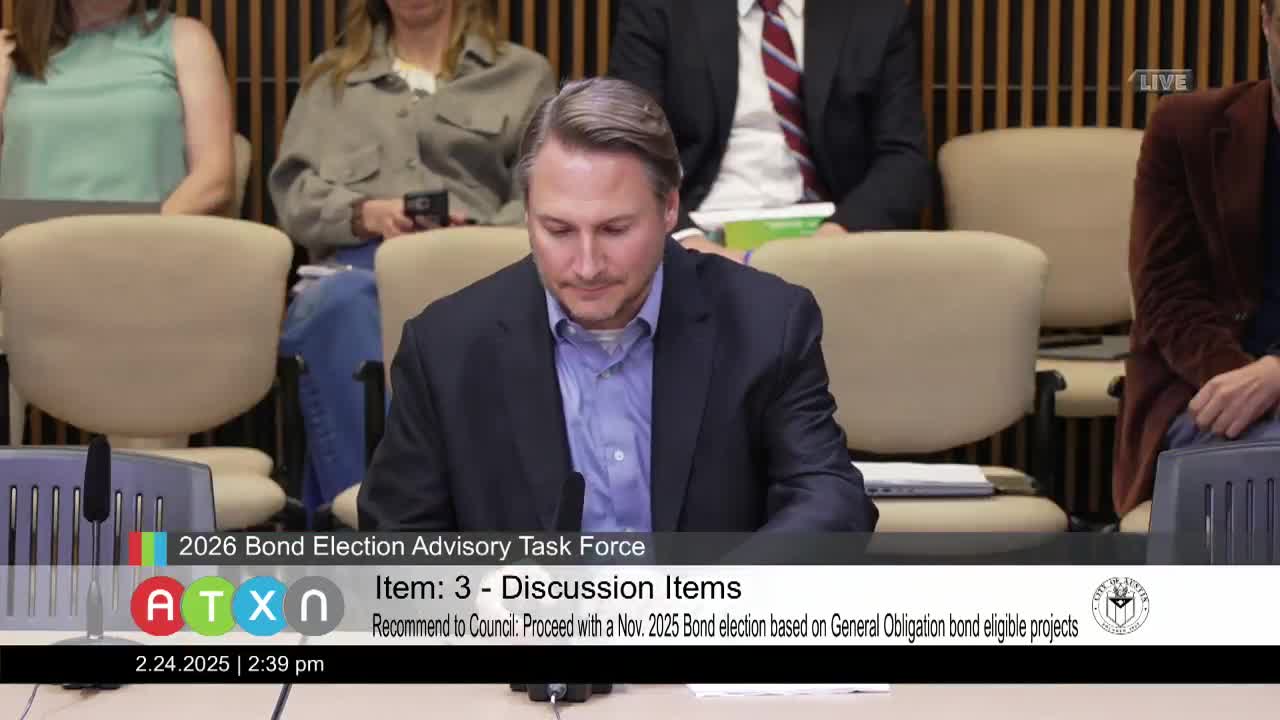
The 2026 Bond Election Advisory Task Force voted 12‑3‑1 on Feb. 24 to decline recommending a November 2025 general obligation bond based on projects from the Environmental Investment Plan (EIP), following an extended staff briefing and member debate over timing, public engagement and project readiness.
Zach Bauer, director of the Office of Climate Action and Resilience, summarized the EIP and the work since February 2024, describing a rapid analysis that cataloged potential climate, water, land and city‑operation projects across departments. Bauer said staff had identified a broad universe of needs — roughly $7.3 billion in projects that could be bond eligible across multiple categories — and emphasized that the initial list had no set timeframe and included long‑term needs as well as near‑term opportunities.
"We were taking a very wide net of projects across department plans and looking at where the investments might be," Bauer said. He told the task force that city council had asked staff in July 2024 to prepare a comprehensive climate implementation program that would produce a more focused, two‑year set of implementation priorities and a prioritized list of bond‑eligible projects.
Bauer walked the task force through the EIP categories and highlighted bond‑eligible items staff flagged: major corridor transportation projects and active‑transportation investments in the emissions category; land acquisition (staff identified a target of up to 20,000 acres in the EIP) and stormwater resilience in the water/land category; investments in community‑facing facilities to improve resilience (recreation centers, fire stations, health centers) in the resilience category; and city‑operations upgrades (the slides showed a total $90 million need for city operations, with limited likelihood of GO bond funding).
Bauer said staff are using a prioritization tool from C40 (the ASAP tool) to score projects on greenhouse‑gas reductions, equity and feasibility, and that the office expects a focused climate implementation plan to be delivered to council in March. "When we finish the comprehensive climate implementation plan, we will share that; it will be shared publicly through a memo to council," Bauer said, adding that staff would then identify which items are bond eligible for task‑force consideration.
Task‑force members pressed staff on whether the March material would include a list of projects that could be recommended for a 2025 bond. Bauer said the March work product would provide a narrowed, prioritized set of projects and that staff would be available to present more detailed guidance to the task force once that analysis is complete.
Members raised several concerns in debate. Some said a standalone, smaller 2025 bond could confuse voters and make it harder to educate the public, arguing a larger, consolidated 2026 package would secure broader support. Others argued the city should move faster on climate investments and that some shovel‑ready items could benefit from earlier voter authorization.
One task‑force member urged caution about a so‑called "blank slate" approach to early community engagement, warning against creating expectations that any individual community request would automatically translate to bond-funded projects. Another member asked for lifecycle carbon analyses to weigh whether proposed facilities would produce net emissions savings once construction and operations are considered; Bauer said life‑cycle analyses had not yet been completed but could be done in the future.
On motions, the task force first considered a motion to have working groups convene and review the EIP list and return with possible items for a 2025 bond at the next full meeting; that motion failed. After further discussion, a subsequent motion that the task force not recommend a November 2025 general obligation bond passed 12 in favor, 3 opposed and 1 abstention. The task force later approved the composition of work session groups (working groups) unanimously and discussed guidance and chair assignments for those working groups.
Capital Delivery Services staff told the task force they are still compiling projections about departmental burn rates and which programs might run short of funding before 2026; staff committed to provide that information when available. Robert Goode of Capital Delivery Services said the office continues to reconcile project burn‑rate projections after past years produced larger unspent balances than expected.
The task force directed staff to share the March climate implementation plan and the prioritized, bond‑eligible project list when available and to return to the task force for additional briefings on feasibility, prioritization criteria, lifecycle impacts and possible federal funding dependencies. The group also asked staff to provide updated cost estimates for projects included in the narrowed list.