Get Full Government Meeting Transcripts, Videos, & Alerts Forever!
Get email alerts on the Public Engagement topic
No spam. Unsubscribe anytime.
City staff lays out outreach plan for 2026 bond program, asks task force to help reach neighborhoods
Summary
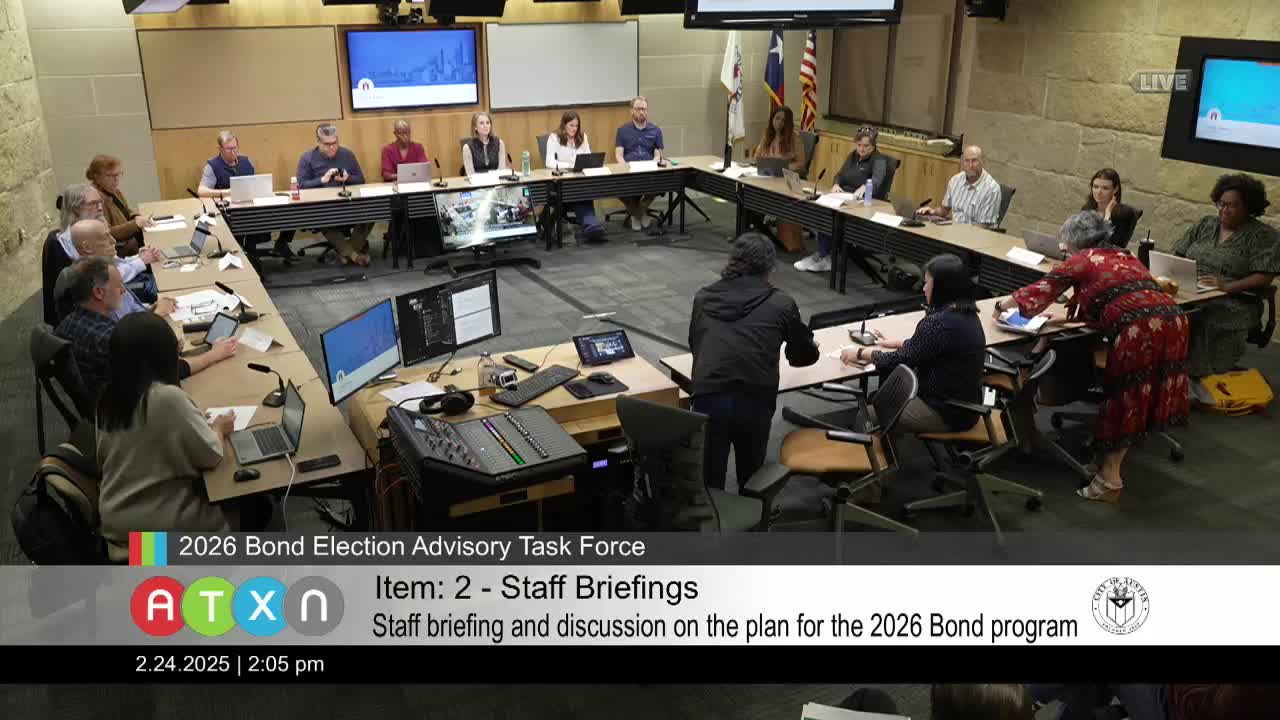
City of Austin communications staff presented a three‑phase outreach and engagement plan for the 2026 bond program and asked task‑force members to help broaden outreach to renters, younger residents and people who do not typically attend daytime meetings.
City of Austin communications staff presented a three‑phase public engagement plan for the 2026 bond program and asked members of the 2026 Bond Election Advisory Task Force to help broaden outreach to renters, younger residents and people who do not typically attend daytime meetings.
The Communications and Public Information Office (CPIO) described Phase 1 as combined outreach and engagement to notify the task force and community about the plan; Phase 2 as data collection and analysis of community feedback; and Phase 3 as “closing the loop,” when staff will publish results and raw data. Marion Sanchez, CPIO community engagement manager, told the task force the timeline includes a March preparation period, April–May field outreach (flyers, tabling, paper and online surveys), a June review break, July preparation for town halls and four town halls planned for August–September, followed by summary reporting in October–November and final publishing in the following spring.
"We're going to be out and about both in person and digitally," Sanchez said. She told the group staff will prepare flyers, research instruments, social media and printable materials and will provide iPads and other tools to collect input in the community.
Jessica King, chief communications director for CPIO, said a joint communications team made up of departmental communications staff will help amplify outreach through department newsletters and social channels. King said staff will also post bond information on AustinTexas.gov and the SpeakUpAustin portal.
To expand reach beyond typical daytime audiences, staff offered three tools for task‑force members: promotion on official channels; promotion of working‑group meetings open to the public; and a reporting tool to funnel feedback from task‑force‑hosted gatherings into staff analysis. Sanchez said staff will supply a social‑media kit (hyperlinks, visuals and copy) to help volunteers share notices.
Staff described a "Meeting in a Box" kit containing instructions and facilitation materials that neighborhood hosts can use to run small conversations; the kits will be available in print and electronically and translated into seven tier‑one languages, including Spanish. Alicia Dean, who leads media buying and design for the outreach effort, was introduced as coordinating paid promotion.
Task‑force members raised concerns about timing and accessibility. Several members urged evening or virtual events to reach people who work daytime hours; others emphasized extra outreach to renters and younger residents. One member asked whether the community would see staff recommendations or a blank slate during early meetings; Sanchez said staff was still determining the exact form of the research instruments but aimed to present “buckets” or headlines that would help community members comment on project types, potential funding amounts and priorities.
Sanchez and King encouraged task‑force members to forward meeting suggestions through the staff liaison to avoid duplication and to submit community feedback they hear at local events so staff can incorporate it into analysis. Sanchez said staff expects a more detailed engagement plan to be ready by mid‑March and that raw engagement data would be published when Phase 3 concludes.
The task force discussed how informal working‑group meetings should be treated for promotion. Staff said it can promote working‑group meetings and will accept input gathered by task‑force members if submitted through the liaison using the provided reporting tool.
The meeting closed this portion with staff committing to provide the task force with the engagement materials and timelines a month in advance of outreach activities, translated Meeting in a Box kits, and a social‑media toolkit for volunteer use.