Get Full Government Meeting Transcripts, Videos, & Alerts Forever!
Get email alerts on the Brownfields topic
No spam. Unsubscribe anytime.
Middletown launches Brownfield Opportunity Area study for Community Campus
Summary
City officials and consultants opened a public kickoff for a Department of State-funded Brownfield Opportunity Area (BOA) study of the former Middletown Psychiatric Center campus, outlining a phased planning process, community engagement, and potential sites including a power plant and a coal ash area.
Kate Stryker, the consultant leading the project for Hudson Valley Pattern for Progress, opened a public kickoff meeting in Downtown Middletown to begin planning a Brownfield Opportunity Area (BOA) study for the Middletown Community Campus, the former Middletown Psychiatric Center.
The study is funded through a Department of State BOA grant and will use a three-phase planning process intended to produce a community-driven vision, site-specific concept plans and a draft BOA nomination to submit to the state for designation. "My name is Kate Stryker. I am the consultant that is project managing this project that you're here to learn about today," Stryker told attendees.
Mayor Justeufano welcomed attendees and described the campus as one of the city's final large developable parcels. "This is the last large piece of developable property within the city," the mayor said, noting the city's population and the campus's role in local redevelopment efforts. The city has acquired roughly 34 acres from New York State for $1, including buildings such as the power plant and Tuckerman Hall, which the mayor said are being considered for alternate uses and, in some cases, transfer to Fei Tian College.
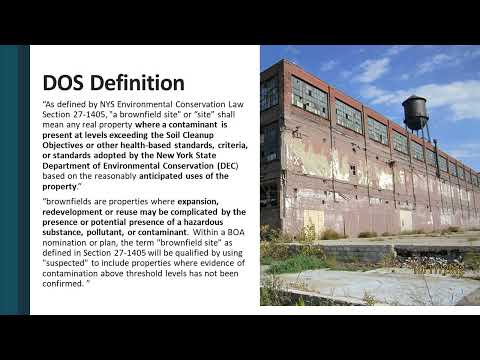
Stryker outlined the project team and steering committee and explained BOA program basics and benefits. She said the BOA planning stage focuses on developing a community vision, selecting candidate sites for redevelopment, and identifying policy, investment and implementation strategies. Stryker summarized the state's brownfield definition under New York environmental law and described how cleanup levels depend on anticipated uses. She said state resources tied to BOA designation can include environmental assessments, regulatory updates, planning services and access to tax credits through the New York State Department of Environmental Conservation's Brownfield Cleanup Program.
Susan Lanfried, the Department of State grant manager present at the meeting, emphasized local control of the planning process: "This is very much a community ground up planning process. It is not something where, you know, we're coming saying this is what we want." Lanfried and Stryker both described public outreach tools—steering-committee meetings, walking tours, visioning sessions, a public survey and public review of a draft plan in the fall—intended to shape the community vision and site priorities.
Project timeline and phases were discussed in general terms. Stryker said the team is in phase 1 (an existing-conditions analysis and public outreach) through July, with phase 2 (concept plans and implementation strategies for selected sites) anticipated through October, and public review of a draft plan to occur in October or November before submission for BOA designation. Stryker noted that environmental testing typically follows planning: a Phase 1 environmental study surveys historical and current use to identify candidate contamination risks; a Phase 2 involves soil and water testing and is costlier. She said the state can assist with Phase 2 assessments once sites are prioritized.
Attendees raised questions about specific contamination and water safety. Stryker said a prior Phase 1 had been completed for the campus but declined to list all findings offhand; she and others identified the power plant and a coal-ash area as obvious concern sites but said that the coal-ash location is not an "official Brownfield" and that the city is monitoring it. Mayor Justeufano addressed a resident concern about drinking water, stating that the stream through the campus is an outfall of the reservoir system and does not flow into the reservoir: "So it's not flowing. Whatever is there does not flow into our reservoir system." Stryker and Lanfried reiterated that assessment and cleanup work would follow the planning and prioritization steps.
Stryker said the project team will consider site selection factors including current use, owner willingness to participate, contamination levels, acreage and development potential, infrastructure and compatibility with existing campus uses—particularly the presence and expansion of Fei Tian College (referred to in the meeting as Feitian/Fayetteian/Fei Tian). The mayor and others described ambition for the campus to support medical, education and arts-related programs and to leverage college expansion. The mayor noted city transfers of large buildings to the college, including a 279,000-square-foot building called Tuckerman and the Kleiner building, for renovation and reuse.
Stryker provided examples of other New York BOA projects (including Oswego County and Rome) where designation helped attract federal, state and private funding for demolition, site preparation, housing and infrastructure; she said there are more than 70 designated BOAs in New York State. She urged attendees to use the project's website and sign the meeting sheet to join the email list and to post ideas on project boards set up at the meeting. "If you, love it, if you hate it, just let us know because we kinda wanna understand the community's relationship to that campus and what it means to you and what you'd like to see there," she said.
Next steps described at the meeting are continued data collection and outreach in phase 1, public visioning and walking tours, selection of priority sites, concept planning in phase 2, and a public review of a draft plan ahead of a BOA designation submission to the state. The timeline was described in months rather than fixed dates; meeting presenters encouraged continued public involvement and promised to post materials and the slide presentation on the project website.
The meeting included multiple public commenters who voiced support for retention of open space and for drawing technology and education-related investment to the campus, including suggestions tied to regional chip- and data-driven industries and to partnerships with local colleges. No formal motions or votes occurred at the meeting.