Get Full Government Meeting Transcripts, Videos, & Alerts Forever!
Get email alerts on the Jail Planning topic
No spam. Unsubscribe anytime.
Cochise County staff review jail planning study, potential sites and delivery options
Summary
County staff and the planning consultant updated the Cochise County Jail District Board on a jail planning study, draft space allocations, a set of candidate sites across the county and next steps including owner’s‑representative procurement and decisions about project delivery methods.
Cochise County officials reviewed progress on a jail planning study and preliminary site evaluations during a Feb. 11 special work session of the Cochise County Jail District Board of Directors.
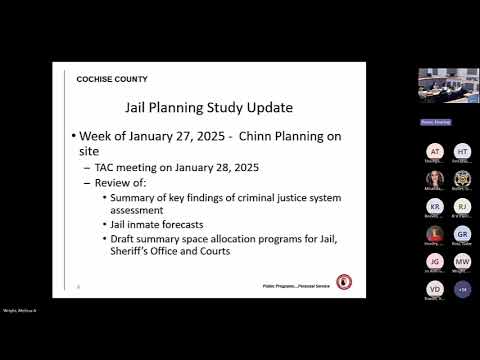
Phil Bordon, the county project consultant working on the effort, told the board the study led by Chin Planning includes a criminal‑justice system assessment, inmate population forecasts, operational concepts and cost estimates for site development and construction. "The services to be provided by Chin Planning was a comprehensive assessment of the county's criminal justice system," Bordon said during the presentation.
The consultant has completed data collection, stakeholder interviews and draft space‑allocation work. Karen Chin, principal of Chin Planning, began data collection in September and met on site with a technical advisory committee that includes county administration, facilities, the sheriff's office, procurement and representatives of the courts. Bordon said Chin provided draft space allocation programming and revised jail forecasts in late January and that the planning study is scheduled to conclude in May.
Why it matters: the study is intended to give the county a basis for matching projected inmate needs to a site, to avoid overbuilding and to preserve options for future criminal‑justice uses at a selected location.
Chin Planning will produce an evaluation matrix ranking potential sites supplied by the county. Bordon said the county asked consultants to consider traffic, land use, zoning, environmental constraints, topography, utilities, emergency access and how a site would relate to other criminal‑justice components. "When you go over sites, you want to make sure . . . you can accommodate future uses if you desire as a board of supervisors," he said.
The consultant team will analyze several properties the county provided so every part of Cochise County is represented. Sites discussed included: the existing jail and sheriff’s administration location in Bisbee; county property southwest of State Route 92 and Melody Lane; land near State Route 191 and North BDI Road adjacent to the airport; a county property northeast of Sierra Vista near Charleston Road and Mohsen Road; a parcel near Davis Road and State Route 80 south of Tombstone adjacent to the Tombstone Municipal Airport; and a location east of Benson on Interstate 10 at North Veil Road. Bordon stressed that the final project footprint could shift within a given analysis area once the consultant defines the acres required.
Board members asked how the planning work will interact with the courts and other justice partners. Bordon said the courts and other stakeholders have participated on the technical advisory committee and will receive draft findings for review; any recommended operational changes would be presented to the relevant departments and elected officials.
The board also discussed project delivery methods. Bordon advised the board to consider procurement options beyond traditional design‑bid‑build for a complex facility, including design‑build or construction‑manager‑at‑risk (CMAR), both of which allow selection of teams based on qualifications. He said bringing experienced jail design and construction teams onboard early can reduce schedule and cost risk because firms familiar with jail design can adapt existing, proven plans to the county's needs.
Bordon and board members discussed reuse or licensing of existing jail design packages and the practical limits to re‑using drawings because site‑specific utilities, grading and other factors typically require redesign and re‑stamping. "The design process should go quick if you use design build or construction manager risk," he said, while cautioning that IP, licensing and restamping costs can apply if plans were produced for other jurisdictions.
Next steps described by county staff include scheduling Chin Planning to present draft findings to the board, finalizing population and space recommendations, completing the site evaluation and deciding whether to procure an owner’s representative and which project delivery method to pursue. Bordon said the owner’s‑representative RFQ process was completed and staff were negotiating scope and fees prior to bringing that contract to the board.
The work session was informational; the board did not take formal votes on sites, delivery method or contracts at this meeting. Bordon and Chin will return with draft findings and a site evaluation matrix before staff bring procurement contracts or delivery‑method recommendations for formal board action.