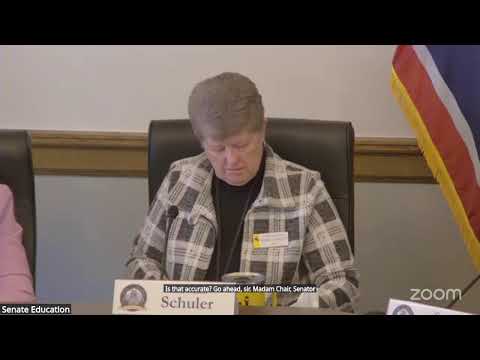
Senate committee backs school policies restricting cell phone use during instructional hours
Summary
The Senate Education Committee voted to require Wyoming school districts to adopt policies restricting student cell phone and smartwatch use during instructional time, with exceptions and a delayed implementation date.
The Wyoming Senate Education Committee on Jan. 20, 2025, voted to pass Senate File 21 as amended, requiring each school district to adopt a policy that restricts students’ use of cellular telephones and smartwatches during instructional time.
Sponsor remarks outlined research linking heavy phone use to decreased attention and mental‑health concerns among students. The bill’s original language would have prohibited phones during instructional time; committee members amended that language to “restrict” use to give districts more discretion, and they moved the compliance deadline from July 1, 2025, to Sept. 1, 2025, to allow districts time for public review and policy adoption.
The bill leaves disciplinary enforcement to local districts and includes exceptions for students with health needs determined by a health care provider or an individualized education program (IEP), and for emergencies or perceived threats. Witnesses from schools, administrators and associations testified in favor of local policy options and enforcement strategies such as caddies or lockers; some administrators and parent witnesses urged flexibility to avoid unintended consequences, including privacy concerns and the burden on teachers.
Representative testimony included educators and school leaders who described pilot programs and enforcement approaches. Kirk Schmidt, a former school finance official, said the bill reduces some flexibility by imposing a statutory requirement but acknowledged that districts still draft the specific policies; Brian Farmer of the Wyoming School Boards Association and the Wyoming Association of School Administrators urged the bill be framed to allow local tailoring and more time for adoption. The State Superintendent’s office expressed support.
After debate and amendments the committee voted: four ayes and one no. The bill as amended now goes to the Senate floor for further consideration.
AI generated
The text on this page is AI generated. Summaries, highlights, analysis, and video transcripts are all produced from the original source material.
AI can make mistakes, so if you spot one, and we will fix it for everyone.
Note: the source content is unaltered by us. Any content source we link to, be it a video, an audio recording, or a document, is presented exactly as its publisher released it. That publisher is usually a government body, sometimes an individual official or another organisation.