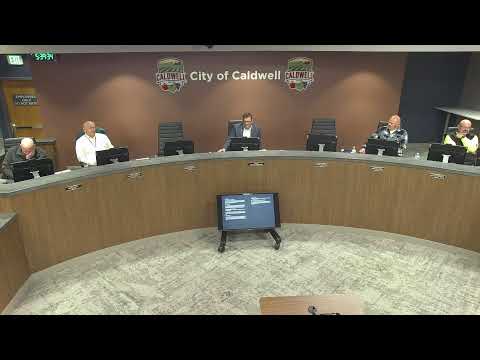
Caldwell workshop reviews procurement rules and change‑order practices after pool project
Summary
City staff and councilors discussed how the city handles contract modifications and change orders — including the recent swimming‑pool bathhouse work — examined procurement thresholds and prohibited contract types, and reviewed delivery methods such as design‑bid‑build, CMGC and design‑build.
Caldwell city staff and councilors held a workshop to review the city’s procurement policy and how contract modifications are handled after a recent swimming‑pool project generated substantial change‑order costs.
Purchasing staff presented the city’s purchasing policy and highlighted the sections councilors most often cite when change orders are questioned. Raelynn, identified in the meeting as the staff member presenting the purchasing policy, summarized the policy’s approval thresholds and analysis requirements, saying the city’s policy requires cost or price analysis for procurement actions of $50,000 or more and that “the city must have cost justification supporting each change order it may issue.”
The discussion centered on whether the pool work had been correctly characterized and whether the city should have bid the bathhouse separately instead of adding it to the existing contractor’s work. Rob, who described the pool project history and operations, said the additional bathhouse work was presented during the pool project and that staff elected to continue with the existing contractor, Benetton Construction, to avoid extra mobilization costs. Rob characterized the item as a change in scope rather than a traditional change order and said some change orders were also added separately and have been defended and reviewed with the contractor.
Councilors raised concerns about cumulative small items that drive project costs. Councilor Stotick asked how the city could prevent contractors from underbidding and later seeking large change orders. Councilor Jody and Councilor Doty pressed staff on whether routine items — lights, guardrails, ADA rails — should be caught earlier in design so they do not become post‑award change orders that compound costs.
City staff and legal counsel (Mark) explained the tradeoffs between shifting risk to bidders and keeping it with the city. Mark, who spoke about contracting risk allocation and delivery methods, noted statutory requirements are limited to specific policy matters and bonds; he said the legislature requires certain statutory contract provisions and that performance and payment bonds are required for public‑works work. Mark explained that many risk allocations (including how differing site conditions are handled) are negotiated and that placing too much risk on a contractor typically raises the bid price.
Staff described several contract delivery methods and their implications. Rob and Mark discussed design‑bid‑build (traditional lowest‑bid method), construction manager/general contractor (CMGC) with a guaranteed maximum price or “not to exceed” structure, and design‑build (single contract for design and construction). They noted CMGC or GMP contracts can reduce the city’s exposure to design‑construction coordination issues but can produce higher upfront guaranteed prices; design‑build can be useful for complex projects but takes more time and offers a single point of responsibility.
Purchasing policy specifics reviewed at the workshop included: a $50,000 analysis threshold for cost/price review, the requirement that change modifications be allowable within applicable grants or cooperative agreements, and a policy prohibition on certain contract forms (for example, cost‑plus‑percentage‑of‑cost and percentage‑of‑construction‑cost contracts) unless special conditions apply. Staff also noted that time‑and‑materials contracts may be used only after documented determination that no other form is suitable and that a ceiling price is required for those contracts.
No formal vote or binding decision was taken at the workshop. Instead, councilors and staff discussed procedural clarifications, design and bidding choices for future projects, and options to reduce the likelihood of large change orders. Staff said they have been reviewing the pool project change orders with Benetton Construction and offered to provide council members site tours to review costs and work in progress.
The workshop concluded after the question-and-answer session; staff said procurement and contracting remains an item regularly placed on workshop agendas for future review.
AI generated
The text on this page is AI generated. Summaries, highlights, analysis, and video transcripts are all produced from the original source material.
AI can make mistakes, so if you spot one, and we will fix it for everyone.
Note: the source content is unaltered by us. Any content source we link to, be it a video, an audio recording, or a document, is presented exactly as its publisher released it. That publisher is usually a government body, sometimes an individual official or another organisation.