Get Full Government Meeting Transcripts, Videos, & Alerts Forever!
Get email alerts on the Education Advanced Courses Gt topic
No spam. Unsubscribe anytime.
Austin ISD reports progress on equitable access to advanced courses and gifted-and-talented identification
Summary
District staff presented baseline data showing progress toward targets for advanced-course participation and improved representation in gifted-and-talented (GT) identification, highlighted successful campuses and outlined next steps including standardized drop forms and expanded professional learning.
Dr. Elizabeth Severance, Austin ISD director of advanced academics, presented the district's monitoring report on Constraint 3 and two constraint progress measures (CPM): CPM 3.1, completion of advanced academic courses for grades 9'-12, and CPM 3.3, the representation index for newly identified students in the gifted-and-talented (GT) program. "Austin ISD prioritizes providing every student with the opportunity to achieve academic growth through challenging coursework," Severance said during the presentation.
The report sets a district goal to increase the percentage of ninth- through twelfth-grade students who have successfully completed an advanced academic course from 76 percent at the end of the 2023'24 school year to 86 percent by June 2029. District baseline data show 51 percent of 9'12 students already have earned credit in an advanced course, while current enrollment among the focus combined group (African American, emergent bilingual, and special education students) is 77 percent; combining past completion and current enrollment produces an 83 percent figure that the district says projects to exceed the 2024'25 annual target by five percentage points.
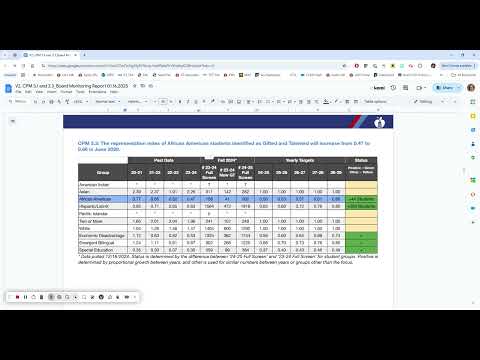
For GT identification, the district reported a target increase in the African American representation index from 0.47 to 0.66 by June 2029. In 2023'24, 158 African American students were fully screened and 41 of those were identified as GT; in 2024'25 the number of African American students participating in the GT identification process rose to 202, the presentation said. Campus-level masking rules were noted for groups of five or fewer.
Severance highlighted campus examples the district identified as outliers in a positive direction. Crockett Early College High School reported 92 percent of students currently enrolled in advanced courses and benefits from a strong partnership with Austin Community College and AVID implementation; Travis Early College High School reported 87 percent enrollment in advanced courses and expanded AP offerings. Among campuses improving GT screening, LBJ increased fully screened students from fewer than five in 2023'24 to 17 in 2024'25, with almost half of those students identifying as African American; Oak Springs Elementary also increased referrals and screening after sustained advocate outreach.
District strategies described as next steps include: implementing a standardized drop form to track why students exit advanced courses; semester-end progress monitoring of grades and enrollment to identify students who need support; targeted professional learning for teachers of advanced courses; reviewing and streamlining GT qualitative forms to reduce bias; and using MAP and other data to identify candidates for screening. The presentation noted the GT identification process must include both qualitative and quantitative information per Texas Education Agency (TEA) requirements and that the current year's GT identification was still being concluded at the time of the briefing.
The report connected CPM 3.1 and CPM 3.3 to other district initiatives, including early learning and postsecondary success, and acknowledged variation across student groups and campuses. It recommended targeted coaching and additional resources for campuses with lower participation or larger gaps. No formal board action or vote on these items was recorded in the presentation; the briefing concluded with references to appendix data tables and a glossary for methodology and masking rules.