Get Full Government Meeting Transcripts, Videos, & Alerts Forever!
Get email alerts on the Economic Development topic
No spam. Unsubscribe anytime.
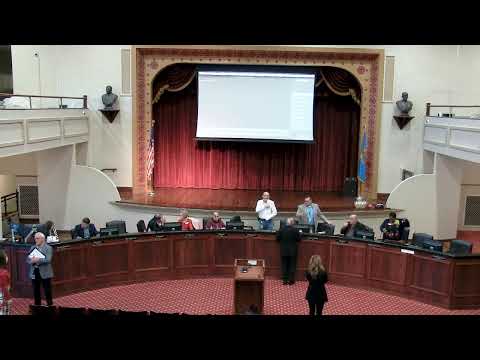
Lawton council holds first public hearing on major amendment to industrial project plan
Summary
At a special meeting the Lawton City Council heard a presentation and opened the first of two required public hearings on a major amendment to the city's industrial-focused project plan that would add workforce training, a homebuying-assistance program and new increment districts tied to development agreements.
The Lawton City Council on Tuesday held the first of two statutorily required public hearings on the proposed Second Amended Skills Training, Education, Development and Investment Project Plan and related tax increment (TIF) districts, presenting details on potential economic impacts and program changes but taking no final action.
The amendment, presenters said, is intended to accelerate non-retail industrial development by creating increment districts that would be activated only when a conditional development agreement is in place, and by adding three new program elements: workforce training funded from tax increments, a homebuying-assistance program funded from new sales tax tied to the development, and targeted public infrastructure funded from apportioned increments.
Dan Bachelor, partner at the Center for Economic Development Law, told the council "economics is not a zero-sum game," and argued that coordinated investment and incentives can grow the city's tax base and local employment. Bachelor said the amendment follows preliminary approvals, including a unanimous recommendation from the review committee representing affected taxing jurisdictions and clearance from the planning commission. No members of the public spoke during the hearing.
Presenters and council members outlined several key structural features of the amended plan. Increment districts will remain dormant until a development agreement triggers activation; once activated, the maximum life of an individual district is 25 years or until authorized project costs are repaid, whichever comes first. The amendment increases the share of tax increment allocated to public schools from 35% under the existing plan to 50% and establishes a $62 million public-infrastructure threshold that, once reached, will change the allocation mechanics so affected taxing jurisdictions begin to receive 100% of their operating levies from increments.
Bachelor estimated long-term investment potential "in the billions of dollars" for the community if several large projects proceed, and cited the hypothetical example of a West Wind commercial facility with an estimated cost between $500 million and $1 billion. Near-term incremental sales tax revenue was described in the presentation as roughly $200,000 to $500,000 annually, with the potential to grow several-fold over a 10- to 20-year horizon depending on the scale and timing of development agreements.
Councilmembers asked technical and fiscal questions. Councilmember Weager asked whether the $62 million threshold was collective across districts; Bachelor said the threshold could be satisfied by the sum of activated districts and that the figure was an estimate based on the infrastructure the city's consultants judged necessary to position the community for larger private investment. Councilmember questions also covered inflation adjustments to project budgets; presenters said the amended plan uses larger infrastructure budgets than the 2019 plan in part to account for higher costs.
The council also heard clarifications about the homebuying-assistance program: it would be established by council policy, funded from new sales tax generated by the economic activity the plan seeks to produce, and would aim to help new employees purchase homes within the city of Lawton. Presenters and staff emphasized that qualifications and program terms would be set by the council when the program is implemented.
As required by state statute, the council had the ordinance title read aloud during the meeting; that reading is procedural and does not constitute approval. A second public hearing and another reading of the ordinance are required before the council may vote to adopt the amended project plan. The council took no vote to adopt the plan at Tuesday's meeting. The meeting concluded with a motion to adjourn that carried on a roll-call vote.
Next steps: a second public hearing and ordinance reading are required under state law before the council can approve or reject the amendment. The presenters said implementation would proceed only after development agreements are in hand that trigger specific increment districts and associated budgets.