Get Full Government Meeting Transcripts, Videos, & Alerts Forever!
Get email alerts on the K 3 Literacy topic
No spam. Unsubscribe anytime.
Darien committee reviews K-3 literacy programs after $145,000 state grant and teacher pilots
Summary
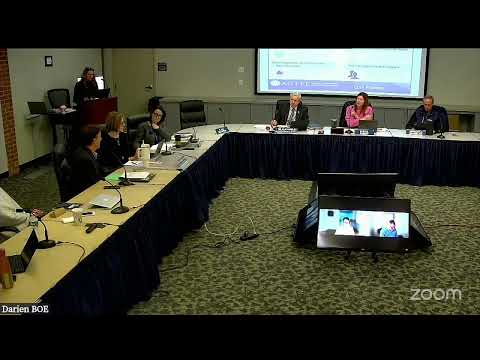
At a Jan. 8 special meeting, Darien Board of Education Curriculum Committee members and classroom teachers reviewed how the district used a $145,000 Right to Read grant, discussed new vocabulary and writing materials, and debated adopting a single approved program versus a compendium of resources.
Darien Board of Education Curriculum Committee members and elementary teachers met Jan. 8 to review K-3 literacy programming, including how the district spent a $145,000 Right to Read grant and classroom experience with new vocabulary and writing materials.
Committee members heard that the district spent the entire Right to Read grant by December on state‑approved curriculum materials, purchasing foundational decodables for K–2 (and some third‑grade) classrooms, and funding AIMSweb for two years and a district digital platform. Julie (district curriculum staff) said the grant funds were used only for materials on the state-approved list and that a leadership team completed required professional learning days.
The meeting focused on three related areas: vocabulary instruction, early phonics screening and assessment, and writing curriculum. Teachers described Word Love, a new vocabulary program implemented this year, as explicit, multisensory and engaging. "Word Love is an absolutely incredible program," said Hillary Rek, a first‑grade teacher at Holmes, adding that students use the vocabulary in speech and writing. Teachers reported using Word Love alongside existing read‑alouds from the district’s Teachers College (TC) units and noted positive student transfer to writing.
Teachers also described classroom assessment tools used across grades. Julie outlined AIMSweb as the district’s universal screener (mandated in K–3), supplemented by a quick phonics screener this year in grades 1–2, foundations unit tests and interreading end‑of‑module tests, formative checks such as Heggerty phonemic awareness, decodable running records and Smarter Balanced interim assessments. On‑demand writing prompts in grades 1–3 are being scored against rubrics that include structure, elaboration and conventions.
Third‑grade teachers said the revised Teachers College writing units streamline lessons and add supports for small‑group instruction, but some classroom teachers pushed back on the grammar and conventions coverage. Melissa Malek, third‑grade teacher at Tokanique, said the new TC units include "about 1 or 2 lessons per bend" on grammar and editing and called that "not sufficient enough for third grade." Teachers and the core review team discussed the possibility of incorporating explicit grammar instruction from other resources, such as Interreading, into the district’s approach.
The core review team and several board members discussed whether to adopt a single, state‑approved comprehensive program (Interreading) or pursue a compendium approach — combining selected components of multiple approved resources (for example, interreading’s grammar instruction with Word Love vocabulary and foundations phonics). Julie said the compendium could include Heggerty, Foundations, Interreading and Word Love depending on the core review team’s recommendations. Board member Katie emphasized that teachers currently piloting programs are in different cohorts and that no teacher present had piloted both Interreading and Word Love this year.
The district also described exploratory conversations with TNTP (The New Teacher Project), a nonprofit the state has funded to offer classroom observation and an action‑planning lens for districts. Julie said TNTP’s work would be paid for by the state if funds are available; the district is awaiting confirmation of allocation.
Board members pressed for more detail about implementation capacity, paraprofessional support and consistency across buildings. Several board members asked staff to prepare a memo that lists the current K–3 standards for reading, writing and grammar and to provide the core review team’s on‑demand writing samples and scoring. Julie said the core review team will analyze student work samples and compare outcomes across programs before making recommendations to the committee.
There were no formal motions or votes recorded at the Jan. 8 meeting. Public comments during the meeting reiterated concerns about students entering high school without systematic instruction in formal written argument and noted that some students with learning differences need instruction that is accessible beyond the workshop model.
Next steps: the curriculum core review team will continue its analysis of on‑demand writing samples and program components, follow up with the state about TNTP availability, and return recommendations to the committee. The committee’s next regular meeting is Feb. 5.