Get Full Government Meeting Transcripts, Videos, & Alerts Forever!
Get email alerts on the Dbi Budget Sro Funding topic
No spam. Unsubscribe anytime.
Building Inspection Commission backs DBI budget, asks mayor and supervisors to restore SRO/SEOP grant funding
Summary
The Building Inspection Commission unanimously recommended the Department of Building Inspection's proposed two-year budget to the mayor and Board of Supervisors and voted to seek restoration of community grant funding for SRO and SEOP tenant-outreach programs after numerous residents and organizers urged the commission not to cut those services.
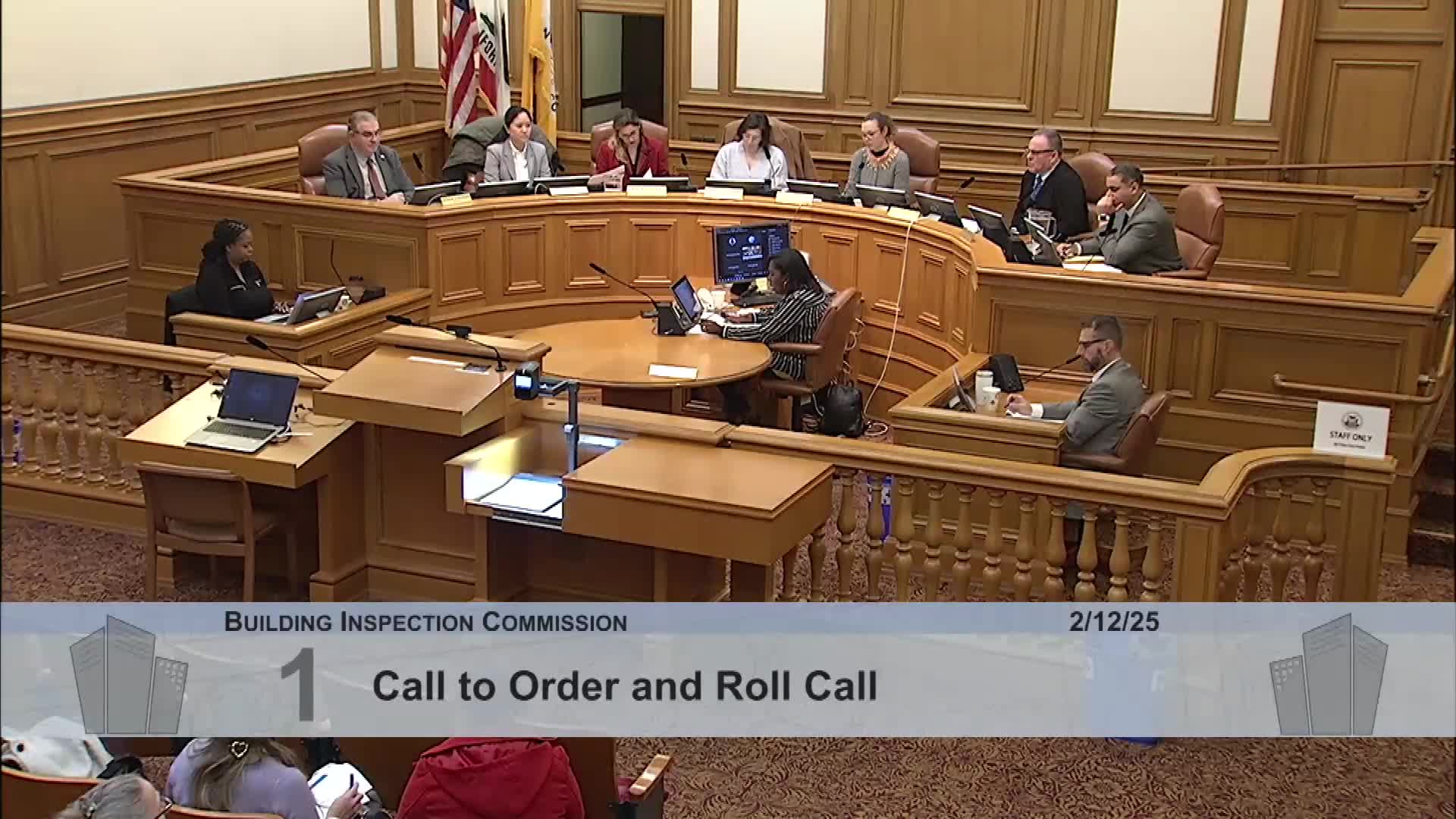
The Building Inspection Commission on Feb. 12, 2025 voted unanimously to recommend the Department of Building Inspection's (DBI) proposed fiscal-year 2024–25 and 2025–26 budget to the mayor and Board of Supervisors, and to press for restoration of a $1,128,000 planned cut to DBI grant-funded tenant outreach programs.
Deputy Director for Administration Alex Koskinen presented the department's two-year budget submission to the commission, describing largely technical adjustments, a set of 11 proposed new positions and a set of policy-driven staffing additions intended to improve permitting and records work. Koskinen also noted a citywide hiring freeze announced by the mayor's office and outlined three options DBI staff identified to replace the grant cut: (1) request that the mayor and Board of Supervisors restore general-fund support; (2) increase hotel license fees (averaging about 180%, by DBI's calculation) and apartment license fees (averaging about 7%); or (3) raise all DBI fees by roughly 1.5%.
The commission's action followed more than an hour of public comment from tenants and nonprofit organizers who said the contract-funded SRO and SEOP outreach programs are critical for habitability enforcement and tenant safety in San Francisco's single-room-occupancy (SRO) and apartment buildings. Lo Shu Bi, introduced in public comment as a client of the Chinatown Community Development Center's housing counseling, told commissioners: "The program is extremely important to the community. It's not only help us to understand our rights as a tenant, but enable us to exercise those rights." Prithi Bateke of Tenderloin Housing Clinic said the organizations funded by DBI "are the frontline staff for the neighborhood." Several speakers described infestations, mold, blocked fire egress and long delays getting repairs resolved without organizer assistance.
Koskinen described the personnel proposals as two categories: technical changes that reclassify or reassign existing positions, and policy-driven additions that would increase headcount if approved by the mayor and Board of Supervisors. He listed 11 requested new positions including staff for a new GIS unit (to create citywide building-attribute data), additional human-resources training capacity, administrative analysts to manage a vulnerable concrete building program and records cleanup, product/project management for a planned permit-tracking-system replacement, additional permit technicians to expand virtual interactive plan review, an administrative engineer to align plan-review staffing, and a legal-affairs manager to coordinate DBI legal needs with the City Attorney's Office. Koskinen said the department is also proposing to revive a technology surcharge to build a technology reserve and estimated the department's share of a full permit-system replacement could be substantial (staff discussed system-replacement cost assumptions up to tens of millions of dollars, and DBI referenced prior assumptions that DBI might cover roughly 70% of a multiagency project).
Commissioners pressed staff on trade-offs between adding positions and protecting the grant-funded tenant-outreach contracts. During deliberations President Alexander Toot moved to approve the budget submission as presented by staff "with the amendment that the community grant funding be fully funded." Commissioner Williams seconded. The motion passed on a roll-call vote with all commissioners recorded as "yes." The commission then voted unanimously to send a letter to the mayor and Board of Supervisors urging hiring authority for the proposed DBI positions and identifying the three funding options staff had presented to restore the grant funding; the motion to send the letter was made by President Toot and seconded by Commissioner Chavez.
Discussion and public testimony emphasized the programs' role in language access and habitual enforcement. Speakers and program staff estimated the outreach work reduces DBI inspection loads by helping resolve many issues without a formal inspection — one organizer said she had assisted 73 clients since January and credited the program with a high resolution rate without inspector visits. Landlord representatives including Charlie Goss of the San Francisco Apartment Association supported continued funding for the collaborative program, saying it helps owners meet code and reduces city enforcement costs.
The commission did not adopt a single funding solution; instead it approved the budget submission with the grant-restoration amendment and instructed the president to send a letter outlining the preferred options and alternatives to the mayor and supervisors. President Toot and Commissioner Newman were assigned to draft that letter; commissioners noted they must avoid having a quorum collaborate on the draft per open-meeting rules.
The commission's actions were procedural recommendations to the mayor and Board of Supervisors; final funding and hiring decisions rest with those offices.