Get Full Government Meeting Transcripts, Videos, & Alerts Forever!
Get email alerts on the School Broadband topic
No spam. Unsubscribe anytime.
Tribal broadband project to steady school internet; district, tribe agree on short-term fixes and coordination
Summary
An informational meeting between Todd County School District 66-1 staff, tribal broadband representatives and local IT staff outlined persistent wireless reliability issues at the new Rosebud-area elementary school, a tribal grant timeline for fiber work and near-term steps to stabilize service and phone systems before occupancy.
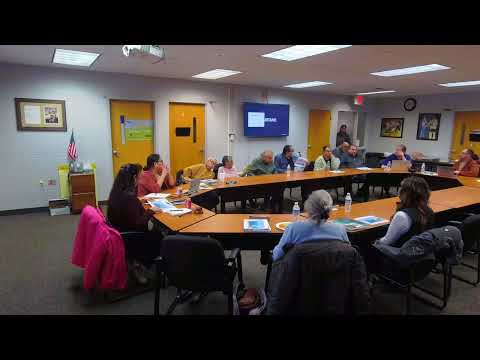
Todd County School District 66-1 and tribal broadband staff met in an informational session to review internet and phone connections for the district’s new school building, discuss persistent outages on the temporary wireless link, and outline a timeline for bringing fiber to the site.
The discussion centered on reliability problems with a point‑to‑point wireless link that has been carrying internet and IP phone traffic to the new school since construction. Mark Baez, a community member who attended the meeting, asked, “where we're at with the Internet stuff for the school and when that was gonna open,” prompting detailed technical and schedule updates from district IT staff and tribal broadband representatives.
A tribal representative said the tribe’s broadband grant is on final notice and that a public comment period will close in about three weeks; the representative said a groundbreaking would follow roughly one to two weeks after that and estimated the fiber installation to “take us about 10 days” for the immediate route once contractors are mobilized. The same speaker said the tribe expects the overall fiber buildout to be completed in months rather than years and that rights-of-way and environmental clearances are already in place.
Why it matters: the new school is not yet turned over for occupancy and several essential systems — IP phones, security cameras, door access and heating/cooling remote management — depend on reliable connectivity. District and tribal staff said they want to avoid outages that would interrupt building systems or classroom instruction when the school opens.
District IT staff described the current network architecture and the technical cause of recurring outages. The school’s temporary connection routes internet traffic over multiple wireless hops from the school to nearby towers; staff showed diagnostic charts indicating frequent, short outages in recent weeks and lower signal strength on the link serving the bus garage and one outlying access route. The district IT director (name not specified) said the link delivered good peak speeds in testing — “we were getting, like, 350 down, 347 megs up” when it was aligned — but added that the wireless path “needs to be tweaked” often, especially after weather events or seasonal changes that cause rain fade and antenna misalignment.
School staff said the actual classroom experience has been positive when the link is up. The assistant principal at Rosewood (name not specified) said classroom testing with multiple Chromebooks showed only “a teensy bit slower than the one at the old school,” and that teachers can continue lessons during short outages. But staff and tribal representatives also reported at least one instance where contractors for the building’s HVAC had to travel from Rapid City because remote access failed and the HVAC vendor could not connect.
Phone service and addressing number portability were discussed as a separate but related challenge. Tribal staff said some telephone numbers and the current carrier’s regulatory waiver complicate moving numbers between providers; the tribe has an active complaint and waiver discussion at the FCC and will include phone‑number transition work as part of longer-term planning.
Near-term steps and responsibilities identified at the meeting: - School and tribal IT staff agreed to hold a follow‑up technical meeting to “tweak” the point‑to‑point wireless alignment and define a handoff process for day‑to‑day support. The school IT director said his team will continue internal configuration and that tribal engineers can supplement field work. - The tribe plans a business‑phase modification after the grant groundbreaking to run fiber from key points to the school; tribal staff said contractors are in place and the short route to the school should not take long once work begins. - Participants agreed to formalize a single point of contact on each side so Yancey/Santee (tribal technical lead) and the district IT contact can coordinate emergency responses and work tickets. - The district will consider small budget increases for temporary staffing or equipment if needed to maintain the interim wireless link until fiber is installed.
Participants emphasized sovereignty and long-term capacity building. Several tribal representatives framed the project as both infrastructure and workforce development: the tribal grant’s wireless phase will provide broader coverage quickly while fiber will be installed to anchor key locations, and the tribe plans to hire and train local technicians to operate and maintain the network over time.
No formal actions or votes were taken; the meeting was explicitly framed as informational and as a planning session to align technicians, contractors and administrators ahead of occupancy. District officials reiterated that the building handover for occupancy is still pending completion of punch‑list items by the contractor, and that a specific move‑in date will depend on that handover.
Participants asked for more frequent joint meetings and clearer escalation contacts so outages are addressed promptly. The meeting closed with agreement to schedule follow‑up technical coordination, and with tribal staff saying the fiber work will begin soon after the grant comment period ends.
Adjournment: the board adjourned the informational meeting at 6:36 p.m.