Get Full Government Meeting Transcripts, Videos, & Alerts Forever!
Get email alerts on the Biking And Rolling Plan topic
No spam. Unsubscribe anytime.
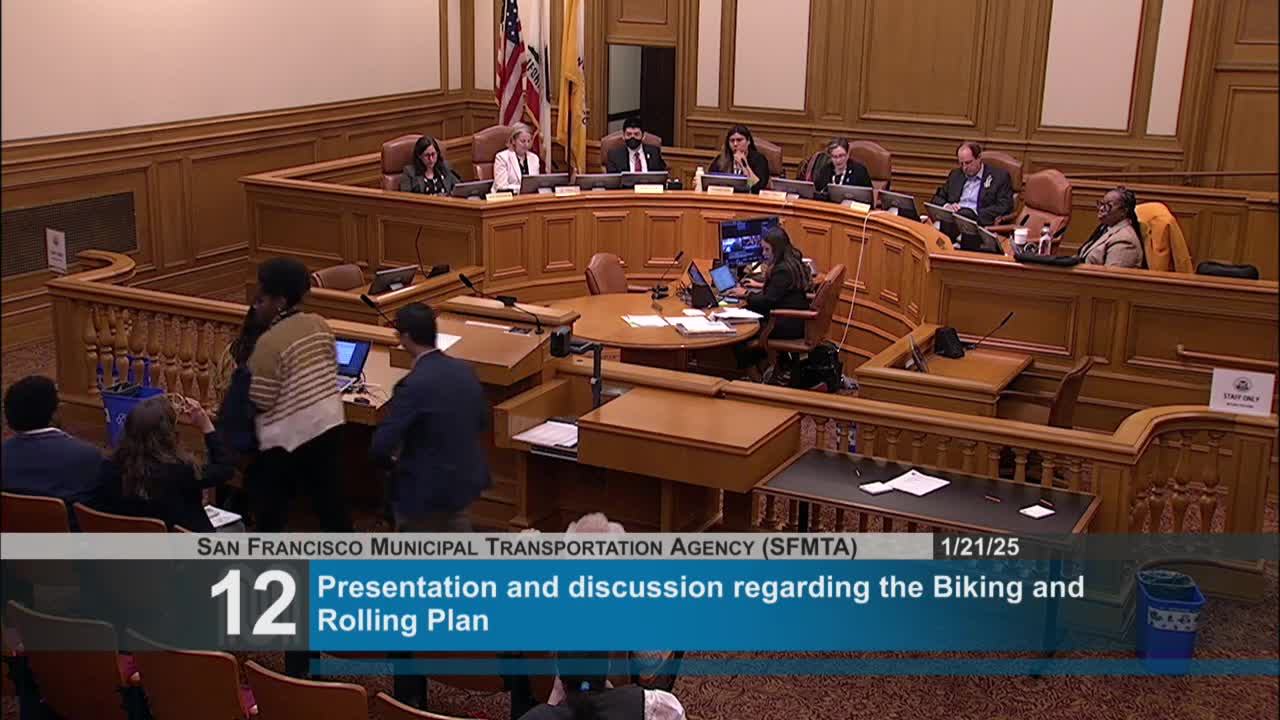
SFMTA presents Bike and Roll plan, centers community action plans; board seeks clearer timeline and funding pathways
Summary
SFMTA staff presented a deeper look at the Bike and Roll Plan and six community action plans on Jan. 21. The plan sets a long-range 'North Star' goal of an all-ages-and-abilities network within a quarter mile of every resident, but board members and public commenters debated funding, sequencing and whether to prioritize Muni’s financial crisis.
SFMTA staff returned to the board on Jan. 21 with a deeper presentation on the agency’s Bike and Roll Plan, including six neighborhood community action plans and a decision-making framework staff said will guide how and when projects are implemented. Staff told the board they plan to return in February with a final plan for adoption.
What staff presented
Project staff described the plan’s North Star goal — a safe, connected bicycle and rolling network within roughly a quarter mile of every San Francisco resident — and explained the plan’s two parts: community action plans developed with six neighborhood groups and a decision-making framework for sequencing projects. Staff emphasized the plan does not itself approve project-level changes; each future project will still go through its normal review, approval and public-notice processes.
Community action plans and priorities
SFMTA highlighted partner-developed action plans for six neighborhoods or constituencies: Western Addition/Fillmore (New Community Leadership Foundation), Mission/Excelsior (Poder/Por el Pueblo), Tenderloin (Tenderloin Community Benefit District), SOMA (SOMA Pilipinas), Bayview/Hunters Point (Bayview Hunters Point Community Advocates) and other locally driven proposals. Common priorities across these plans included improved sidewalks and pedestrian access, safer crossings and enhanced accessibility for seniors and people with disabilities, and better local connectivity and maintenance. Several neighborhoods requested that projects center local priorities — school access, cultural place‑making and protection against displacement — before installation of major street changes.
Decision framework and implementation factors
Staff said project selection will be guided by four factors: safety impact, technical feasibility (traffic volumes, signal and curb space constraints), resources (funding and staffing) and community readiness (local leadership and public engagement). Staff provided examples of projects that could move forward if readiness and funding align, and said they will revisit priorities every two years.
Board and public response
Public comment at the hearing was sharply divided. Supporters — including neighborhood organizations and the San Francisco Bicycle Coalition — urged an ambitious, time‑bound plan focused on safety, school zones and a connected crosstown grid. Critics — including many members of the public who said they drive for work or care for elderly relatives — asked the agency to pause or slow the plan and instead prioritize restoring Muni service amid a multimillion-dollar operating shortfall. Several speakers urged clearer timelines, funding commitments and transparency about the relationship between the plan and street‑level changes that affect parking and deliveries.
Board questions and requested changes
Directors pressed staff to be explicit about what the board would be asked to adopt in February (policy guidance and community action plan adoption, not project-level approvals) and requested clearer timelines or a two-year implementation roadmap that distinguishes aspirational network goals from the subset of projects that are funded and “shovel‑ready.” Board members also asked staff to spell out accountability measures: how SFMTA will track progress, who will coordinate with other departments (public works, planning, police) and which projects could be prioritized within the agency’s near-term funding envelope.
Next steps
Staff said they will return to the board in February with a final proposed plan and asked for direction on outstanding questions (timing, accountability metrics and near‑term priority projects). The board’s Feb. adoption item is expected to include the community action plans and the North Star network as policy guidance; staff emphasized that each individual project will still require its own public hearing and approvals before construction.
(Reporter’s note: the presentation materials and the separate community action plans are the SFMTA’s working documents; adoption language in February will determine which elements are formal agency policy.)