Lifetime Citizen Portal Access — AI Briefings, Alerts & Unlimited Follows
SFMTA: $5.2 billion backlog in state-of-good-repair; transit-critical assets need roughly $424M/year
Loading...
Summary
SFMTA asset management staff told the board on Jan. 21 that 27 percent of the agency's $16.9 billion asset inventory — about $5.2 billion — is not in a state of good repair; staff described an average annual need of $424 million to sustain transit service–critical assets.
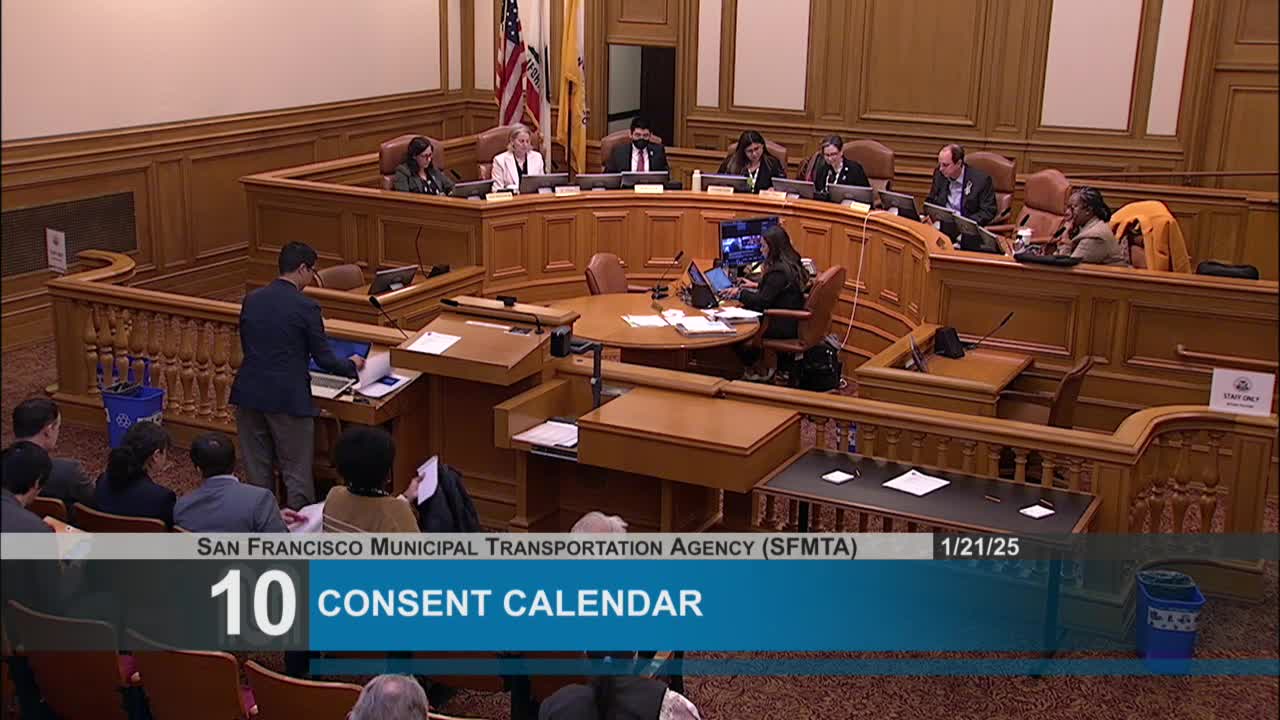
SFMTA asset management lead analyst Jason Chan presented the agency’s 2023 State of Good Repair (SOGR) report to the board on Jan. 21, outlining asset-condition scores, the current backlog and projected investment needs over the next 20 years.
Key takeaway: The agency reported $5.2 billion in backlog — assets with condition scores below the agency’s 2.5 state-of-good-repair threshold — equal to roughly 27 percent of a $16.9 billion asset inventory. Chan said 68 percent of that backlog (about $3.5 billion) is for assets that have passed their useful life.
What the numbers mean
Chan described agency assets by class (vehicles, track, signals, parking and traffic infrastructure, facilities and “other systems and vehicles”) and explained that condition is currently scored primarily by age and useful life. He reported:
• About 59 percent of all agency assets meet the SOGR threshold; 72 percent of transit service–critical assets are in SOGR.
• The total SOGR backlog is approximately $5.2 billion; 43 percent of that backlog is transit service–critical.
• Significant backlogs exist in parking and traffic infrastructure (about $1.1 billion) and in track and overhead systems; large shares of those asset classes are in poor or marginal condition and seeded to require near-term investment.
• The agency modeled long‑term needs and concluded that replacing only transit service–critical assets on a sustainable schedule would require about $424 million per year on average. To stabilize the backlog and support full asset replacement over 20 years, the agency estimated an average annual need of $785–$915 million; by contrast, SFMTA’s recent average annual SOGR spending was about $303 million.
Recent work and trade-offs
Chan highlighted recent projects and maintenance strategies that have improved reliability: a full rehabilitation of Terravel (rails, overhead, paving), a Kirkland bus maintenance facility upgrade to support battery buses, and a midlife overhaul program for buses that reduced vehicle breakdowns and stabilized average fleet age from about 12 to about seven years. He warned that delayed midlife overhauls and bus replacements would raise corrective maintenance costs and likely increase breakdowns.
Board questions and context
Directors asked whether capital funds could be shifted to operating purposes to address the agency’s immediate operating shortfall. Kirschbaum said capital-to-operating transfers are a policy option the agency and its muni funding working group will examine, but cautioned that converting capital for operating is “eating your seed corn” and risks larger long‑term costs because fixed infrastructure failures (tracks, overhead, parking structures) have systemwide impacts when deferred.
What happens next
The SOGR presentation is informational; Chan and staff said the numbers frame the agency’s long‑term capital needs and will feed into the Muni funding working-group analysis and future capital programming discussions. Several directors urged continuing work on joint development and other ways to leverage agency properties for long‑term capital revenue; staff said they will bring a draft joint development policy to the board in February.
(Reporter’s note: all numerical figures are taken from the SFMTA SOGR presentation to the board on Jan. 21.)