Get Full Government Meeting Transcripts, Videos, & Alerts Forever!
Get email alerts on the State Budget topic
No spam. Unsubscribe anytime.
House Appropriations Committee approves amended FY2025 budget (HB 67) with $4.4 billion in one‑time additions, sends bill to Senate
Summary
The Georgia House Appropriations Committee voted to pass House Bill 67, the amended FY2025 budget, approving roughly $4.4 billion in additional resources that include major allocations for hurricane relief, corrections, water infrastructure and retirement system funding. The measure moves next to the state Senate.
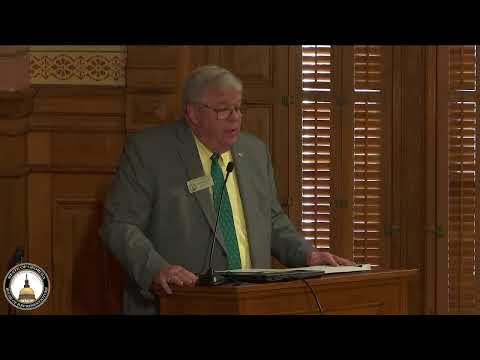
The Georgia House Appropriations Committee voted to pass House Bill 67, the amended fiscal year 2025 budget, sending the committee substitute to the state Senate after a voice vote. Representative (Chairman) Dubnick moved the committee substitute and Chairman Meeks seconded the motion; members approved it by voice vote.
The bill recognizes a revenue estimate of $40.5 billion and, according to the committee presentation, includes roughly $2.7 billion in surplus funds for a total infusion of about $4.4 billion in additions to the original FY2025 plan. Committee leaders told members the supplemental funds are aimed at one‑time investments in infrastructure, disaster recovery and state operations.
Why it matters: HB 67 directs a substantial one‑time infusion to state priorities identified after Hurricane Helene and to long‑term obligations. The largest standalone allocations highlighted by the presenter include a $333 million package for the Department of Corrections, $811 million for hurricane relief and recovery, and a $500 million deposit intended to strengthen the Employees' Retirement System.
Major allocations and purposes cited by the committee presentation: - Retirement and long‑term obligations: $500,000,000 toward the Employees' Retirement System to bolster long‑term funding and support future cost‑of‑living adjustments for retirees. - Water and wastewater infrastructure (GEFA): $750,000,000 for the Georgia Environmental Finance Authority, including $500,000,000 directed to coastal communities (direct aid/loans) and $250,000,000 in low‑interest loans statewide. - Transportation and infrastructure: $530,000,000 for Department of Transportation projects focused on interstate freight and logistics corridors; $37.5 million added to the Georgia Transportation Infrastructure Bank (GTIB), including $7.5 million shifted to airport aid and $5,000,000 to rail projects. - Department of Corrections: a $333,000,000 infusion for facility repairs, staffing and security initiatives. The House presentation said the package increases hiring targets (the presentation said staff additions moved from 330 to more than 400 positions in the House version), reduces procurement of secure modular units from four to two, increases body camera and taser purchases, funds an “overwatch and logistics” monitoring unit, and includes targeted funding to address salary compression and retention. - Hurricane Helene relief and recovery: the House added approximately $197,000,000 above the governor’s proposal for a total package the presenter described as $811,000,000; components include $145,000,000 to the emergency fund for initial cleanup and relief, $298,000,000 to DOT for infrastructure repairs and debris cleanup, and additional support for agriculture and timber producers. - Agriculture and forestry: $250,000,000 total for farmer and timber producer assistance — $100,000,000 for the Forestry Commission for cleanup and $150,000,000 in loan authority through the Georgia Development Authority. - Rural hospitals and health: $35,000,000 in one‑time funds to assist 45 rural and critical access hospitals with financial stabilization and hurricane‑related costs. - Education and school safety: $114,000,000 to cover K‑12 enrollment growth; $50,000,000 in additional school security grants; $3,000,000 seed funding for a school threat assessment system run by GEMA; and $2,400,000 to support increased AP and PSAT exam utilization. - Human services and foster care: $22,000,000 to address foster care utilization and cost of care; $1,719,000 for court‑appointed special advocates (CASA) replacing federal funds deemed ineligible; $1,400,000 to fund a $3,000 salary adjustment for Department of Human Services eligibility workers effective April 1. - Technology, state operations and insurance: $58,000,000 for the Georgia Technology Authority for IT modernization; $225,000,000 for the Department of Administrative Services to meet state liability and property insurance needs.
Committee discussion and changes: Subcommittee chairs summarized targeted adjustments that the full committee incorporated. Examples included trimming or delaying start dates for some personal‑service funding where positions had not yet begun and reducing the number of modular correctional units requested by the governor from four to two while shifting funds into staffing, technology and maintenance needs. The presenter described the changes as “one time” investments in capital and safety and said they reflect both the governor’s priorities and additional items the House added in response to Hurricane Helene and ongoing corrective‑system needs. The presenter said, in part, “this storm had a much larger impact than any other disaster in our history,” language used during the presentation to justify expanded disaster relief funding.
Procedure and next steps: The committee passed the committee substitute by voice vote after a motion from Chairman Dubnick and a second from Chairman Meeks. The bill now advances to the Senate for consideration. Committee staff and subcommittee chairs said they will be available to answer questions from members as the bill moves forward.
What the vote did not specify: The committee approved the amended budget by voice vote; the transcript records a unanimous audible affirmative response and no recorded roll‑call tally. Exact roll‑call numbers were not specified in the committee record provided.
The committee presentation included extensive line‑item changes delivered by subcommittee chairs (for courts and judiciary, general government, education, higher education, transportation, human resources, health, economic development and public safety). Those line items were discussed at the subcommittee level and incorporated into the House substitute presented to the full committee.
Funding amounts cited in this report reflect the committee presentation. If an item lacked a concrete dollar amount in committee remarks, the article identifies that element as “not specified” or reports the language the presenter used.
The committee record indicates the bill passed and was sent to the Senate; staff and members said they will continue to provide detail to colleagues and answer questions as the measure proceeds.