Get Full Government Meeting Transcripts, Videos, & Alerts Forever!
Get email alerts on the Mobility topic
No spam. Unsubscribe anytime.
Charlotte staff outline mobility plan, say $55 million pilot ready and present long‑term 30‑year funding vision
Summary
City transportation and general‑services staff told the Charlotte City Council at a retreat session that a new, place‑based approach to mobility is already producing measurable, short‑term results and can be scaled to a long‑range, 30‑year investment program if a regional sales‑tax proposal gains approval.
City transportation and general‑services staff told the Charlotte City Council at a retreat session that a new, place‑based approach to mobility is already producing measurable, short‑term results and can be scaled to a long‑range, 30‑year investment program if a regional sales‑tax proposal gains approval.
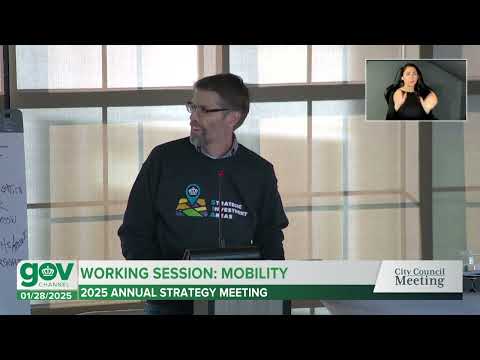
Ed McKinney, who led the staff presentation as the city manager’s office project lead, said the idea is to pair targeted street, sidewalk and transit‑stop investments with broader policy aims such as housing access and economic opportunity. “We want to prove to the council and the community what we can do with this money,” McKinney said, describing a team‑of‑teams approach that puts procurement, design, construction inspection and community engagement at the table early.
The staff described an initial, council‑funded $55 million bond that produced two test areas — Harrisburg Road and Arrowood — where the city has moved quickly on “tier 1” projects. McKinney highlighted a Harrisburg quick win: “We built 350 linear feet of sidewalk,” he said, and showed an internal sign marking the project as complete. Staff told the council they had already programmed roughly 60 percent of the $55 million in short‑ and mid‑term projects and expect many of the remaining items to enter design or construction within months.
Former Oklahoma City Mayor Mick Cornett, brought to the retreat as a peer speaker, framed the issue as part of a larger civic competitiveness argument: “We're creating a city where your kid and your grandkid are gonna choose to live,” Cornett said, urging elected officials to frame infrastructure investments as long‑term civic renewal. Cornett described Oklahoma City’s multi‑phase, voter‑backed infrastructure programs and emphasized the mix of public campaign work and private sector support he used to pass multi‑year sales‑tax initiatives.
Staff also tied the local work to the region’s proposed transportation funding package. In the presentation Ed McKinney and other staff repeatedly used the figure discussed earlier in the day — Charlotte’s projected share described in the meeting materials as “570,000,000,0.0” — which staff characterized in the retreat briefing as the city’s 40 percent share of the regional plan under discussion. McKinney said the city is aligning the strategic investment approach with the regional transit “Better Bus” proposal and with planned rail investments so surface infrastructure, bus stops and mobility hubs connect to higher‑frequency service where possible. McKinney noted the Better Bus plan calls for a 50 percent increase in bus service overall and highlighted the goal known in staff materials as “15 for 60” — 15‑minute or better service for roughly 60 percent of current riders.
On procurement and delivery, staff pressed the point that speed and teamwork matter. McKinney said the team favored “unbundling” larger projects into smaller, buildable pieces so work can advance quickly rather than waiting for lengthy single‑project procurement cycles. He also described a “center pendulum” design principle used internally to find the compromise between ideal designs and buildable scope.
Council members pressed staff about equity, local business participation, neighborhood impacts and whether the city can ensure projects benefit existing residents. Council members also raised homelessness, safety and workforce training as connected priorities; staff and outside speakers said the mobility investments were intended as one tool among many to support access to jobs and services. McKinney said the next steps are to complete programming for the $55 million pilot, expand community engagement in Arrowood and Harrisburg later this year, and to lay out a multi‑decade implementation framework if the county‑level tax measure moves forward.
What happened next: Staff will complete designs and begin additional contracts under the $55 million program; they said they are ready to scale the approach and will return to council with additional details for community engagement and project phasing.
Why this matters: Council members and staff framed mobility investments not primarily as transportation engineering, but as a lever for economic access, housing affordability and workforce opportunity. Quick, visible investments — sidewalks, lighting and bus shelters — were presented as the start of a longer, place‑based strategy.