Get Full Government Meeting Transcripts, Videos, & Alerts Forever!
Get email alerts on the Community Solar topic
No spam. Unsubscribe anytime.
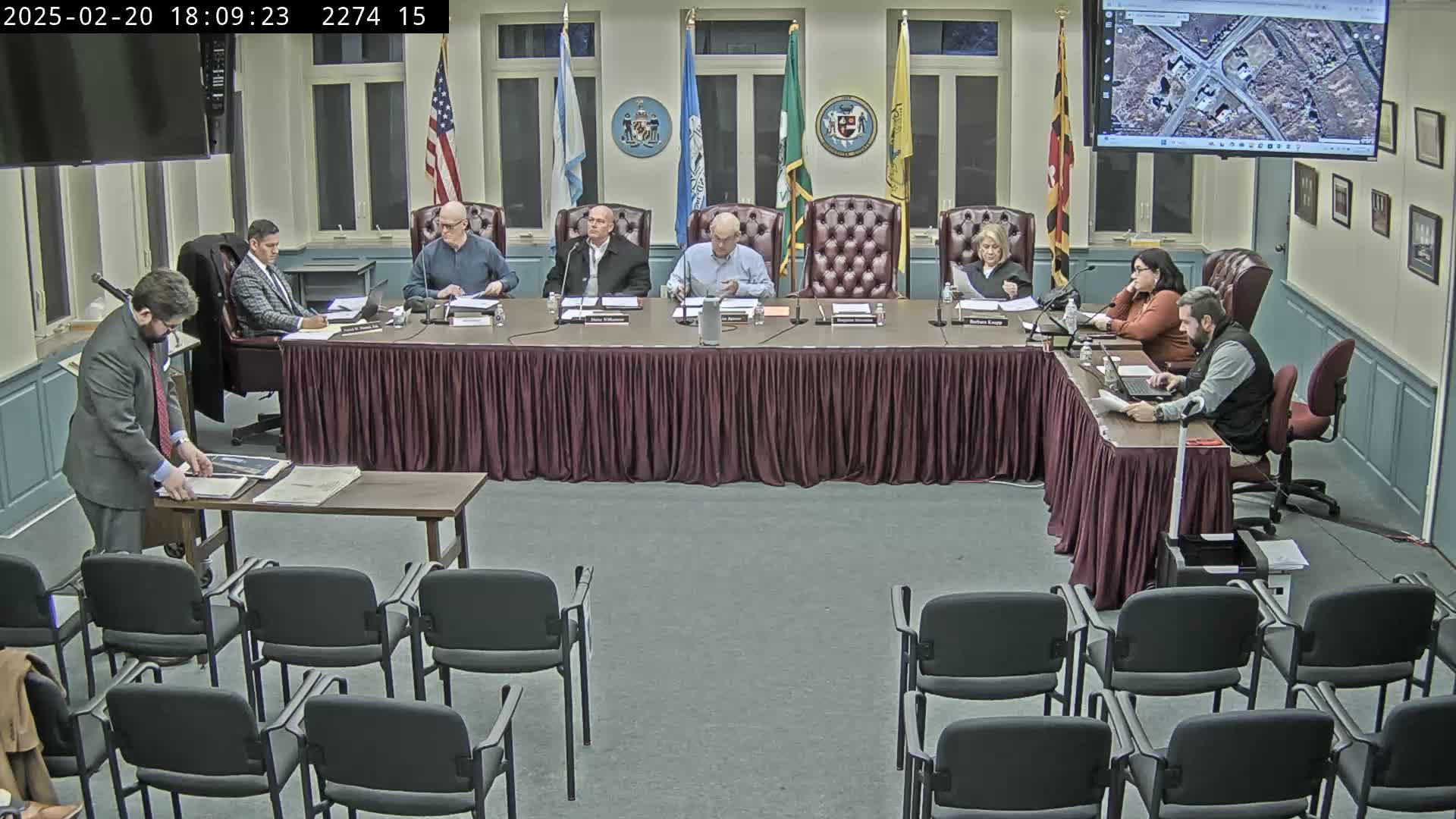
Board of Appeals approves small-scale community solar and fence height variance for Halo Herlock project
Summary
The Dorchester County Board of Appeals granted a special exception and a variance allowing a community solar installation on a 16.33-acre parcel, with conditions including a decommissioning surety, a landscaping and maintenance plan, and a 7-foot fence consistent with the National Electrical Code.
The Dorchester County Board of Appeals approved a special exception and a variance for a proposed community solar project on a 16.33-acre parcel owned by Halo Herlock Property LLC.
Counsel for the applicant identified herself as representing Halo Herlock LLC and described the project as a community solar installation using single-axis tracking panels over an approximately 11.88-acre limit of disturbance. She said the project will allow Delmarva Power customers to subscribe and estimated the system would generate enough electricity for roughly 250 homes, producing subscriber savings typically between 5% and 7.5% depending on the year.
Staff reported the Planning Commission issued a favorable recommendation. The applicant is seeking the Board’s approval under the county’s utility services land-use classification (applied because of a recent county solar text amendment) and a variance to permit a 7-foot chain-link fence, which exceeds the usual code height by 1 foot in side and rear yards and by 3.5 feet in the front yard. Counsel said the fence height is consistent with the National Electrical Code and solar industry practice.
The applicant proposed a 50-foot wide landscape buffer along the northwestern, northern and eastern boundaries but said discussions with an adjacent property owner — Hubbard Road Nursery LLC — produced an agreement to modify the proposed buffer along most of the eastern boundary to allow the nursery to expand agricultural operations onto the area outside the fence under a long-term lease. Counsel said most of the western and southern boundaries are already screened by existing forested buffers.
The board conditioned approval on several items recommended by staff and the applicant: an approved landscaping and maintenance plan with a 2–3 year planting bond; a decommissioning plan with a decommissioning surety to be reassessed every five years; site plan review and ordinary permits for stormwater, erosion and electrical; and the modified buffer exhibit reflecting the agreement with the adjacent nursery. Counsel also provided tax and economic estimates included in the record: first-year real estate tax (estimated about $3,892) and estimated personal property tax in year one of about $20,130; over the life of the project (estimated 25–35 years) personal property payments could total more than $650,000.
Board members asked clarifying questions about the decommissioning process and the end-of-life disposition of panels. Counsel explained decommissioning would remove racks, cabling and fencing; recyclable metal would be reclaimed and any nonrecyclable waste managed according to prevailing practices. She said site restoration or continued agricultural use would depend on the owner’s plans and applicable law at that future time.
After deliberation, the board voted to approve the special exception with the conditions described above; it separately approved the variance to permit the 7-foot fence. The transcript records affirmative votes as “Aye”; individual roll-call votes were not recorded in the public hearing transcript.