Get Full Government Meeting Transcripts, Videos, & Alerts Forever!
Get email alerts on the Housing Refinancing topic
No spam. Unsubscribe anytime.
Housing Trust Group refinancing approved after committee seeks partial paydown and reserves funding
Summary
Miami committee approved a modified subordination for Wagner Creek that requires the developer to fund a $275,000 replacement reserve and use remaining refinance proceeds to pay down the city's HOME loan, leaving a reduced city balance.
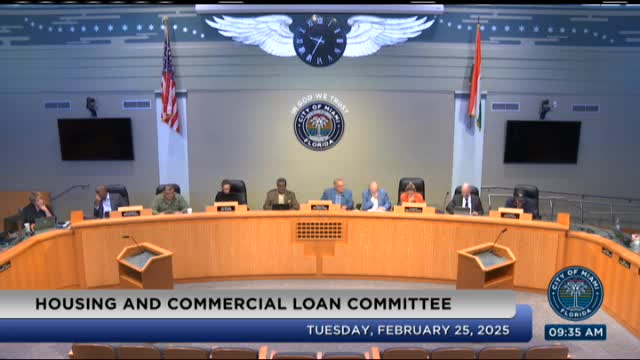
The Housing and Community Loan Committee voted to approve a modified refinancing arrangement for the Wagner Creek Apartments project that asks the developer to fund a $275,000 replacement reserve and apply remaining refinance proceeds to reduce the city’s outstanding HOME loan balance.
The vote followed extended discussion about cash‑out proceeds, long‑term affordability and federal compliance. Committee members raised concerns that a large cash‑out could remove funds the city could reuse for other affordable housing projects. Committee members pushed for stronger assurances the city’s interests and the 11 city‑assisted units would remain protected.
Housing Development Coordinator Alberto Cacion summarized the request, saying the developer seeks “a cash out refinancing at this property to deliver cash to the developing member and investor member” and that the permanent loan being offered by Citibank via Freddie Mac would be substantially larger than the prior loan. He also told the committee the department reviewed the request and recommended subordinating the city’s HOME loan to the new senior loan while maintaining existing loan terms.
Grama Toye, senior vice president of the Housing Trust Group, described the refinancing as a standard part of the property’s financing cycle: “We’re just refinancing the property,” she said, and added that proceeds are typically reinvested into other affordable housing developments.
Committee members pressed for details. Several requested an appraisal and pro forma projections; staff and the developer said underwriting relied on debt coverage ratios and that customary lender documentation would be provided. Committee members expressed concern that the developer would “cash out” large proceeds and not return funds to the city. In response, the developer said proceeds typically go back into other projects, naming Rainbow Village and Courtside as examples of candidate uses.
After debate and multiple motions — including a proposal to require payoff of the city loan and an alternative to impose a one‑time fee and a higher interest rate — the committee ultimately approved a motion that kept the department’s recommendation in place but asked the developer to fund the $275,000 replacement reserve and to pay down the city loan by the balance remaining after that reserve contribution. The committee recorded the final approval by voice/hand count; members reported the outcome as seven in favor and two opposed.
The committee also discussed federal compliance risks tied to HOME funds and the possibility that HUD actions could affect availability of federal dollars; staff warned that some federal obligations are subject to change and that keeping funds deployed in active projects reduces administrative complications.
The developer said the permanent loan had not yet closed and that timing pressures (they were scheduled to close within weeks) complicated the committee’s deliberations. Committee members asked staff to return with clearer documentation if further action was required.
The committee’s approval conditions require staff to document the reserve funding and the net payoff arrangement in closing documents and to ensure ongoing affordability commitments remain enforceable.
The discussion began when the Wagner Creek item was introduced and concluded when members voted to approve the conditioned subordination. The committee’s action does not remove the city’s loan but reduces its outstanding balance per the approved condition.