Get Full Government Meeting Transcripts, Videos, & Alerts Forever!
Get email alerts on the Developing Countries Support topic
No spam. Unsubscribe anytime.
UN Secretary‑General urges bigger finance, governance reforms to help developing countries
Summary
United Nations Secretary‑General António Guterres told the Group of 77 and China that 2025 must be “the year of keeping promises to developing countries,” urging richer nations and multilateral institutions to expand finance, reform debt and governance structures, and ensure developing countries share in the benefits of new technologies and the energy transition.
United Nations Secretary‑General António Guterres told the Group of 77 and China that 2025 must be “the year of keeping promises to developing countries,” urging richer nations and multilateral institutions to expand finance, reform debt and governance structures, and ensure developing countries share in the benefits of new technologies and the energy transition.
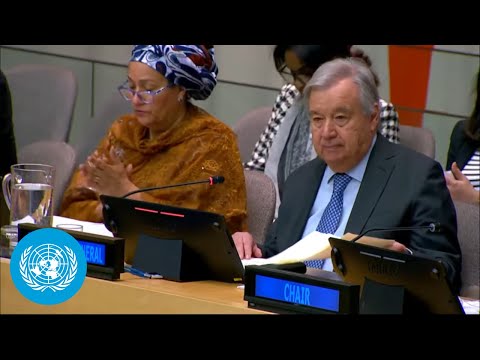
Guterres made the remarks while addressing the intergovernmental coalition on the margins of its annual gathering, commending Uganda’s stewardship of the Group of 77 and China over the previous year and congratulating Iraq as the group’s chair for 2025. He framed his appeal around the need to accelerate action so that countries can deliver on the 2030 Agenda for Sustainable Development.
The secretary‑general said the world faces overlapping crises — armed conflict, climate disasters, a widening digital divide and deepening geopolitical mistrust — that fall especially hard on developing countries. He said those countries have received a ‘‘raw deal’’ on finance, climate support and representation at decision‑making tables, and he called for concrete institutional changes to address that imbalance.
“We need multilateral development banks that are bigger, bolder, and better, enabling them to massively scale up affordable financing for countries in need,” Guterres said. He called for preemptive action to help countries in or near distress so they can refocus on investing in the Sustainable Development Goals and for a debt‑resolution architecture that is “timely and effective.”
On climate finance, Guterres urged developed countries to honor climate commitments, including “a doubling of adaptation finance to at least 40,000,000,000 US dollars a year.” He also pressed multilateral development banks to deploy concessional finance to countries most in need, taking account of structural vulnerabilities.
Guterres highlighted inequities in the energy transition and technology investment, saying Africa holds a disproportionate share of premium solar resources while receiving a small share of global investment in solar power. He also called for mechanisms to ensure that developing countries benefit from critical minerals by participating more fully in value chains.
On digital governance, Guterres pointed to the Global Digital Compact and the declaration on future generations as outcomes from the recent Summit of the Future that demonstrate countries can rally for reform. He described the Global Digital Compact as the first truly universal agreement covering governance of artificial intelligence and said it must be implemented so “all peoples can benefit from the promises and potential of AI.”
He also praised the Pact for the Future — an outcome of the Summit of the Future — and said its commitments to expand representation, including on the United Nations Security Council and in international financial governance, are important steps toward updating institutions founded in 1945.
Guterres closed by saying he would deliver a fuller address on priorities later in the week and by urging continued work on the summit commitments. “Let’s keep fighting for justice. Let’s make 2025 a year in which promises made are promises kept,” he said.
A presiding official thanked the secretary‑general after the address.