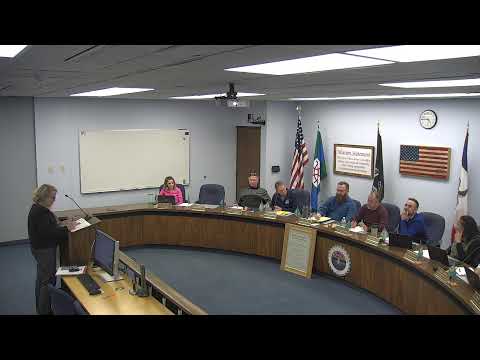
Clinton City council approves sewer, solid waste and other funds; ADM flow expected to double sewer revenues
Loading...
Summary
Council approved multiple FY26 proprietary and special-revenue funds after hearing that Advanced Digestion Module (ADM) flows could roughly double sewer fund revenue if ADM comes online in October. The meeting also covered unranked staffing requests, a potential solid-waste rate increase, transit capital priorities and marina facilities.
Clinton City Council on Thursday approved the sewer fund, solid waste fund, marina operations and amenities funds, airport funds, the Engineering Services Fund and a package of smaller special-revenue funds while holding the transit fund for further review.
The most consequential change presented was to the sewer fund: Anita, a city staff member, said the city projects sewer revenues to rise sharply for FY26 if the Advanced Digestion Module (ADM) begins sending flow in October. The presentation shows projected sewer revenues rising from roughly $9.2 million to $18.6 million, driven by a nine‑month ADM estimate that Anita said she calculated using 8,000,000 gallons per day and the rate in the wastewater services agreement. Anita gave the ADM nine‑month revenue estimate as $10,072,562 and said the city is modeling October 1, 2025, through June 30, 2025 for the initial ADM period.
Why it matters: ADM-related revenue would cover large new debt and operating costs tied to the recent RWRF (regional wastewater resource facility) expansion. Anita tied a projected $10.2 million in SRF (State Revolving Fund) loan debt payments to fund 536 and listed $5.3 million in operating expenses for the sewer operations fund (Fund 512) plus $1.5 million in capital projects tied to the long-term control plan. If ADM performs as modeled, Anita said the sewer fund could hold about $1.4 million in cash reserves by year end.
Council members and staff pressed on assumptions, including the 8,000,000‑gallon‑per‑day flow figure and timing. Taylor, a wastewater operations staff member, confirmed the city will bill ADM monthly using flow data provided by Taylor’s group. Anita said she was conservative in budgeting and that FY27 projections would assume 12 months of ADM revenue if ADM remains online.
Operations and costs: Anita told the council operations and maintenance (O&M) costs will rise, with electricity and full‑time staffing the largest upward pressures. She said plant personnel and benefits were budgeted to reflect two additional plant and maintenance operator positions tied to the expanded plant’s needs. Anita also noted insurance (ICAP) and property revaluations as factors increasing non‑personnel costs.
Sludge and landfill costs: Taylor and Anita described near-term reductions in sludge tonnage to landfill after new dryers come online. Taylor said sludge hauling to landfill is already down about 40% from last May and the drying equipment, expected online in March, should dry sludge further — reducing landfill fees and possibly enabling alternative uses for the dried product.
Staffing requests: Anita presented an “optimum staffing” consolidated list requested previously from department heads. Items on that list (not ranked) included two full‑time IT positions, two community development hires (a lower‑level code enforcement officer and a nuisance inspector), a full‑time rental inspector/permitting specialist, a fire administrative assistant, parks labor, an additional police officer, and a recreation activity specialist. Anita said those positions are not yet built into the general‑fund budget and that she does not expect FY26 general‑fund capacity to cover most of them; she asked council to note the requests for future consideration.
Solid waste fund and cart/rate discussion: Brian Lemke, Public Works, and Anita reviewed the solid waste fund. The council approved the solid waste fund as presented. Brian showed that a $1 increase in the city services/cart rate would generate an estimated $107,100 annually; he and Anita noted the current residential rate had not been increased since FY18 and that inflation since then would put an inflation‑adjusted equivalent near $12.60 (versus a present suggestion of $10.44). Anita said she did not build a rate increase into FY26 revenue but presented the math for future consideration. Anita reported about $2.4 million in solid waste fund cash on the ledger while also explaining a prior county payment and internal transfers made the ledger balances complex.
Transit fund and transit capital: Dennis (transit staff) and Anita reviewed a proposed $1.4 million transit‑fund revenue projection and a planned $822,000 transfer out for bus replacements and other capital. Anita said that, as presented, the transit fund shows about a $1.5 million deficit driven largely by planned capital transfers; she also noted the levy cap limits transit levies to 95 cents, which she calculated would generate about $1,052,994 if fully used. Councilors asked Dennis to prioritize vehicle replacements; they also debated federal electric‑bus grants that would cover roughly 85% of the cost for three electric buses and associated infrastructure. Multiple councilors and staff raised operational concerns about electric buses in cold weather (battery performance, maintenance and training needs and fire risk). Anita and Dennis agreed to bring a prioritized, clarified list of capital requests and funding options back next week; the council did not vote to approve the transit fund at this meeting.
Marina, airport and other funds: The council approved Marina operations (Fund 547), Marina amenities (Fund 548) and associated transfers; Anita noted an available 1,376‑square‑foot downstairs commercial space and discussed needed roof/ceiling repairs related to water intrusion from the upstairs tenant. The airport’s capital and operations budgets were also approved; Anita said the airport’s FY26 capital funding includes $98,000 from planned borrowing and $600,000 in federal and state grants for taxiway and other work.
Small and special funds package: Council approved the Engineering Services Fund, then approved in a single motion a package of smaller funds including the gaming fund, hotel/motel (tourism) fund, multiple TIF‑related funds, SMID, special assessments, demo fund, HUD award fund, and local option sales tax — with an amendment increasing the local option sales tax revenue projection to $4,250,000. Anita and council discussed revising the Grow Clinton (tourism/place‑making) contract so the organization receives a base allocation (a proposed $250,000 if the city collects $500,000 or more) and a share of revenue above that threshold; Anita said Grow Clinton has been receptive but final contract language will return after joint review with Grow Clinton and city staff.
Votes at a glance - Sewer Fund (Fund 511/512/536): motion to approve the sewer fund as presented — motion seconded; roll call: unanimous yes. Outcome: approved. - Solid Waste Fund: motion to approve as presented — motion seconded; roll call: unanimous yes. Outcome: approved. - Marina operations & amenities funds (Funds 547/548): motion to approve both funds — motion seconded; roll call: unanimous yes. Outcome: approved. - Airport capital and operations funds (Funds 571/571 capital/operations): motion and second; roll call: unanimous yes. Outcome: approved. - Engineering Services Fund: motion/second; roll call: unanimous yes. Outcome: approved. - Package approval (gaming, hotel/motel, TIF/LMI, SMID, special assessments, demo, HUD, and local option sales tax as amended): amendment to increase projected local option sales tax to $4,250,000 — amendment passed by roll call; package motion and vote: unanimous yes. Outcome: approved. - Transit Fund (FY26): no final approval taken; council asked staff for follow‑up (prioritization of capital and levy implications).
What’s next: Anita told council she will present the general fund, departmental special‑revenue accounts, tax‑levy funds and proposed borrowing at the next workshop; staff will return with a prioritized transit capital list, any corrected allocations and revised insurance projections. Anita also said she will circulate a draft of the proposed Grow Clinton contract changes for review before bringing it back to council.
The meeting’s substantive decisions were narrow approvals of presented fund budgets (proprietary and special funds) with transit held pending clarified capital priorities and levy analysis. Council members repeatedly requested clearer rank ordering of vehicle and capital needs when grants or matching funds are an option.