Get Full Government Meeting Transcripts, Videos, & Alerts Forever!
Get email alerts on the Student Wellbeing topic
No spam. Unsubscribe anytime.
Coral Shores students report heavy workloads, limited sleep and high screen time in school survey
Summary
Student leaders from Coral Shores High School presented a student‑generated survey showing many students balance work, extracurriculars and AP/honors courses, with common reports of limited sleep, high screen time and 1–3 hours of daily free time. Board members asked about effects of proposed later school start times.
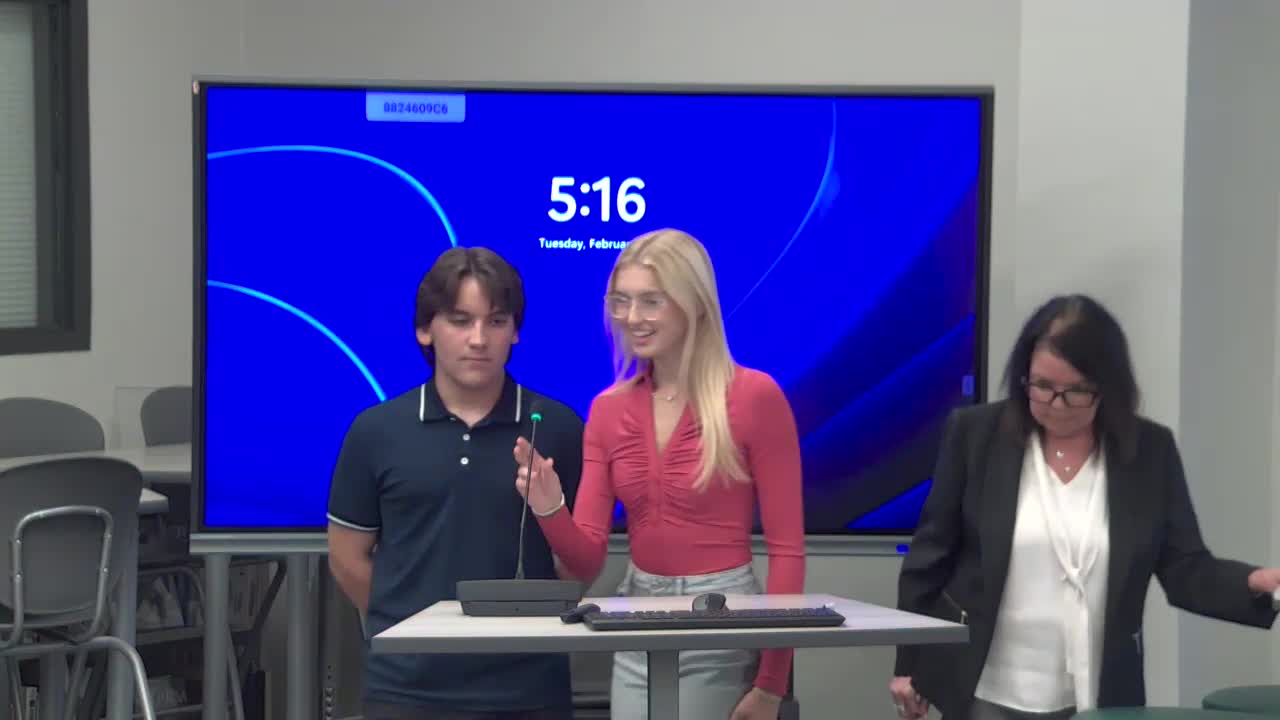
Student leaders at Coral Shores High School told the Monroe County School Board on Tuesday that a school‑room survey of students described tight schedules, limited sleep and high screen time that some students say impairs focus and well‑being.
Alybeth Wilson, student body president, and Robert Aleman, senior class president, told the board they posted a Google form to Google Classrooms for grades 9–12 and collected "over a hundred" student responses. "Many students wake up as early as 5 a.m. with limited sleep," Wilson said, and the results showed a common pattern of heavy academic workload combined with work and family responsibilities.
Nut graf: The student‑supplied data show a majority of respondents juggling AP/honors coursework, extracurricular activity and paid work; the students presented detailed breakdowns of homework time, employment hours, club participation and screen time and urged the board to consider the effect of schedules on student sleep and mental health.
Key findings students presented - Homework and academic support: 32.8% of respondents reported spending less than one hour on homework; 50% reported a moderate amount of homework; 13.8% said they spend 3–4 hours nightly on homework. About 16.8% reported receiving two or more hours of extra help after school. - Work and stress: 54.9% of respondents said family and work responsibilities were their primary source of stress. Twenty‑nine percent worked 12–17 hours per week; smaller shares worked more or less. - Free time and screens: 58% of students reported 1–3 hours of free time per school day; 42% reported 4–6 hours of daily screen time, and roughly 10% exceeded seven hours of daily screen time. - Extracurriculars: Interact, Key Club, PBIS and National Honor Society were among the most popular clubs; many students reported participating in sports and leadership activities but spending one hour or less per week in clubs was the modal response. - Overall workload: 87.9% of respondents described their schedules as having a heavy academic workload. Students cited overlapping assignments and college‑preparation tasks as drivers of stress.
Student perspective and board questions Wilson said many students choose AP and honors classes to prepare for college and to improve their GPAs. Robert Aleman added that students who take more AP classes are typically those intrinsically interested in academic subjects; both students said electives such as digital video production were among the most engaging classes. When a board member asked about the state requirement to consider later start times (an 8:30 a.m. high school start was raised), one student said a later start would also push dismissal later and could reduce after‑school time for sports and jobs, potentially increasing stress.
What the board will do next Board members asked for a copy of the student presentation so they could review grade‑level breakdowns and requested the student leaders provide the disaggregated data by grade. The board did not take any formal action based on the presentation; the findings were accepted for information and will be available for planners as the district considers schedule and student‑support decisions.
Ending Students concluded by urging the board to weigh both sleep benefits and after‑school scheduling impacts when discussing start times; the board thanked the students and asked staff to provide the full survey export for follow‑up.