Get Full Government Meeting Transcripts, Videos, & Alerts Forever!
Get email alerts on the Environmental Stewardship topic
No spam. Unsubscribe anytime.
Albemarle planning commission reviews draft Environmental Stewardship chapter, seeks more data on LID, biodiversity and water protections
Summary
Planning staff presented a draft Environmental Stewardship chapter of the county comprehensive plan (AC44) and commissioners pressed for clearer measures, funding and tracking for low impact development, biodiversity protection and groundwater/reservoir safeguards.
Tanya Swartzendrober, the county planning manager, and Scott Clark, conservation program manager, briefed the Albemarle County Planning Commission on the draft Environmental Stewardship chapter of the comprehensive plan on Dec. 17, 2024. Staff framed the chapter around water supply and quality, biodiversity and natural systems, and actions recommended by the Stream Health Initiative and the Biodiversity Action Plan.
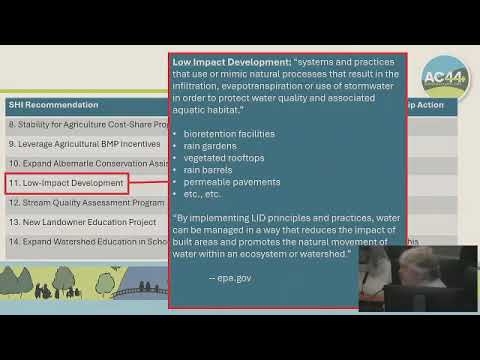
The chapter ties updated policies and objectives to a set of proposed actions focused on low-impact development (LID), biodiversity demonstration projects, and protection of public and groundwater supplies. Clark described how the Stream Health Initiative produced 14 recommendations after a phased public process, and said staff tried to reflect those recommendations in the draft actions. He also reviewed the county's prior biodiversity work and the Natural Heritage Committee's 2018 Biodiversity Action Plan, which prioritized habitat connectivity, buffers and management on county lands.
Commissioners asked staff to clarify the chapter's scope and to provide metrics and resource estimates. Commissioner Claiborne asked whether the chapter focuses only on streams and not larger rivers; Clark said staff did not intend to limit the scale and would clarify language to include larger river resources and noted that parks and recreation questions about river activation belong in that chapter. Commissioner Moore asked how actions that staff label "already underway," such as a riparian buffer ordinance, will be represented in the chapter; staff said they will explicitly call out ongoing initiatives.
Several commissioners pushed staff to identify measurable indicators and responsibilities. Commissioners asked for: - explicit, trackable measures for LID incentives and requirements (for example, counts/areas of rain gardens, green roofs, pervious paving or constructed best management practices); - better GIS data on impervious cover and riparian buffer gaps; and - a clearer statement of which actions will require new staffing or funding and which can rely on existing programs or partner activity.
Clark and county engineers noted existing reporting by the stormwater conservation district and the county that track constructed practices and stormwater treated, and offered to provide those annual reports to commissioners. County engineer Frank Paul and soil/water conservation district staff agreed more systematic recordkeeping and mapping of practices would help quantify progress.
Commissioners also questioned how the chapter accounts for climate-driven change and longer-term resilience. Clark said the Natural Heritage Committee and the Action Plan adopted a landscape-scale approach (cores and corridors) that helps biodiversity adapt to shifting ranges, and that some measures such as controlled burning, wildlife corridors and connectivity are aimed at improving resilience. Members discussed controversial adaptation concepts such as assisted migration for plants and the need to incorporate adaptability into long-range planning.
Members and several staff discussed cross-references with other plan chapters and ordinances. Commissioners noted that the county's solar ordinance and the buffer ordinance contain performance standards related to biodiversity and riparian protections and suggested clearer cross-references in the draft chapter. Commissioner Murray emphasized the need to account for reservoir buffers and protections for drinking water impoundments; staff confirmed the county code contains a 200-foot buffer beyond the floodplain for drinking water impoundments and said they would more clearly reflect that protection in the chapter narrative.
Public questions raised during the meeting and in follow-up comments focused on biosolids, agricultural practices, and PFAS contamination; some speakers asked for the plan to explicitly address biosolids monitoring. Staff said they would follow up and consider whether to add a recommended action to investigate a local monitoring program for biosolids applications, noting that such programs require staff resources to implement and enforce. Commissioners asked staff to add items describing resource and staffing needs so the Board of Supervisors can prioritize actions in future budget cycles.
The commission did not take formal action on the draft chapter at the Dec. 17 meeting; staff said the next formal round of review will be in January and February, and that the public can review draft chapters and submit comments on the project website: engage.albemarle.org/ac44. Staff also said they will return with clarifications on scope (rivers vs. streams), citations to ongoing programs (buffer ordinance, stream health phase details), proposals for measurable indicators for LID actions, and a clearer breakdown of which proposed actions require new staff or funding.
Why it matters: The Environmental Stewardship chapter sets countywide priorities on surface- and groundwater protection, biodiversity, and green infrastructure. Commissioners pressed staff to move beyond aspirational language and to add measurable metrics, funding estimates and cross-references to existing ordinances and programs before the chapter advances to the Board of Supervisors. The chapter will influence priorities for conservation easements, stormwater investments and regulatory measures in both the rural and development areas of Albemarle County.
What's next: Staff will return with requested clarifications and data in January and February 2025; the public can comment online at engage.albemarle.org/ac44. Planning staff said they would provide commissioners with recent stormwater district annual reports and will consider adding a biosolids monitoring action for further study.