Get Full Government Meeting Transcripts, Videos, & Alerts Forever!
Get email alerts on the Affordable Housing topic
No spam. Unsubscribe anytime.
Pittsboro board backs amendment to Jack Clark rural housing element after renegotiation with Chatham Park
Summary
The Town of Pittsboro Planning Board voted to recommend approval of changes to the Jack Clark Rural Housing Element that alter affordable-housing triggers, reduce long-term affordability obligations and cut the town's potential financial liability tied to Chatham Park development.
The Town of Pittsboro Planning Board on Jan. 21 voted to recommend approval of the Jack Clark Rural Housing Element Amendment, a negotiated rewrite that changes how affordable housing obligations tied to the Chatham Park development are triggered, reduces some long-term affordability restrictions and lowers the town's estimated financial exposure.
Jonathan Franklin, town manager for the Town of Pittsboro, presented the amendment and said the rewrite responds to federal and state legal requirements and to major changes in system development fees tied to a merger with Tri River. "The initial issue was that some of the original language in the original element, was not compliant with some federal and state laws," Franklin said. He told the board the rewrite also responded after the system development fee (SDF) rose from $5,000 to $15,500, which substantially increased the town's potential reimbursement liability.
The amendment moves the affordable-housing trigger from platting events to issuance of certificates of occupancy (COs). Franklin said that change delays when developers must satisfy affordable-housing obligations until units are built and COs are issued, and that is intended to allow affordable units to be "sprinkled throughout" a development rather than built all at once and clustered.
The amendment also adjusts affordability tiers and incentives. Franklin said roughly 60 percent of Chatham Park's targeted affordable units fall in the 81%–120% area median income (AMI) band, about 20 percent in the 61%–80% AMI band and 20 percent at 60% AMI or below. Under the revised element: - Units at 60% AMI and below retain a 30-year restriction and a $10,000 incentive or SDF reimbursement (as in the prior draft). - Units in the 61%–80% AMI band are subject to a $5,000 incentive with a 15-year restriction (Franklin said 15 years is the federal minimum for public money). - Units between 81% and 120% AMI will not receive a town incentive under the new language, and therefore will not be restricted for 30 years.
Franklin said the town's maximum contingent liability under earlier language rose from about $8 million to roughly $25 million when the SDF rose to $15,500; the amended element reduces the town's exposure to roughly $5 million, he said. He also described a negotiated agreement under which Chatham Park will design and construct a greenway needed to serve a Habitat for Humanity ownership project on Timber Loop; that contribution gives Chatham Park credit for 52 owner-occupied townhome units while saving the town money on greenway construction. Franklin said the greenway contribution represents about $650,000 in savings and the town will not pay SDF reimbursements on those 52 units, about $260,000, for a combined estimated saving of $910,000.
Franklin described timing and payment mechanics: when a unit receives a CO, the developer will bill the town; Tri River installs the meter and the CO is issued, and the town will have up to 365 days from invoice receipt to pay the reimbursement. Franklin said that process and the way projects are scoped should give the town "runway" of roughly two to three years from pre-scoping to payment, allowing time to ensure funds are available.
Board members asked several clarifying questions. A board member identified as "Tom" asked whether the board had considered shifting more units from the 81%–120% band into the 61%–80% band; Franklin said negotiation had considered that but the current compromise reflected lengthy bargaining. Franklin and other board members discussed homeowner-occupied units and said it is difficult to produce owner-occupied affordable units at the lowest income band; Franklin said the town will continue to press developers and builders to produce more owner-occupied units below 80% AMI.
Franklin said the amendment also contains a requirement to demonstrate the impact of public funding in project settlement statements; he said Chatham Park will likely document donated land on settlement statements to show subsidy and help projects pencil financially. Franklin said the amendment reflects about 15 to 18 months of work and multiple versions of the element.
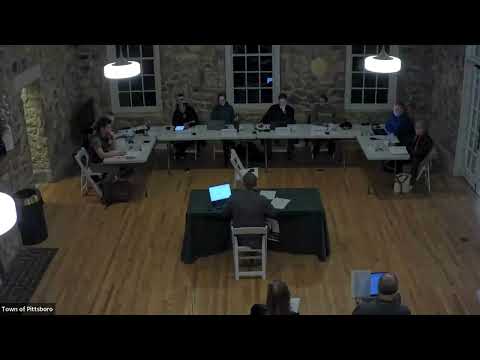
After discussion, Board member Adeline moved and Board member Charity seconded a motion to recommend approval of the amendment. "All in favor indicate by saying aye," the chair said; the board voted by voice and the motion "passes unanimously," the chair declared.
Votes at a glance: the board approved the recommendation to adopt the Jack Clark Rural Housing Element Amendment (motion by Adeline; second by Charity; outcome: recommended for approval, voice vote).