Get Full Government Meeting Transcripts, Videos, & Alerts Forever!
Get email alerts on the Housing Production Plan topic
No spam. Unsubscribe anytime.
Revere councilors hear debate, delay vote on five‑year housing production plan amid misinformation campaign
Summary
City staff presented a five‑year housing production plan intended to help Revere meet state Chapter 40B targets; councilors and residents raised questions about tools in the plan and an anonymous flyer that circulated in neighborhoods. The Committee of the Whole tabled the plan to a future meeting and placed the second agenda item on file.
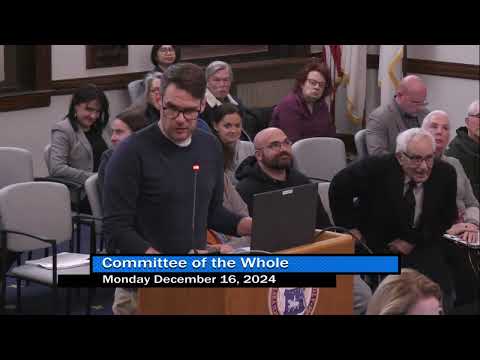
Revere City planning staff presented a five‑year housing production plan on Dec. 16, describing it as a voluntary “roadmap” to increase deed‑restricted affordable housing and to help the city avoid developer appeals under Chapter 40B. Councilors and residents praised elements of the plan — such as down‑payment assistance and reuse of municipal lots — but several councilors said they wanted more time to review proposals including right‑of‑first‑refusal options, changes to lot‑size rules, and allowing two‑ and three‑family units by right. The Committee of the Whole tabled the plan to its next meeting.
The plan, staff said, was developed over roughly 18 months by a 12‑person working group, included two public meetings and an online survey of nearly 300 Revere residents, and lays out a toolkit of zoning and programmatic options to pursue over five years. "This plan is not time sensitive. It's not anything where our hair is on fire, and we need to approve this tonight," Tom Skorowski, a city planner who presented the plan, told the committee. Skorowski said adoption would show the state Revere is making a "good faith effort" to meet the 10% deed‑restricted target tied to Chapter 40B; he said Revere's current deed‑restricted share is about 7% and projected to drop to roughly 5–5.5% if the city continues at its current pace.
Why it matters: If a municipality falls short of the state's 10% deed‑restricted benchmark, developers can seek relief through the Chapter 40B comprehensive‑permit process, which can allow projects that do not meet local zoning if they provide sufficient affordable units. Skorowski said certifying a housing production plan can provide a “safe harbor” against certain 40B proceedings in year one and, if certified each year, in years two through five.
Discussion highlights: Councilors and residents repeatedly raised concerns after anonymous flyers circulated in several neighborhoods claiming the plan would "dismantle" zoning, force property takings, or impose immediate tax surcharges. Skorowski disputed those claims, saying the plan does not repeal the zoning ordinance, does not force property owners to sell, and would not create a property tax surcharge without a future council vote and a citizen referendum. "Approving this plan just gives us the tool kit that we can then use at our discretion," Skorowski said.
Councilors asked for clearer language and more detail before any final vote. Several said they supported specific items — reuse of underused municipal land, down‑payment and mortgage assistance, and permitting accessory dwelling units — but wanted to slow the process on more controversial tools such as optional rights of first refusal for property owners, and any broad changes to lot sizes or by‑right allowances for multi‑family units. Councilor McKenna said she worried about neighborhoods with limited street capacity; Councilor Kelly cited examples where similar right‑of‑first‑refusal proposals provoked pushback in other cities; Councilor Zambuto said he was not persuaded a 40B threat was imminent but that the package was too large to accept in one vote.
Public comment: Multiple residents and housing advocates urged the council to adopt the plan or proceed quickly with its tools to preserve workforce housing. A speaker identifying herself as vice chair of the Revere Affordable Housing Trust Fund described two‑ and three‑family homes as essential to keeping workers and younger residents in the city and said, "Housing is a human right." Resident speakers gave personal accounts of being priced out or struggling to afford housing in Revere and supported the plan's tools.
Actions and next steps: Committee chair Cogliandro said the housing production plan would be tabled to the next Committee of the Whole meeting for further review and clarifications. The committee also moved to place the other agenda communication (relative to housing development incentive zones) on file for follow‑up; no final votes on specific zoning changes or program adoptions were taken.
Councilors and staff indicated follow‑up work will include more outreach to neighborhoods, clearer descriptions of how optional tools (for example, right‑of‑first‑refusal or any tax‑surcharge measures) would be implemented, and a more granular review of zoning adjustments before any ordinance changes are proposed.
Ending: The subcommittee paused action to allow time for additional council review and public engagement; the housing production plan will return to committee with clarifications before any formal council vote or referral to the full council.