Get Full Government Meeting Transcripts, Videos, & Alerts Forever!
Get email alerts on the Solar Energy Ordinance topic
No spam. Unsubscribe anytime.
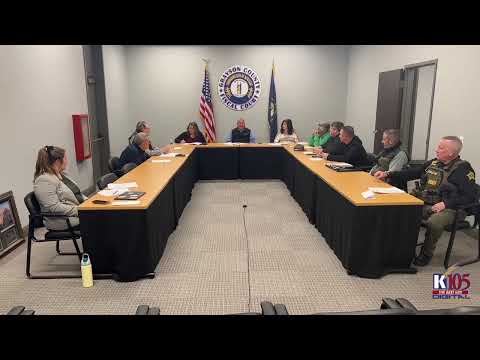
Grayson County fiscal court approves first reading of solar-energy ordinance with 2,000-foot setback
Summary
The Grayson County Fiscal Court approved first reading of an ordinance that would require licensure and siting rules for intermediate and large-scale solar energy systems, including a 2,000-foot setback and a 15-foot evergreen buffer; members said the setback could be amended on second reading.
The Grayson County Fiscal Court on an unspecified date approved the first reading of an ordinance that would set licensure and siting requirements for intermediate and large-scale solar energy systems in the county.
The ordinance, presented by county staff, would apply to intermediate and large-scale solar facilities and would not apply to small systems under 2,500 square feet, integrated systems or rooftop systems. It requires a setback of at least 2,000 feet from any property line, right-of-way or roadway, a perimeter fence with screening and an evergreen buffer set back 15 feet from property, the presenter said.
Erin, a county staff member, summarized the proposal: "This is the first reading of an ordinance establishing licensure requirements for solar energy systems in Grayson County. This ordinance is identical in nature to Christian Counties and is adapted from a model ordinance that suggested by Keiko. In summary, it addresses the following. It sets rules, regulations, and licensure requirements for the siding, construction, installation, enlargement, operation, maintenance, transfer, and decompositioning of intermediate and large scale solar energy systems. It does not apply to small veil, small scale systems which are less than 2,500 square feet or integrated systems or rooftop systems." Erin added detail about setbacks and buffers in the same explanation.
Court members asked whether the state has any specific setback requirement; staff said they would research state rules. Court members also asked whether the setback could be changed after the first reading; county staff said the measure could be amended on second reading, and the fiscal court approved the ordinance’s first reading so that potential changes could be considered on second reading.
Ben moved to approve the ordinance on first reading; Darren seconded the motion. The court voted to approve the first reading; no opposition was recorded in the minutes. The measure will return for a second reading, at which point the court may consider amendments to setbacks or other provisions.