Get Full Government Meeting Transcripts, Videos, & Alerts Forever!
Get email alerts on the Boat Parking Enforcement topic
No spam. Unsubscribe anytime.
Prince George's County Council holds boat-parking bill for one week after residents press for removals
Summary
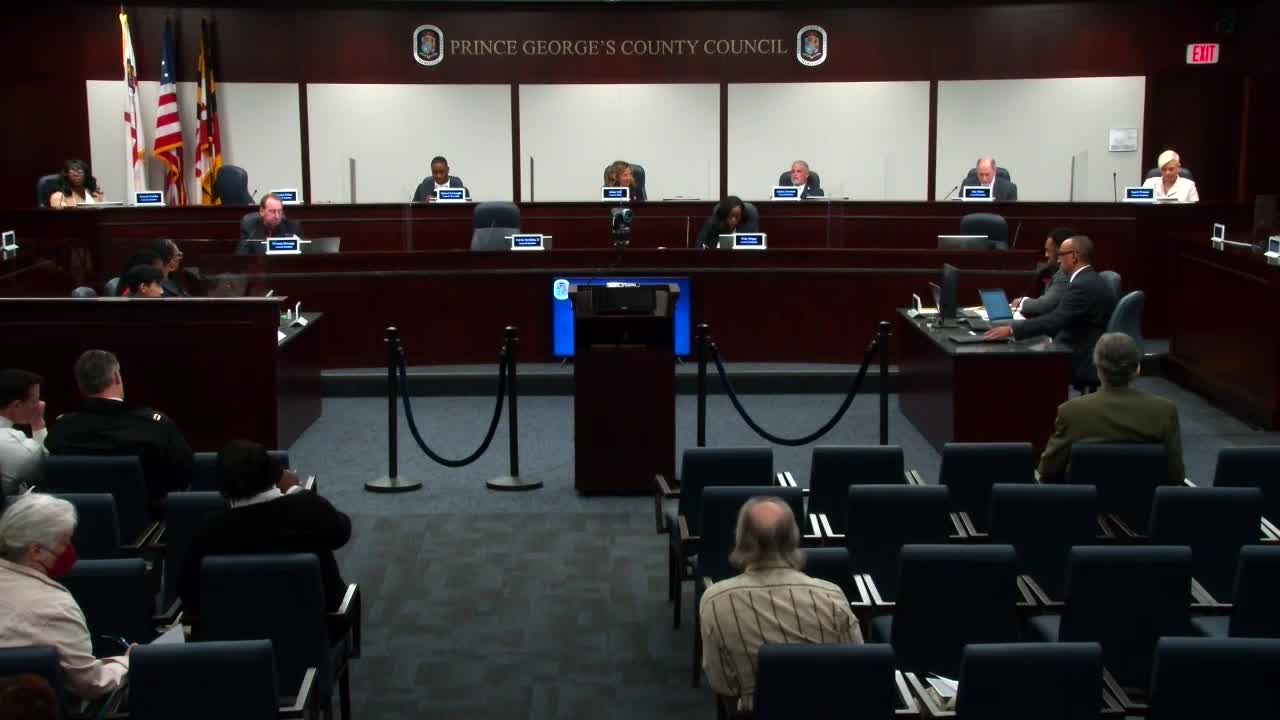
The Committee of the Whole on Feb. 4 voted 8-0 to hold CB-2-20-25, a bill that would ban parking of privately owned watercraft on county roads, after residents described long‑term abandoned vessels and administration officials warned of towing and disposal costs and unintended consequences.
Prince George's County Council Committee of the Whole voted 8-0 Tuesday to hold proposed CB-2-20-25 for one week as members and county staff work through enforcement and disposal questions raised by residents and agencies.
The measure, sponsored by Councilmember Eric Olson, would prohibit parking personally owned watercraft on county streets, roads, highways and rights of way; establish fines of $250 for a first offense and $500 for a second; and allow for towing and impoundment of repeat offenders. Olson said the ordinance responds to safety, traffic and neighborhood quality complaints about boats left on public streets.
Councilmember Olson said boats parked on public streets "obstruct visibility for drivers and pedestrians, increasing the risk of accidents," and that emergency and service vehicles can be delayed when large watercraft block lanes. "Boats are designed for use on water and should be stored at designated marinas, docks, or private storage facilities," he said.
Why it matters: residents from multiple neighborhoods described the same problem—large, sometimes deteriorated boats left on streets for months or years that create blind spots, reduce neighborhood appearance and, they said, pose safety risks for schoolchildren and drivers. County agencies cautioned that removing abandoned boats raises different logistical and financial challenges than routine vehicle towing, and staff asked for time to work with the sponsor on technical fixes.
What the bill would do and administration concerns
As drafted in proposed draft 2, CB-2-20-25 would (1) bar parking of personally or corporately owned watercraft on county public streets and rights of way, (2) impose a $250 first-offense fine and $500 subsequent-offense fine, and (3) authorize impoundment for repeated violations. Joel Peebles, a legislative officer who assisted in drafting the bill, described small text changes in draft 2 intended to align the new language with existing county code.
The County Executive's Office, represented by Akindra Skinner, opposed the draft as written and asked the council to hold the bill for a week so staff could work with the sponsor. "We totally understand where the bill sponsor is trying to go... but we're hoping that either through a committee today, or offline, if we can hold it for a week for further discussion," Skinner said.
Samara Gomez, deputy director for the county Revenue Authority, told the council that, as drafted, enforcement could "unintentionally incentivize illegal dumping." Gomez outlined cost and operational concerns: she said proper disposal of an abandoned boat can cost an average of about $2,500 for a 25-square-foot vessel once fuel and hazardous materials are removed, while existing county contract payments for towing boats run as high as $900. She warned tow vendors often require cranes and space in their yards and may decline to accept boats because the salvage and resale pipeline that exists for cars does not apply to boats.
Gomez said additional problems include missing registration or hull identification numbers on abandoned boats, which complicates owner notification and the ability to collect fines. She also cited the risk that nominal fines could make dumping cheaper than legal removal unless penalties and removal funding are coordinated.
Legal context and possible state remedies
Councilmember Fisher cited state law in the Natural Resources Article that defines an "abandoned vessel" and sets criminal penalties and liability for removal costs. She read portions of Natural Resources Article §8-721(a), noting that a vessel on public property more than 30 days may be treated as abandoned and that state law allows fines and liability for removal costs. Fisher suggested the council explore partnerships with the Maryland Department of Natural Resources (DNR) and regional grant programs to cover removal costs.
Several council members urged distinguishing between two common situations: (1) privately owned, registered boats parked temporarily by homeowners who lack storage and (2) derelict, abandoned boats dumped in neighborhoods. Councilmember Genoga argued the county should treat abandoned vessels more like environmental violations with heavier fines for dumping, while other members urged practical solutions such as making unregistered or unidentifiable vessels automatically eligible for removal.
Residents' testimony
Multiple residents from the Kingswood neighborhood and other communities testified about a specific large boat that they said has been parked at a prominent intersection since January 2024 and has caused multiple accidents, traffic blind spots and declined neighborhood appearance. Victoria Reynolds, who identified herself as a Kingswood resident, told the council the vessel "is junk" and urged passage of the ordinance so the boat can be removed.
Lorraine Taylor and William Anthony Taylor described repeated 3-1-1 complaints and neighborhood walks with the sponsor. Sheila Sloan, speaking for the Kingswood Civic Association, said more than 30 neighbors joined a walk with Olson's staff and that attempts to secure removal through existing channels "have not worked." Connie Boddy said the boat's owner appears periodically, has paid parking fines, and the boat has remained on the street despite enforcement attempts.
Other residents described related problems—unlicensed food trucks and derelict vehicles near abandoned boats—and said the presence of those vehicles interferes with snow removal, street sweeping and pedestrian safety.
Action, vote and next steps
Councilmember Olson moved to hold CB-2-20-25 for one week to allow the sponsor, agencies and stakeholders to work on technical and operational changes; the motion was seconded and the Committee of the Whole voted 8-0 to approve the hold. Chair Ivy called for agencies to examine the specific neighborhood cases and to offer potential approaches for towing, storage and funding.
The council plans to revisit the bill in one week; committee members and staff said they expect to negotiate amendments addressing enforcement language, fee structure and disposal logistics. No penalties or permanent code changes were adopted at Tuesday's meeting.
Ending
Residents urged prompt action to remove vessels they say have been blighting neighborhoods and creating safety hazards; county staff asked for time to resolve practical barriers to removal and to consider funding or partnerships with state programs that remove abandoned vessels. The council's one-week hold sets a short timeline for that work before the measure returns for further committee action.