Get Full Government Meeting Transcripts, Videos, & Alerts Forever!
Get email alerts on the Land Use topic
No spam. Unsubscribe anytime.
Council reopens debate on salvage-yard licensing, members press details on concrete requirement and transfers
Summary
Rosenberg City Council reopened discussion of transfer rules for nonconforming salvage-yard and motor-vehicle storage licenses at its Jan. 28 workshop, focusing on a city requirement that areas used to store vehicles be surfaced with concrete or asphalt and on how licenses can be transferred to new operators.
Rosenberg City Council members spent more than an hour discussing transfer rules for nonconforming salvage-yard and motor-vehicle storage licenses and whether to form a committee to revisit Chapter 16 Article 5 requirements, including a city requirement that vehicle-storage areas be surfaced with concrete or asphalt.
Staff told council the current ordinance allows a nonconforming license to be transferred to a new operator only if the site is brought into compliance with several items within 365 days of the transfer, including the city's fencing requirement and the city’s concrete or asphalt surface-material requirement. The ordinance continues to exempt nonconforming yards from minimum acreage and certain distance requirements. City staff said the item returned to the workshop after prior committee discussion and public comments raised questions about transfers and how businesses had been operating under older licenses.
Business owners and tow operators described a pattern that developed after the city tightened rules in 2008 and again in 2021. Several speakers said some newer operators had been working under the permits of preexisting license holders rather than holding a city operator license themselves. “They were operating as an operator under a licensee,” one speaker said, describing the earlier practice; staff and council said the 2021 amendments required the operator of the yard to hold the license.
Speakers representing storage-lot operators and towing services urged council to consider the economic impact of requiring repaving and other infrastructure costs. One operator said a sub-base and 4-inch asphalt cap for a small lot could cost around $30 per square foot and “$75,000” for a modest pavement project; another described having poured concrete slabs only where vehicles are stored and said the ordinance had been understood to require paving only for the area used to store vehicles.
Councilmembers and staff discussed environmental and drainage rationales presented during the prior committee review. One speaker and committee members said the concrete/asphalt requirement was intended to capture and contain oil, fuel and other vehicle fluids rather than allowing them to seep into ground and groundwater; others questioned whether concrete always improved environmental outcomes and whether detention or capture systems were the relevant remedy. City engineering staff told council that adding gravel, crushed concrete or compacted rock is considered impervious for detention calculations; if raw land is paved, detention requirements may apply.
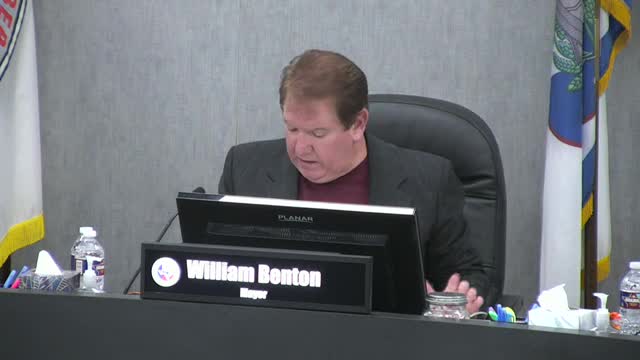
Council debate over process: Mayor Benton and several councilmembers discussed whether to form another ad hoc committee. Councilmember Richard and several others said they had already spent significant time on the ordinance with staff and the previous council; others preferred to proceed with discussion at the workshop that evening. After some back-and-forth, council chose to continue the conversation that night rather than definitively form a new committee; council members clarified that staff seeks direction on the transfer requirement for nonconforming licenses and on whether to form a review committee.
What was not decided: Council did not vote to change the concrete/asphalt transfer requirement at the workshop. Staff asked for direction; council members expressed a range of views, including protecting investments made by operators who previously complied and concerns about fairness to new entrants. Several members asked staff to provide clearer written guidance about what parts of an existing lot must be paved (staff and the mayor clarified the current interpretation: owners must pave only the impervious areas where vehicles are stored, not entire lots not used for storage).
Why it matters: The issue affects operators of towing and vehicle-storage lots, environmental safeguards, and who may serve on the city’s towing rotation. Any ordinance change could require capital work (paving, detention/ drainage) for businesses and affect how nonconforming licenses may be transferred in the future.