Get Full Government Meeting Transcripts, Videos, & Alerts Forever!
Get email alerts on the Cannabis Retail topic
No spam. Unsubscribe anytime.
Planning commission revokes expired cannabis authorization at 500 Laguna, clearing way for new applicants
Summary
The commission voted unanimously to revoke a long-expired cannabis retail conditional use authorization for 500 Laguna Street, saying the authorization had lapsed and blocked other potential equity applicants within the 600-foot radius.
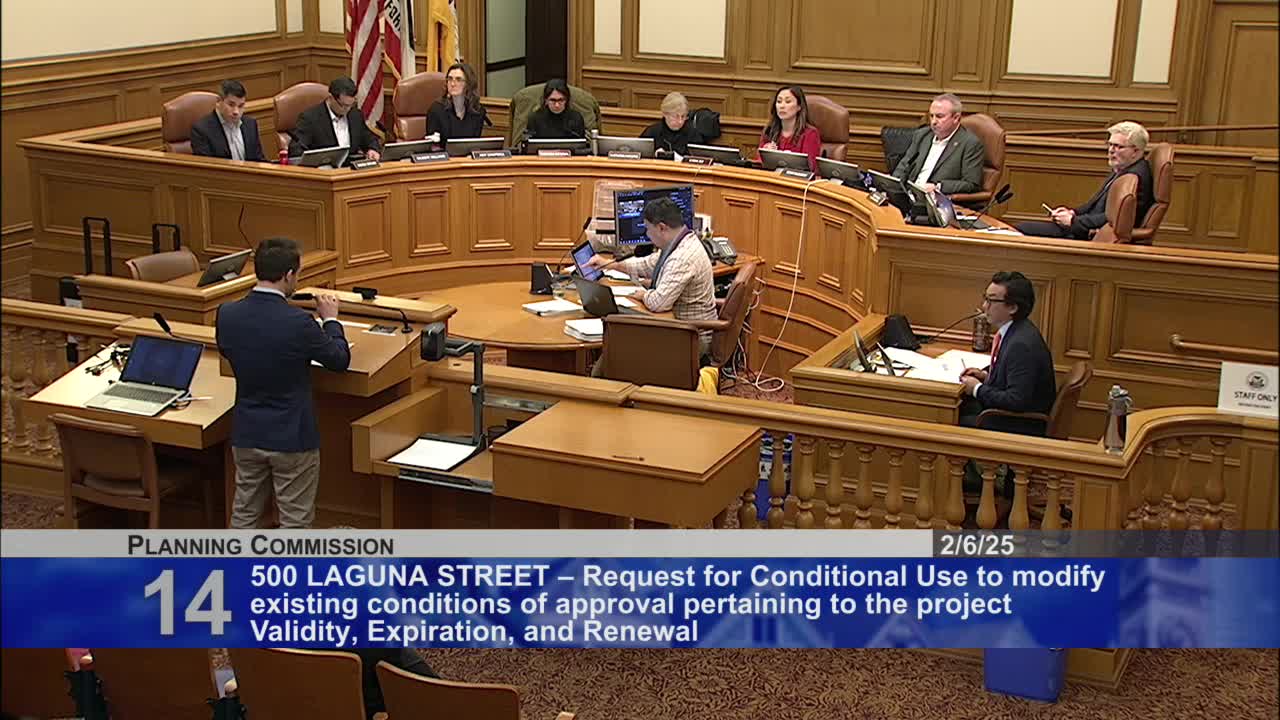
The San Francisco Planning Commission voted 7-0 on Feb. 6 to revoke a cannabis retail conditional use authorization for 500 Laguna Street that had been granted in 2020 but expired after multiple delays.
Planning staff told commissioners the motion before the panel was to either grant a new two-year extension of Conditional Use Authorization number 2019015062 (originally granted 01/23/2020) or revoke it. The property owner requested a two-year extension of the 2020 authorization, which had been valid through Jan. 23, 2023 and temporarily extended to Jan. 23, 2024 under zoning administrator guidance related to the COVID-19 emergency. The owner asked the commission to extend the authorization to Jan. 23, 2026.
Matthew Chandler, Planning Department staff, said the department recommended revocation because the authorization period had ended, there was no active lease with the originally approved business, and letters on file—14 to date—requested revocation and cited community concerns about site neglect and lack of engagement. Chandler also told commissioners that the standing authorization effectively served as a 600-foot buffer that blocked other cannabis retail applicants in the area from moving forward.
Kaushik (Kaushik) Datani, trustee for the property owner, told the commission that the prior tenant, Chris Callaway, had failed to complete tenant improvements and had canceled permits, leaving the property vacant. Datani said the landlord completed improvements after the tenant left and that revoking the authorization would allow new, approved applicants to lease the space. Callaway, who addressed the commission during public comment, said he had invested in the project but was never able to open because of permit delays and disputes, and urged the commission to revoke the authorization so the storefront could be put to general retail use.
After public comment, commissioners moved to revoke the previously granted authorization. The motion was made by Commissioner Imperial and carried unanimously, 7-0.
Planning staff said the revocation should allow other equity and Office of Cannabis applicants to proceed in the neighborhood. The decision is final at the Commission level but may be appealed through the city's standard administrative processes.
"To date, the department has received 14 letters requesting that the commission revoke the conditional use authorization," Chandler said during the staff presentation, summarizing written community input.