Get Full Government Meeting Transcripts, Videos, & Alerts Forever!
Get email alerts on the Neighborhood Commercial District topic
No spam. Unsubscribe anytime.
Planning Commission approves Leland Avenue neighborhood commercial district after community-backed revisions
Summary
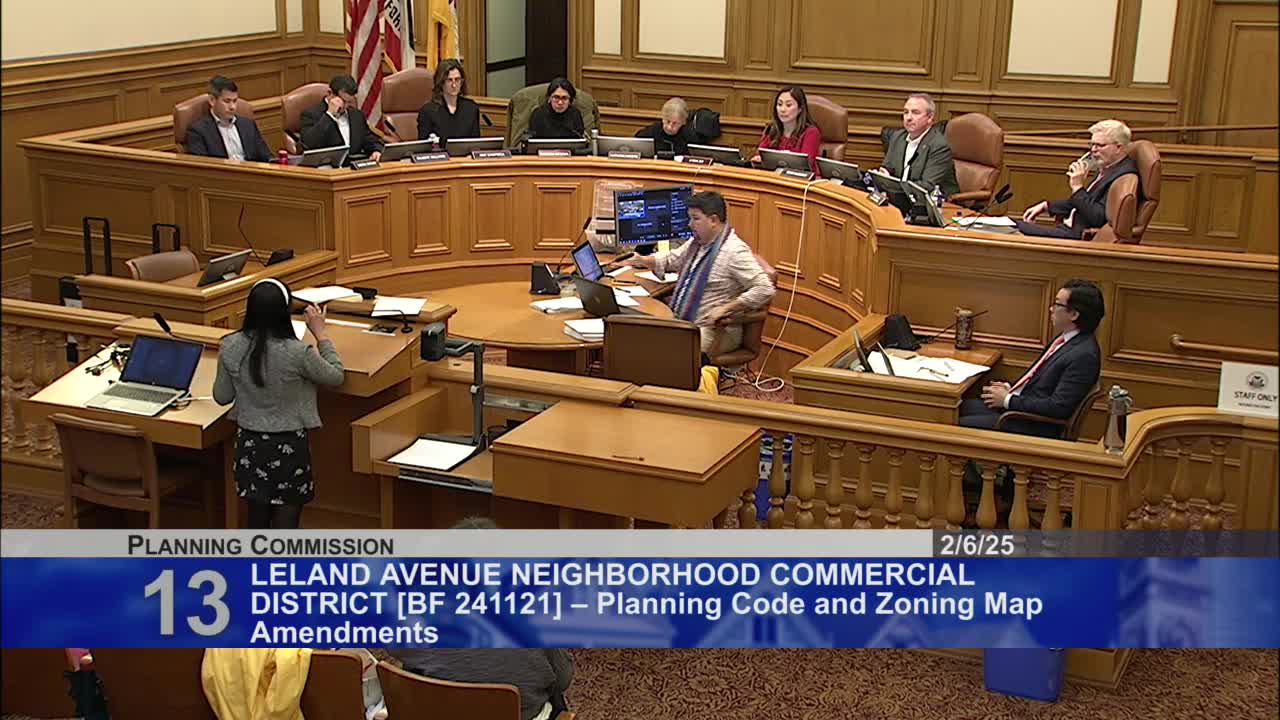
The San Francisco Planning Commission voted 5-2 on Feb. 6 to recommend approval of a new Leland Avenue Neighborhood Commercial District (NCD) zoning designation largely as written by community members, rejecting the Planning Department's recommendation to principally permit ground-floor childcare and residential care facilities.
The San Francisco Planning Commission voted 5-2 Thursday to recommend approval of an ordinance establishing the Leland Avenue Neighborhood Commercial District, a three-block corridor in Visitation Valley proposed by Supervisor Walton's office and local merchants.
The neighborhood-driven plan would rezone the stretch of Leland Avenue between Bayshore Boulevard and Coral Street from C-2 to a new NCD. The change would keep many existing NC-2 controls but conditionally permit some institutional ground-floor uses and prohibit fringe financial services; the Planning Department had asked the commission to principally permit childcare and residential care facilities on the ground floor, a modification the community opposed.
Supporters told the commission the NCD reflects more than a year of community work and is intended to strengthen the corridor's small-business vitality, pedestrian character and ties to the Visitation Valley Greenway and Bayshore Caltrain station. Veronica Flores, planning department staff, described the department's suggested change as intended to ease permitting for childcare and residential care facilities citywide and to reduce barriers for providers. Natalie G., representing Supervisor Walton's office, said merchants and residents deliberately chose conditional use review for ground-floor institutional uses because the three-block corridor is small and community members want to have a say about what occupies storefronts.
Commissioners who supported the ordinance cited the extensive local outreach and the corridor's small scale. Commissioner Brown said Leland Avenue is "a very attractive and appealing and vibrant place" and that the community's long engagement should be respected. Commissioner Imperial said the ground-floor uses would still be allowed above the first floor and that the designation's goal was corridor activation. Commissioners Campbell and McGarry voted against the motion, citing concerns about childcare and residential care facility access and the corridor's relatively high vacancy rates.
The motion to approve the ordinance without the Planning Department's recommended modification passed 5-2 (Campbell, McGarry opposed). Commissioners who voted yes were Williams, Braun, Imperial, Moore and Sewell.
The commission's action is a recommendation; the proposal still requires the Board of Supervisors and follow-up administrative steps before the new zoning takes effect. Planning staff noted in the hearing that if childcare and residential care providers face undue barriers after the ordinance is adopted, staff could prioritize those permits under existing business-processing programs.
"This has been very much a true community-driven process," Natalie G. told commissioners. "After over a year of hard work and collaboration, it is important that we ensure there's alignment between the planning department and the community rather than creating any sense of disconnect."