Get Full Government Meeting Transcripts, Videos, & Alerts Forever!
Get email alerts on the Nuclear Waste Storage topic
No spam. Unsubscribe anytime.
Wyoming committee fails to advance bill to allow reactor manufacturers to store spent fuel onsite
Summary
CHEYENNE — The Minerals, Business & Economic Development Committee considered Senate File 186, a measure to authorize advanced nuclear reactor manufacturers in Wyoming to store spent nuclear fuel produced as part of on‑site manufacturing and refurbishment, but the committee voted to reject advancing the bill after extended questions and public testimony.
CHEYENNE — The Minerals, Business & Economic Development Committee considered Senate File 186, a measure to authorize advanced nuclear reactor manufacturers in Wyoming to store spent nuclear fuel produced as part of on-site manufacturing and refurbishment, but the committee voted to reject advancing the bill after extended questions and public testimony.
Senator Ed Cooper (Senate District 20), who introduced the measure in committee, said the proposal is aimed at allowing firms that manufacture small, transportable reactors to store the small quantities of spent fuel they would generate. "They're ready to go for all practical purposes to locate here in Wyoming, to manufacture microreactors on-site," Cooper said, adding that the reactors under discussion are about "a megawatt to 1 and a half megawatts" and that a manufacturing campus could be "something over between half a million and and 3 quarter million square feet of of facility." He described a business model in which units are manufactured, deployed and later returned to the manufacturer to be refurbished and refueled.
The bill, as discussed, would require the manufacturer to submit its NRC (Nuclear Regulatory Commission) license application and supporting materials to the Wyoming Department of Environmental Quality (DEQ) for verification, and would limit on-site storage to spent fuel produced by that manufacturer's reactors. Representative Lloyd Larson (House District 54), who worked on the bill language, summarized the statutory framework and the proposed amendment to clarify that the DEQ may require "additional financial assurance for decommissioning of the installation to the extent that it is not demonstrated by the financial assurance required by the United States Nuclear Regulatory Commission."
Why it matters: supporters say the measure clears a path for a new advanced-manufacturing industry and associated jobs in Wyoming while preserving NRC regulatory primacy for safety and licensing; opponents say the state needs more study and stronger guarantees before authorizing long-term storage in Wyoming.
Key points of discussion
- Ownership and liability: multiple lawmakers pressed on who would own the spent fuel while it is stored in Wyoming. Representative Lolli asked whether clarifying ownership in statute would help assign liability; Representative Larson pointed to the bill language that states any spent fuel "remains the property of the advanced nuclear reactor manufacturer." Senator Cooper reiterated that the bill ties storage permission to fuel produced by a Wyoming manufacturer, not imported material.
- Financial assurance and insolvency risk: Representative Larson and Representative JT Larson introduced and pressed for an amendment making explicit that the DEQ may require additional financial assurance for decommissioning beyond NRC requirements if the department deems it necessary. Director Todd Parfit of DEQ explained that the NRC already requires periodic reviews of financial assurance and that amounts vary widely depending on license type; he cited nuclear-plant financial assurance ranges "anywhere from $280,000,000 to $612,000,000" for full nuclear plants and said materials licenses can require anywhere from a few thousand dollars to over a million dollars in assurance, depending on circumstances. The committee adopted the Larson amendment clarifying DEQ's ability to require supplementary assurance.
- Scale of waste and technology: supporters and technical witnesses emphasized that the manufacturing model under discussion generates far less spent fuel than a commercial gigawatt reactor. Radiant (the company discussed in testimony) described a one-megawatt, transportable high-temperature gas reactor and said the company plans to manufacture and refuel units at its factory, shipping units to customers and later returning them for refurbishment. "We're setting up our factory to be able to manufacture up to 50 of these a year," Radiant's director of operations Matt Wilson said; he added that even at that pace the total material would be small compared with a standard large reactor. Several technical witnesses explained the fuel form (TRISO) and said it behaves differently from older fuel types.
- Regulatory primacy and permitting: DEQ and other witnesses repeatedly pointed to NRC jurisdiction for licensing and safety standards. DEQ Director Parfit said the bill would not give DEQ permitting authority to override NRC safety licensing; DEQ's role, as drafted, is to verify that the required information has been submitted and to apply state industrial-siting rules if the project meets state siting thresholds (he cited a current industrial-siting threshold figure of roughly $280,000,000 for jurisdictional review). Parfit also noted that the amendment removing prescriptive references to "dry cask" storage was intended to avoid foreclosing future storage technologies.
- Public safety, transport and permanence concerns: citizens and conservation groups raised questions about transportation risks, chain of custody, and the absence of any definite federal permanent repository. Maria Catherman (Converse County) urged deferral to the interim for broader public engagement and study, saying, "I think this industry might be a good fit for Wyoming. But ... this is not something we want to rush." The Wyoming Outdoor Council's John Burrows also urged more study and public input. Several committee members echoed those concerns and asked for more evidence on long-term liability and technical details.
Testimony and evidence presented
- DEQ (Todd Parfit, Director) and Brandy O'Brien (Land Quality Division) described existing Wyoming statute architecture (articles 15, 20, 21) and explained DEQ's intended verification role and the industrial siting overlap if a facility is jurisdictional.
- Rob Krieger (Wyoming Energy Authority) and Sean Schaub (WEA nuclear industry coordinator, online) described state interest in attracting advanced nuclear manufacturing and clarified that Radiant's model differs from larger reactor projects; Krieger said Radiant's product (about 1 MW) is much smaller than a megawatt-scale commercial reactor and that Radiant had explored multiple states.
- Radiant (Matt Wilson) answered questions about the company's timeline and business model: prototype testing at Idaho National Laboratory is scheduled for 2026, the company reported roughly $170 million in private funding to date, and commercial deployments were framed as likely toward the end of the decade if the demonstration, NRC licensing and financing succeed.
- Independent experts: Ronnie Franovich (former NRC inspector) testified in favor and said the NRC has an extensive regulatory history and that "used nuclear fuel storage is safe today." Other experts and commenters, including Ron Smith (engineer) and Maria Catherman, urged deferral and more study; Smith recommended restricting any storage to fuel produced by reactors built in Wyoming.
Committee action and outcome
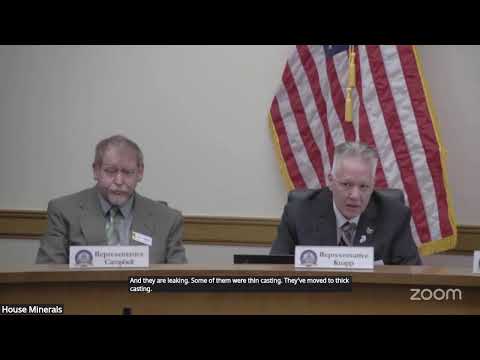
The committee considered and adopted an amendment (moved by Representative JT Larson, seconded by Representative Lolli) clarifying that the DEQ may require additional financial assurance for decommissioning beyond NRC-required assurances. The full measure, however, failed to advance on a roll-call vote. The final tally on Senate File 186, as amended, was: 3 aye (Representative Larson, Representative Volley, Chairman Heiner), 5 no (Representatives Campbell, Knapp, Schmidt, Tarver, Weber) and 1 excused (Representative Riggins). The committee chair announced, "by your vote, we have failed to pass Senate file 186." The bill will not move forward from this committee at this time.
What remains unresolved
Lawmakers asked for clearer public outreach and more technical detail on bonding formulas tied to potential manufacturing volumes, on transportation risks if reactors are repeatedly moved to remote sites, and on the long-term path for permanent federal disposition of spent fuel. Multiple witnesses suggested an interim study or further hearings so the committee and the public could review prototype test results, NRC licensing pathways and financial-assurance models before deciding whether to change state law.
The committee hearing record includes technical exhibits, DEQ and industry testimony about licensing and financial-assurance practices, and public comments both supporting and opposing further action. The committee's rejection of the bill leaves the matter for potential future consideration after additional study and public engagement.