Get Full Government Meeting Transcripts, Videos, & Alerts Forever!
Get email alerts on the Data Centers Tax Incentives topic
No spam. Unsubscribe anytime.
Minnesota Senate Taxes Committee hears hours of testimony on converting data-center sales-tax refunds to upfront exemption
Summary
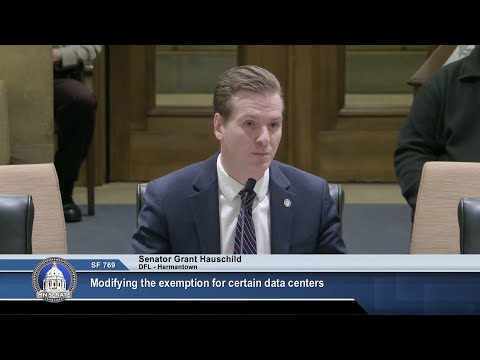
Senator Hauschild, sponsor of Senate File 769, told the Minnesota Senate Taxes Committee on Feb. 25 that the bill would make two principal changes: create a separate "large-scale" data-center category and convert the current refundable sales-and-use tax treatment into an upfront exemption for qualifying projects.
Senator Hauschild, sponsor of Senate File 769, told the Minnesota Senate Taxes Committee on Feb. 25 that the bill would make two principal changes: create a separate "large-scale" data-center category and convert the current refundable sales-and-use tax treatment into an upfront exemption for qualifying projects.
The measure would add a large-scale definition (projects of at least 25,000 square feet and roughly $250 million in investment), require DEED certification of qualified large-scale projects, direct DEED to notify the Department of Revenue within 30 days, and require the department to notify applicants within 10 days. The bill would also extend the program's sunset for these large-scale projects to 2050 and includes prevailing-wage and green-building requirements, plus a repayment provision if a project later fails to qualify.
Why it matters: converting the sales-tax refund process into a point-of-sale exemption would remove much of the public'facing accounting that currently exists when companies pay taxes up front and then apply for refunds. Supporters argued the change would reduce administrative burdens, align Minnesota with neighboring states and increase the state's competitiveness for large data-center investments; opponents said it would reduce transparency and could significantly increase costs to the state general fund.
Supporters' case: testimony favoring SF 769 focused on jobs, local economic activity and competitiveness. Barbara Comstock of NetChoice said similar incentives in other states produced large capital investment and local tax revenues, and urged Minnesota to adopt the exemption rather than lose projects to neighbors. "We changed the program from a refund to an exemption, as is done already in Minnesota's manufacturing and sales use tax exemption," she said.
Trade unions and utilities also endorsed the bill. Andrew Campo, president of the Minnesota Pipe Trades Association, called the Rosemount site an example of how construction on data centers produces thousands of work hours and family-sustaining jobs; he said his union has 170 workers on that single site now. Joel Johnson of the IBEW said the projects create thousands of construction jobs and hundreds of permanent positions, and Zack Martin of Minnesota Power said large data-center investments can be attractive to Greater Minnesota because they require larger capital but comparatively modest long-term staffing.
Business groups pushed for simplification of administration. Gavin Hansen of the Minnesota Business Partnership told the committee that requiring an upfront refund application imposes delays and administrative burdens that make Minnesota less competitive. "Transitioning to an upfront exemption rather than a refund based process would bring Minnesota's tax policy in line with best practices," he said.
Opponents' case: environmental, labor and civic groups warned that an upfront exemption would reduce transparency and could cost the state many millions. Taryn Fitzinger of the Minnesota Association of Professional Employees testified that converting to an upfront exemption "prevents the public and the legislature's ability to accurately track the size of the program." Ivana Stark of Clean Water Action Minnesota and others flagged water consumption and chemical use at hyperscale facilities. "Giving billionaires more tax breaks when average Minnesotans are struggling to buy basic necessities isn't the answer," Stark said.
Several witnesses cited fiscal figures already in the record. Testimony and submitted materials indicated the current refundable exemption is estimated to cost about $230 million in the 2026-27 biennium and that Department of Revenue analysis shows a roughly $20 million fiscal impact in FY 2028 tied to a specific project in Rosemount. Attorneys and environmental groups warned the exemption has grown substantially since its inception and cautioned that an upfront exemption would make future growth harder to monitor.
Policy and technical clarifications: a Department of Revenue representative (Ms. Pollock) clarified that under current law qualifying data-center purchases are refundable: purchasers pay sales tax at point of sale and later apply to the department for a refund. SF 769 would leave the existing refund option in place for smaller or qualifying data centers but create a new large-scale category eligible for an upfront exemption. Ms. Pollock also reviewed the existing minimum criteria in statute for data-center refund eligibility: for new centers normally a minimum of 25,000 square feet and $30 million in investment within 48 months plus uninterruptible power or generator backup, fire-suppression systems and enhanced security; refurbished centers have similar but distinct investment and timing thresholds.
Committee actions and next steps: the committee adopted an author's A2 amendment to the bill at the start of the hearing. Senator Dibble offered an A4 amendment during the hearing that would have required additional pre-service disclosures and environmental, water and metals-sourcing certifications and triggered specific Environmental Quality Board review processes; Dibble withdrew the amendment after discussion and said he would seek further meetings with the bill sponsor. Chair Rest concluded the hearing by laying SF 769 over for possible inclusion in the omnibus tax bill; no final bill vote occurred.
Points of contention raised repeatedly in testimony: whether Minnesota should match neighboring states' permanent exemptions to remain competitive; the extent to which local communities actually receive long-term tax benefits; grid and transmission impacts and whether new high-voltage transmission or other infrastructure would be required; water usage and potential impacts on aquifers; and whether prevailing-wage and voluntary green-building conditions in the bill are sufficient. Several witnesses urged stricter, enforceable state-level standards in lieu of voluntary certifications.
The committee heard more than two dozen witnesses in a hearing that ran to the committee's scheduled end. Members asked department staff and testifiers for additional data on program usage thresholds in other states, detailed fiscal modeling, and the environmental and grid studies that would accompany large projects. Chair Rest noted the Tax Expenditure Budget and an ongoing review by the Legislative Budget Office and the Tax Expenditure Commission, and indicated the committee would take up related local sales-tax and vendor allowance matters in subsequent meetings.
The bill will move forward only if and when the committee or omnibus process includes it; the committee did not take a final passage vote on SF 769 at this hearing.