Get Full Government Meeting Transcripts, Videos, & Alerts Forever!
Get email alerts on the Land Use Wetlands topic
No spam. Unsubscribe anytime.
EAC recommends Type 2 classification for 4,000 sq. ft. Kennedy expansion amid wetland questions
Summary
The Bay North Environmental Advisory Committee recommended a Type 2 (negative declaration) classification for a 4,000-square-foot office expansion at the Kennedy site, noting wetlands on the parcel but concluding the proposed work would not affect them; members flagged ongoing uncertainty from new DEC wetland rules.
The Bay North Environmental Advisory Committee on Jan. 29 recommended that the 4,000-square-foot Kennedy expansion be classified as a Type 2 action, meaning the committee does not require a full environmental review at this time.
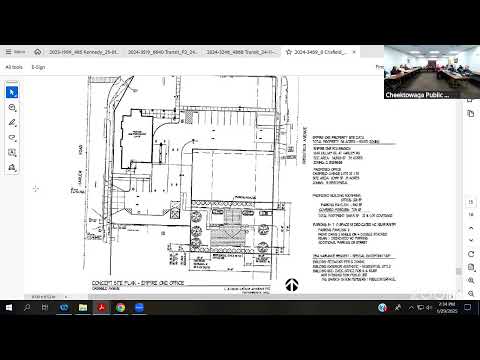
Committee members discussed mapped wetlands at the rear of the parcel and recent changes to New York State Department of Environmental Conservation (DEC) wetland rules that took effect this year. An EAC member said, “I believe this is a type 2 action given that it's a 4,000 square foot building,” and the committee voted to recommend the Type 2 determination.
Why it matters: the DEC recently issued new guidance that changes wetland thresholds and procedures; committee members said that, absent a jurisdictional determination from DEC or a formal filing with the agency, the town’s role is limited to making an environmental classification and conditioning site plan approvals where appropriate.
What the committee heard: town engineering reported that mapped wetlands “graze right along the rear of the parcel” but are not near the planned improvements. An applicant representative (identified in the meeting as the property owner) said the portion of the property that includes the mapped wetland would not be touched by the proposed work. Committee members noted the applicant controls most of the drainage obligations on the site and that the proposed stormwater control would cover roughly 3.02 acres, “over a third” of the area the town expected to be controlled.
Unresolved issues and precautions: speakers repeatedly pointed to uncertainty about how the DEC’s new procedures apply to projects filed before Jan. 1. The committee agreed the town itself should avoid taking liability and that responsibility for DEC filings and any final jurisdictional determinations lies with the property owner and applicant. Members said they could condition town approvals on the outcome of any DEC jurisdictional determination if needed.
The vote: the committee made and seconded a motion to recommend a Type 2 determination; the motion passed on a voice vote (ayes recorded). The committee noted it could revisit the matter if DEC issues further guidance or a jurisdictional determination that affects the site.
Next steps: the recommendation will be forwarded to the town board and planning staff; the applicant will proceed with the town’s review process but may need to file for a DEC jurisdictional determination and comply with any subsequent requirements.