Get Full Government Meeting Transcripts, Videos, & Alerts Forever!
Get email alerts on the Dbi Budget topic
No spam. Unsubscribe anytime.
Building Inspection Commission approves DBI budget submission, urges restoration of SRO/COP grant funding
Summary
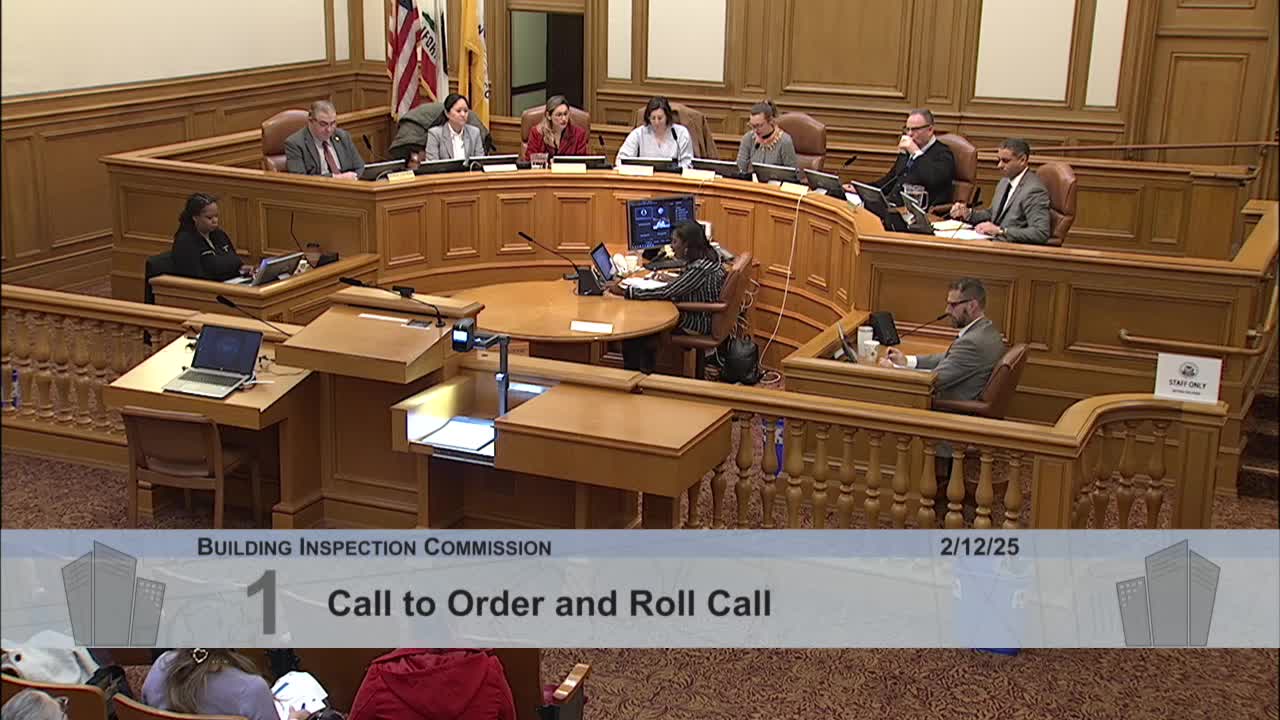
The San Francisco Building Inspection Commission voted unanimously on Feb. 12 to approve the Department of Building Inspection's proposed two-year budget submission to the mayor and Board of Supervisors, amending the submission to fully restore community grant funding that supports SRO and tenant outreach programs.
San Francisco — The San Francisco Building Inspection Commission voted unanimously on Feb. 12 to approve the Department of Building Inspection's proposed budget submission to the mayor and Board of Supervisors, adding an amendment directing that community grant funding for SRO- and outreach programs be fully restored.
The amendment followed a departmental presentation that outlined proposed staffing additions, technical and policy budget changes, and three options to fund a $1,128,000 cut to community grant programs that support SRO (single-room occupancy) tenants and tenant outreach programs.
Deputy Director Alex Koskinen, Deputy Director, Administration for the Department of Building Inspection, presented the two-year budget and walked commissioners through updated figures, a set of 11 proposed new positions and changes to fee policy. "These are non-discretionary items," Koskinen said of many technical adjustments that simply realign job classes and reflect current staffing assignments. He described 11 new policy positions the department is requesting, including a business analyst for a proposed GIS unit, an HR staffer to internalize previously outsourced DHR services, administrative analysts to manage a vulnerable concrete building program and records cleanup, product/project manager staff for a permit-tracking transition, additional permit technicians for virtual plan review, an administrative engineer to align plan-review management ranks, and a legal affairs manager to coordinate city attorney services.
Koskinen told the commission the department is proposing to revive a technology fee (estimated as roughly 2–3 percent of existing fees) to create a technology reserve; he said the department is planning for a system replacement that could cost tens of millions of dollars and estimated DBI's share at about $30 million under prior replacement assumptions. He also said the mayor's office has announced a citywide hiring freeze but had not provided final guidance to DBI on position submissions.
The presentation included three options to fill the $1,128,000 shortfall to the grant budget: 1) ask the mayor and Board of Supervisors to restore the general-fund support to the current-year level; 2) increase hotel license fees by an average of roughly 180 percent and apartment license fees by an average of about 7 percent (the department said hotels pay more per-license because there are far fewer hotels than apartment properties); or 3) increase all DBI fees by approximately 1.5 percent. Koskinen said staff recommended option 1 but outlined the other two options for the commission's consideration.
Public commenters urged the commission to restore grant funding and described tenant-facing outcomes from the community-based programs. "The program is extremely important to the community," said Lo Shu Bi, introduced as a client of housing counseling teams at the Chinatown Community Development Center, who described longstanding maintenance problems in an Excelsior District unit and credited the counseling program with helping her family document and press for repairs. Norma Soto, identified as a Tenderloin resident with assistance from the C.O.P. Tenderloin Housing Clinic, said the program helped resolve mold, rodent and ventilation issues in her unit. Charlie Goss, government affairs manager for the San Francisco Apartment Association, said the collaborative programs bring landlords and tenants together and reduce city enforcement costs.
Commissioners debated the options and funding tradeoffs, asking whether proposed new staff were built into the fee model (Koskinen said the positions' costs are reflected in the fee proposals) and whether DBI reserves could be used. Several commissioners said they were reluctant to deepen immediate fee increases for constituents and preferred pursuing general-fund restoration first, or a balanced option that minimized harm to tenants and small owners. Commissioner Michelle Williams said she favored option 3 (a modest across-the-board fee increase) as the most equitable if general-fund restoration was not possible.
The commission took three formal actions related to the budget: it approved DBI's budget submission with an amendment to fully fund the community grant program; it directed the commission president to send a letter to the mayor and Board of Supervisors urging hiring of the proposed DBI positions and presenting the three funding options for the grant shortfall; and it asked staff to include a recommended preference (restore general-fund support, with a modest fee increase as a fallback) in that letter. All motions passed unanimously by roll call vote.
The commission's approval does not itself change city appropriations. The letters and recommendations will be transmitted to the mayor's office and the Board of Supervisors, which hold authority over final budget and fee changes.
Voting and next steps
The motion to approve the budget submission with the community-grant funding amendment was made by President Alexander Toot and seconded by Commissioner Williams; the vote was 6–0. The commission then voted unanimously to send a letter to the mayor and Board of Supervisors outlining the department's staffing requests and the three funding options for the grant shortfall. Commissioners Alexander Toot and Newman were designated to draft the letter (with legal guidance on committee-communication rules), and the commission discussed identifying a preferred option in the letter while presenting alternatives for legislative consideration.
Why it matters
The grant programs at issue fund tenant outreach and code-enforcement assistance for single-room-occupancy and other vulnerable buildings in neighborhoods including Chinatown, the Tenderloin and the Mission. Commenters and staff said the programs both prevent code violations from escalating and reduce inspection or enforcement costs for the city. The department also emphasized that several proposed new positions are intended to improve permit issuance times and prepare DBI for a multi-department transition to a modern permit-tracking system.
What the record shows
- Proposed new positions: 11 roles (business analyst for GIS, HR staff, two administrative analyst/product manager roles, two permit technician II positions, additional GIS/permtech support, an administrative engineer position, and a legal affairs manager). (As presented by Alex Koskinen.) - Grant shortfall: $1,128,000 (figure presented by DBI staff). - Funding options presented: restore general fund support; raise hotel license fees (avg. ~180%) and apartment license fees (avg. ~7%); or raise all DBI fees by ~1.5%. - Technology reserve proposal: revive a technology fee (estimated 2–3% of fees) to begin building a reserve (staff discussed a $3 million-per-year collection as a placeholder and estimated DBI responsibility for a future system replacement in the tens of millions).
The commission's recommendations will be forwarded to the mayor and Board of Supervisors for consideration during budget hearings. The department and commissioners noted the mayor's hiring freeze remains an outstanding variable for final approval of new positions and for the mayor's office to act on any general-fund restoration.