Get Full Government Meeting Transcripts, Videos, & Alerts Forever!
Get email alerts on the Broadband Deployment topic
No spam. Unsubscribe anytime.
State broadband office says BEAD funding on track; providers report major builds
Summary
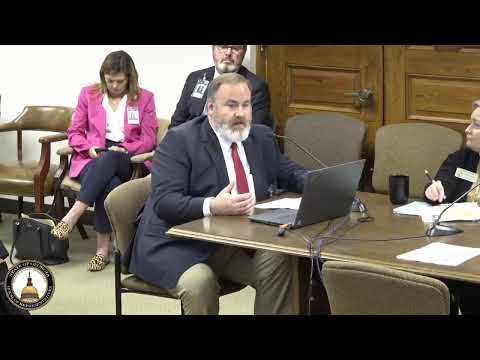
Jessica Simmons, broadband program lead at the Georgia Technology Authority (GTA), told the House Energy, Utilities & Telecommunications Committee during a committee briefing that Georgia has advanced its broadband mapping, state-funded grants and the federal Broadband Equity, Access and Deployment (BEAD) program and expects to move from scoring to negotiation and final federal approval this year.
Jessica Simmons, broadband program lead at the Georgia Technology Authority (GTA), told the House Energy, Utilities & Telecommunications Committee during a committee briefing that Georgia has advanced its broadband mapping, state-funded grants and the federal Broadband Equity, Access and Deployment (BEAD) program and expects to move from scoring to negotiation and final federal approval this year.
“The great news is seeing so many different colors all blended together,” Simmons said, describing the state’s interactive broadband availability map and the multiple funding streams “braided together” to expand service. She told the committee the state’s BEAD allocation is just over $1.3 billion and the state has access to just under $5 million for planning and operations.
The update included a timeline and several funding figures committee members requested: Gov. Kemp previously allocated about $414 million in state fiscal recovery funds for broadband infrastructure; about $254 million of that has been dispersed so far. The state also holds a $246 million Capital Projects Fund grant (for which U.S. Treasury holds the funds) and has drawn down roughly $20 million to date. Simmons said all projects funded with state fiscal recovery funds must be complete by the end of 2026.
Nut graf: The committee heard that Georgia has concentrated mapping and grant activity in recent years, and state and federal funding streams are being coordinated to reach tens of thousands of remaining unserved and underserved locations. Committee members and providers pressed for clarity on timing, technology preferences and the effect of possible federal changes on deadlines and environmental review.
BEAD status, mapping and timeline
Simmons said Georgia used the FCC’s national broadband availability map for BEAD eligibility and conducted a formal challenge process with providers. Based on that work, the state’s BEAD-eligible dataset includes 71,776 unserved locations and 93,298 underserved locations; she said roughly 65,000 locations are in scope for Georgia’s $1.3 billion BEAD allotment.
Simmons said round 1 of the state’s BEAD competitive grant closed in January and the office is now scoring applications and entering the negotiation phase. She said the state expects to submit its final proposal of selected awardees to the National Telecommunications and Information Administration (NTIA) this fall for federal approval. “Once we receive that approval, we can move forward with the award agreements,” she said.
Simmons also highlighted program design issues the state is managing, including an “extreme high cost per location threshold” that will limit how much the program will pay for locations that are very expensive to reach. She said those locations may be pushed to alternative technologies in later rounds so the program funds reach the maximum number of households. She warned that BEAD applicants accepted for awards will have up to four years to build to those locations under federal rules.
Potential federal changes and environmental reviews
Simmons told the committee there is ongoing discussion at the federal level about ways to speed deployment — for example, waivers or streamlining of permitting and the National Environmental Policy Act (NEPA) review process — but the state will await formal NTIA guidance before changing its plan. She said the state’s current BEAD approach favors fiber deployments in keeping with federal preferences to date, but noted that NTIA classifications of “reliable” and “alternative” technologies (licensed fixed wireless, coaxial hybrid fiber, unlicensed fixed wireless or satellite) could evolve.
Digital equity and other grants
Simmons confirmed the state received a $22.5 million State Digital Equity Capacity Grant under the Digital Equity Act, aimed at adoption, skills training and devices — a program distinct from BEAD’s infrastructure focus — and said the state is waiting on federal guidance to design that program.
Provider reports to the committee
A slate of providers and industry groups described their recent build activity and their participation in state and federal grant rounds.
Rhonda Chatham, executive director of the Georgia Telephone and Broadband Association (GTBA), said 22 member companies (and their subsidiaries) are community-based providers. “Roughly 80% of our members’ passings are fiber to the home,” she reported, and said the association’s members have grown their passings from roughly 92,000 locations in 2022 to about 361,000 today. Chatham noted a 2024 take rate of about 57% for locations passed and said buried fiber networks generally performed well during Hurricane Helene.
Elizabeth Reynolds, state director of legislative affairs for AT&T, described private capital investment by the company and community programs: “In the last 5 years alone, AT and T has invested nearly $14,900,000,000,” she said, and reported the company’s statewide presence and contributions to digital literacy and device distribution.
Jason Bragg, representing Georgia EMC, said 25 of the state’s 41 electric membership cooperatives (EMCs) now offer some form of broadband service, either through EMC-owned affiliates or partnerships. Bragg reported EMC projects collectively pass about 267,000 locations, serve about 80,000 subscribers, have built roughly 28,000 miles of fiber and have planned investments of about $1 billion for announced projects.
A Windstream representative described hundreds of thousands of rural customer connections and recent build activity, saying the company laid about 4,000 miles of fiber across more than 60 counties in the previous year and expects to complete a prioritized ARPA-funded round in 18 counties that will reach about 80,000 locations.
Hunter Hopkins of the Georgia Cable Association said the association’s five members (Comcast, Charter, Mediacom, Cox and Vibe Broadband) serve about 2.1 million broadband customers in 29 counties and listed awards won under federal programs (including ARDOF, ARPA and the Capital Projects Fund) that the companies are deploying.
What remained unsettled at the meeting
Committee members pressed about mapping, timing and federal risk. Simmons told the committee the state has drawn down some Capital Projects Fund dollars and does not currently expect that funding stream to be blocked, but she said the state is monitoring federal guidance and executive-branch actions closely. She estimated, with qualifications, that projects could complete by about 2030 under current timelines and federal rules, though some projects already scheduled should finish well before then.
Ending
Committee members thanked presenters and noted continued legislative oversight. The broadband office’s near-term next steps are scoring and negotiating round 1 BEAD awards, submitting the final proposal to NTIA, and continuing implementation of state-funded capital projects that must be completed under current deadlines.