Get Full Government Meeting Transcripts, Videos, & Alerts Forever!
Get email alerts on the Eminent Domain Energy topic
No spam. Unsubscribe anytime.
Committee debates bill adding limits to eminent domain for energy collection systems; amendment narrows thresholds
Summary
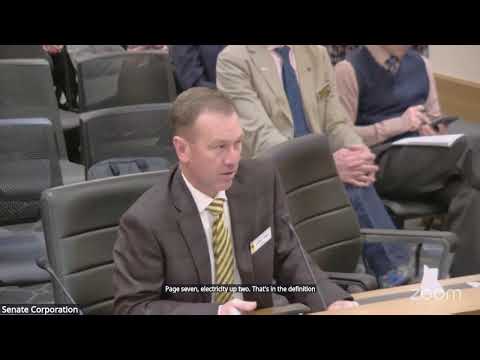
Senate File 181 would restrict use of eminent domain for energy collection systems unless project developers reach a high percentage of agreements with affected landowners or land mass. The Corporations Committee heard hours of testimony from industry, landowners and regulators and adopted an amendment lowering the agreement threshold.
Sen. Barry Crago introduced Senate File 181, a draft that would create specific statutory limits on the use of eminent domain for energy collection systems associated with commercial electricity facilities. “The big overview… is you have to have an 85% agreement with either 85% of the land mass or 85% of the land owners,” Crago said, describing a threshold the bill would require before a condemning party could bring a condemnation action.
Crago said the draft was intended as a compromise to protect landowner rights while preserving a path for projects to proceed when a substantial portion of affected landowners or land mass have agreed to terms. The bill would create a new chapter for energy collection systems, require petitioning parties to present executed land-use and compensation agreements to the court in condemnation proceedings, and include provisions to ensure improvements and certain on-site property values are included when calculating fair market value.
Witnesses were split. Jim McGagna of the Wyoming Stockgrowers Association described the draft as a product of years of negotiation and said it represented a middle ground between no eminent-domain authority and unconstrained condemnation. “This bill with a few changes now is basically what we developed in 2011 and 12 to move forward with,” he said.
Landowner and landowner-advocate testimony urged stronger protections. Karen Bud Fallon, an attorney who represents landowners, said the bill protects neighbors who do not want collector lines crossing their property while allowing landowners who accept wind or solar projects to proceed. She pointed to Wyoming case law on condemnation compensation and said compensation must account for industrialization of agricultural land, including prior payments for other easements and improvements.
Industry witnesses and a representative of American Clean Power opposed the draft as written or urged changes; Cindy Delancey said the net effect of the current draft would be to make eminent domain effectively unavailable and risk projects and the local economic benefits they produce. Delancey asked committee members to consider refining rather than broadly restricting the current condemnation statutes and to clarify the bill’s interplay with public utilities and existing permitting processes.
A mix of county commissioners, commissioners’ counsel and other local officials spoke on notice and local-government roles, reclamation and definitions. Jenny Staben of the Industrial Siting Division said the ISD provides notice to local governments when applications are pending before the Industrial Siting Council and requires permittees to report significant changes.
Committee action: Senator Bonar moved an amendment to reduce the 85% thresholds to 80% and to change the minimum required number of landowners from three to five. Senator Crago signaled he supported the amendment as a compromise. The committee adopted that amendment by voice vote (counts not specified in the transcript) and agreed to carry further work on the draft into a follow-up session Monday morning.
Why it matters: The bill attempts to balance landowner property rights and the practical need to build collector lines and interconnection facilities for renewable energy projects. Testimony highlighted competing policy goals—protecting individual landowners from unwanted industrialization of property while enabling projects that many landowners rely on for supplemental income—and noted potential conflicts with existing public-utility authority, ISD permitting, and existing compensation standards from Wyoming case law.