Get Full Government Meeting Transcripts, Videos, & Alerts Forever!
Get email alerts on the Dgo Fees Isf Transparency topic
No spam. Unsubscribe anytime.
Legislative fiscal staff demonstrate COBie and fee‑prep tools, urge clearer ISF and fee transparency for Department of Government Operations
Summary
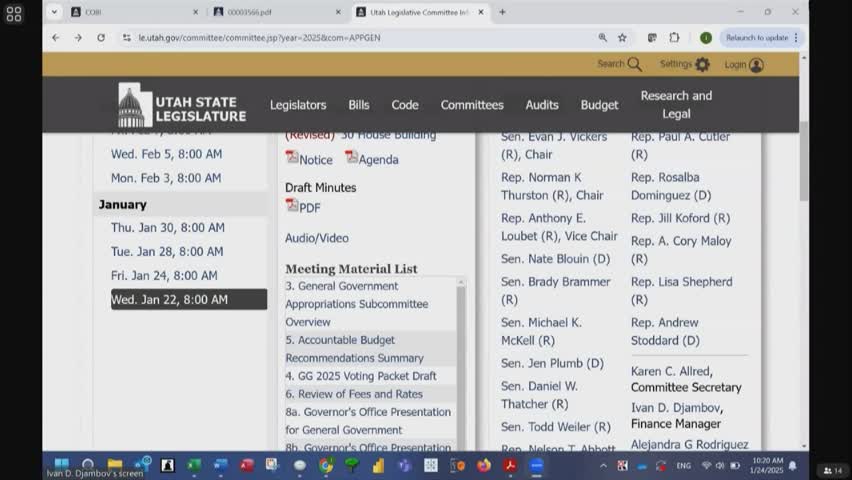
Legislative Fiscal Analyst Yvonne Jambo walked the committee through the appropriations subcommittee webpage and the state’s companion‑budget information (COBie) tools, highlighting gaps in fee‑level transparency, the role of internal service funds (ISFs) and ongoing work to collect program‑level cost details.
Yvonne Jambo of the Legislative Fiscal Analyst’s Office reviewed resources available to the Joint Appropriations Subcommittee to evaluate the Department of Government Operations’ budget, fees and internal service funds.
Jambo demonstrated how the committee’s web page links to COBie (the companion budget information system) and explained the department’s structure: the department combines former Administrative Services, Human Resource Management and other functions; it holds both appropriated line items and internal service funds that bill other government entities for services.
“Most of those operations are funded through dedicated credits because it’s an ISF,” Jambo said, showing a COBie view that groups ISF fee lines and that lists the department’s requested fee changes and federal grants. She highlighted a new internal “fee‑prep” program used by agencies to report program‑level fee costs and methodologies; the tool is a stopgap to improve statutory fee transparency while analysts pursue longer‑term improvements.
Jambo pointed out that ISFs are not controlled in the same way as general‑fund appropriations because statutes allow them to spend the dedicated credits they collect; for that reason, committees control growth of ISFs primarily by authorizing FTEs, capital outlay and the ISF rates themselves. She noted the combined ISF activity in the department is substantial — on the order of hundreds of millions of dollars — and that some ISF accounts and fee groups still do not include complete program‑cost detail.
Committee members asked whether the fee‑prep detail is audited; Jambo said the data come from agencies and is subject to the LFA’s review but is not an audited financial statement and that the LFA would work with agencies to improve consistency and completeness ahead of budget decisions.
Next steps: the LFA said it will continue to refine COBie/fee‑prep reporting, work with agencies to complete program‑level cost information for fees and provide the committee with more granular fee and ISF summaries for appropriation review.