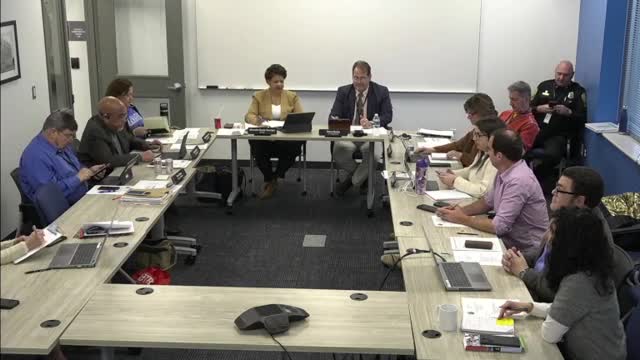
Manassas council hears 2045 comprehensive plan and mobility master plan updates; traffic calming, Route 28 corridor and housing highlighted
Loading...
Summary
Manassas City Council members spent the work session reviewing an update to the city’s 2045 Comprehensive Plan and a new Mobility Master Plan that staff said will guide land‑use, transportation and parks decisions for the next two decades.
Manassas City Council members spent the work session reviewing an update to the city’s 2045 Comprehensive Plan and a new Mobility Master Plan that staff said will guide land‑use, transportation and parks decisions for the next two decades.
The update, presented by planning staff, notes that “the current plan was adopted in February of 2020, and the Code of Virginia requires that a review of the plan take place every five years,” and frames the work as a set of recommendations to guide future zoning and design work, not as immediate regulatory changes, the presentation said.
City planners outlined several high‑priority proposals: creating a Route 28 “tourist corridor” overlay to allow higher aesthetic and streetscape standards on that gateway; focusing redevelopment and “missing‑middle” housing options in the Mathis Avenue character area (the shopping center site was noted as a redevelopment opportunity); recommending the Marstellar site as a candidate location for Fire Station 1 and for park, recreation and cultural planning; and stronger environmental measures such as increased tree canopy.
Why it matters: the comprehensive plan sets the city’s long‑range policy framework and signals issues that will require follow‑up zoning, design guidance and community outreach. Several council members emphasized the advisory nature of the plan and asked staff to make clear that adoption of plan language would not itself change property rules or trigger construction without further steps.
Transportation and safety priorities dominated the mobility update. Staff described the Mobility Master Plan as a technical, multimodal document covering roadways, transit, bicycle and pedestrian facilities and traffic safety. The presentation noted about 150,000 average daily trips in Manassas, with roughly 10% of trips under one mile and about 25% under two miles — indicators staff said point to opportunities for shifting short trips to walking, bicycling or micromobility.
Planners reported that the updated traffic model shows 50 of 62 signalized intersections operating at a level of service C or better under current conditions, 12 at D or worse, and one intersection — Prince William Parkway at Liberia Avenue — considered in failing condition in the model. Staff also presented 2045 scenarios both with and without the proposed Route 28 bypass and said uncertainty about the bypass affects future traffic projections and downtown options.
“Traffic calming is a growing need,” the mobility presentation said. Staff described a prioritized list of sidewalk‑gap projects and about 20 high‑priority pedestrian projects; a set of bicycle facility recommendations ranging from on‑street buffered lanes to separated multiuse paths; and the addition of a long “nature route” and a historic loop intended to link parks and heritage sites. Staff also described a “toolbox” of traffic‑calming treatments — lane narrowing and striping changes, added parking lanes, crosswalk refuges and bump‑outs, temporary bollards for pilots and, where appropriate, mini‑roundabouts — and said a Main Street pilot project using short‑term, low‑cost treatments is scheduled for spring implementation after community outreach.
Council members asked for clarifications about the proposed tourist corridor overlay on Route 28 — whether it would be an overlay zoning district created by council and implemented later through planning‑commission and zoning processes. Staff confirmed the corridor would begin as a comprehensive‑plan recommendation and, if adopted in the plan, would be studied by the Planning Commission and implemented by zoning and design tools that would require property‑owner notification and further public hearings.
On parks and open space, planners said the adopted level‑of‑service standard (an aspirational 8 acres per 1,000 residents) leaves the city with an estimated deficit of about 37 acres under current conditions; using population projections the deficit could grow to about 112 acres by 2045. Staff said a follow‑up technical update and land‑inventory review will examine how much of the city’s open space is privately held (HOA land) and how much is available for public acquisition or programming.
Other items discussed during the presentation and council Q&A included: clarifying the definition and map of federal HUBZone designations for economic development incentives; a brief summary of shared TIP grant work (a regional grant application for a railroad‑corridor trail with Prince William County and Manassas Park, which was not funded in the latest round); and regular public‑comment and adoption steps. Staff said planning‑commission review will continue and council should expect a final adoption packet in February for formal consideration, accompanied by every public comment received and staff responses.
Council and staff emphasized next steps and community engagement. Staff reiterated the plan’s role as a policy guide and noted that specific regulatory changes (zoning, architectural review, traffic‑calming policy updates and capital projects) would require additional analysis, outreach and separate approvals. The presentation identified updating the city’s traffic‑calming policy — described as “radically out of date” — and aligning it to neighborhood planning and pilots as a near‑term work item.
Votes at a glance / administrative directions from the meeting: - Council agreed (by consensus/nodding) to ask the city attorney and staff to begin drafting the documentation and process needed to pursue a council pay adjustment authorized by the General Assembly (subject to public hearing and the ordinance adoption process; effective date referenced as July 1, 2027). No formal roll‑call vote was recorded in the transcript. - Council accepted staff’s recommendation to consolidate the Georgetown South parking permit sale period into a single annual sale in January, and staff said permit holders with a currently active additional permit would carry forward through the consolidated timeline (the treasurer’s office will prepare the required resolution and notifications). The transcript records discussion about correcting an erroneous date on the draft form (the carry‑forward expiration should be January 2026, not 2025). - Council selected representatives for an upcoming joint interjurisdictional committee with Prince William County and Manassas Park: the mayor and an appointed council member are to represent Manassas and an alternate was named; staff said they will notify county staff so the committee can schedule meetings. (The transcript records agreement that Mark would serve and Sonia would be the alternate; council asked staff to confirm and convey the appointments.)
What the record does and does not show: the materials presented were technical recommendations and do not enact zoning or capital‑project changes. Council members repeatedly asked staff to make clear in outreach materials that adoption of comprehensive‑plan language is a policy signal and that subsequent steps — zoning changes, design guidelines, property‑owner notices and separate approvals — would be required to implement regulatory changes. Council asked staff to reach out broadly for community input, to include neighborhoods without HOAs, and to hold another neighborhood/HOA meeting in the spring focused on traffic‑calming outreach.
Staff resources noted: the mobility fact sheet and full plan materials are posted online (Manassas 2045 Comprehensive Plan and Mobility Master Plan pages); staff said every public comment will be logged and answered in the final adoption packet. A planning‑commission review schedule and a proposed February council adoption timeline were reiterated.
The council asked staff to return with more detail on the HUBZone map and tax‑credit mechanics; to provide specific neighborhood‑level data for sidewalk and park searches; and to prepare community‑facing materials that emphasize the exploratory nature of corridor and gateway design work. The scene closed with staff confirming the plan remains on track for planning‑commission completion and a council adoption packet in February 2025.
Ending: Staff said community input is welcome and will be cataloged in the final adoption materials; council members asked that staff keep neighborhoods and small stakeholder groups informed as plan elements move toward formal review and any zoning or capital steps that follow.