Get Full Government Meeting Transcripts, Videos, & Alerts Forever!
Get email alerts on the Interconnection Queue Reform topic
No spam. Unsubscribe anytime.
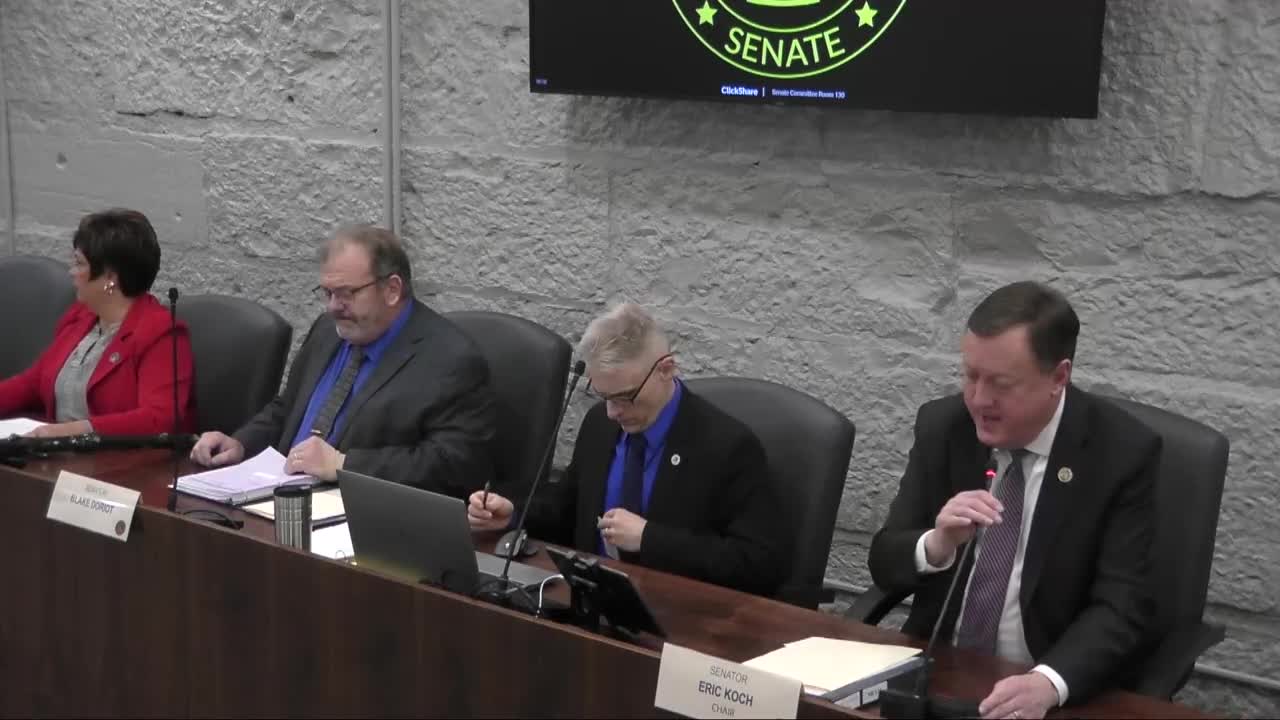
Senate Utilities Committee urges federal action to unclog interconnection queues
Summary
The Senate Utilities Committee unanimously passed House Concurrent Resolution 3 urging federal regulators and Indiana’s congressional delegation to adopt changes that speed interconnection approvals at regional transmission organizations and reduce speculative projects in queue backlogs.
The Senate Utilities Committee voted 10-0 to pass House Concurrent Resolution 3, a nonbinding measure asking federal regulators and Indiana’s congressional delegation to address lengthy interconnection queues at regional transmission organizations such as MISO and PJM.
Representative Soliday, who introduced the resolution, told the committee the measure aims to “unjam the queue” and push federal partners to consider a priority system that would speed approval for projects needed to meet firm loads. Soliday said the current first-come, first-served approach can lock valuable transmission capacity for years and cited examples in which developers hold positions in the queue without completing projects.
The resolution asks the Federal Energy Regulatory Commission and Indiana’s congressional delegation to consider reforms that would shorten processing time and prioritize essential projects. Soliday said, “we have what’s called the duck bill where demand is starting to, approach exceeding supply,” and that a priority system could help address near-term capacity needs.
Luke Wilson of the Indiana Utility Regulatory Commission expanded on the scale of the problem, citing a Department of Energy–funded study that examined queues through 2023. Wilson told the committee there were nearly 11,600 projects representing about 15,100 gigawatts of generator capacity seeking interconnection, and that 95% of those projects were solar, wind or storage. He summarized the study’s finding that roughly 20% of projects reached commercial operation, and that average queue times have risen from about two years in 2008 to nearly five years in 2023.
Representatives of load-serving and generation organizations supported the resolution. Carolyn Wright of the Indiana Municipal Power Agency said delays “cause uncertainty and uncertainty causes an increase in cost.” David Ober of the Indiana Chamber and Matt Long of the Indiana Energy Association also urged committee support, saying reform would help ensure reliable and timely dispatchable power.
Not all testimony was unqualified. Kerwin Olsen of the Citizens Action Coalition said the RTOs were created to foster competitive marketplaces that deliver least-cost energy to consumers and warned against reforms that could allow incumbent utilities to “skip their place in line” and disadvantage cleaner or cheaper resources.
The committee received the resolution, heard public and stakeholder testimony, and then moved to a roll call. The committee recording shows the following votes: Senator Hundley — Aye; Senator Spencer — Aye; Senator Ford — Aye; Senator Buchanan — Aye; Senator Dorio — Aye; Senator Byrne — Aye; Senator Deere — Aye; Senator Lysing — Aye; Senator Donato — Aye; Chair Cook — Aye. Senator Zay was recorded as excused. The motion to pass the resolution carried 10-0.
Because the resolution is nonbinding, it does not change state law; it transmits a statement of support for specific federal and regional process reforms to FERC and Indiana’s congressional delegation.