Get Full Government Meeting Transcripts, Videos, & Alerts Forever!
Get email alerts on the Department Budget topic
No spam. Unsubscribe anytime.
Rec and Park forwards 2025–27 budget proposal that includes golf management RFQ, paid parking and program fees
Summary
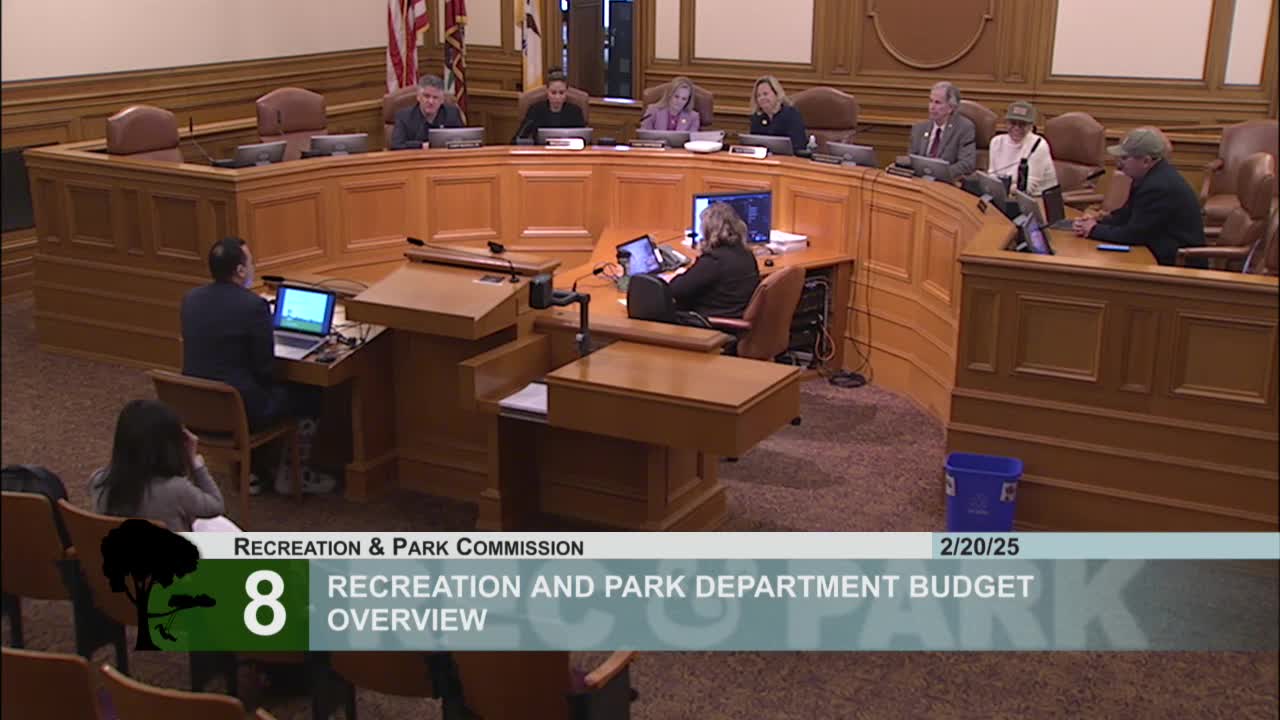
The Recreation and Park Department presented a two‑year budget proposal Feb. 20 that includes revenue and efficiency measures — an RFQ for golf-course operations, a court reservation fee, a scholarships/cost‑recovery model and paid parking in Golden Gate Park — and the commission voted to forward the package to the mayor's office.
The Recreation and Park Department presented its proposed operating budget for fiscal years 2025–26 and 2026–27 at the commission meeting Feb. 20 and the commission approved forwarding the proposal to the mayor's office for consideration.
Antonio Guerra, the department's director of administration and finance, said the department faces a structural deficit that the proposal tries to address through a mix of new revenue, revised cost-recovery policies and efficiencies. Year‑one shortfalls were framed as manageable but the department projects a roughly $15 million gap in year two if new revenue is not realized. Guerra told the commission the department sought to balance protecting core services while identifying possible revenue streams and cost savings.
Key initiatives in the proposal include: a codified scholarships program and a tiered cost‑recovery model for recreation programs (estimated additional revenue of about $600,000 in year one and $1.2 million in year two); a $5-per-hour court reservation fee for tennis/pickleball courts (estimated $1 million); an RFQ/RFP process for golf course operations intended to reduce the department's general‑fund subsidy for golf (the budget assumes a roughly $6 million reduction in subsidy in year two); and a plan for paid parking in Golden Gate Park (the budget assumes net parking revenue of roughly $1.2 million in year one and $9.2 million in year two if implemented).
Guerra also identified potential capital and maintenance requests: roughly $15 million in year one and $15.5 million in year two to address playgrounds, courts, forestry and field replacement, plus investments in fleet replacement and security cameras. The department emphasized that interdepartmental service costs and personnel pay growth have outpaced its general‑fund support in recent years, creating structural pressure.
Public commenters and stakeholder representatives focused heavily on golf and skate facilities. Richard Harris, president of the San Francisco Public Golf Alliance, urged caution about a rapid elimination of the golf subsidy and asked that any reduction be conditional on new management agreements. Several other golfers and golf‑course advocates — including presidents or representatives from municipal golf clubs — spoke in favor of long‑term operator agreements rather than abrupt subsidy cuts and stressed the need to pair any fee increases with course improvements.
Skate advocates and community groups urged the commission and department to invest in and audit skate facilities and small‑wheeled access, saying supply drives demand and that more skate facilities could increase city recreation participation and revenue. Community members also asked the department to consider activating underused park assets such as pools, stadiums and fields to generate revenue and programmatic opportunities.
Guerra and General Manager Phil Ginsburg warned commissioners that if additional revenue is not realized, the department could face service reductions in year two, including reduced park‑cleaning frequency, elimination of restroom monitors and gardener apprenticeships, reduced recreation facility hours (from 60 to 40 hours per week in some locations), rotating pool closures, reduced park ranger coverage and a growing deferred‑maintenance backlog.
The commission voted to forward the budget proposal pursuant to the agenda language; commissioners expressed concern about impacts to staff and services but supported sending the package to the mayor's office for further review and negotiation. The budget will proceed through the city's budget calendar, including the controller's joint report in March, mayoral submission in June and subsequent oversight by the Board of Supervisors.