Get Full Government Meeting Transcripts, Videos, & Alerts Forever!
Get email alerts on the Library Millage topic
No spam. Unsubscribe anytime.
Public hearing on library millage draws more than 100 speakers; council fails to act
Summary
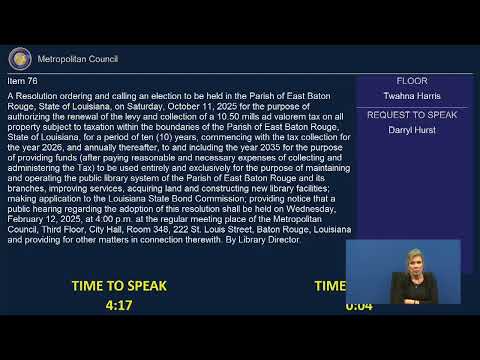
The East Baton Rouge Parish Library asked the Metro Council to put a renewed 10.5‑mill, 10‑year dedicated property tax on the Oct. 11, 2025 ballot, but after more than 100 public speakers and late‑night procedural votes the council did not take final action.
The East Baton Rouge Parish Library asked the Metro Council on Feb. 12 to place a renewal of a dedicated 10.5‑mill property tax before voters on Oct. 11, 2025, but the council did not complete action after hours of public comment and competing motions.
Library Executive Director Katrina Stokes told the council that the renewal “is not a new tax. This is the sole revenue for your award‑winning East Baton Rouge Parish Library system,” and said the lower 10.5 rate — down from 11.1 mills approved in prior renewals — would allow the system to operate 15 branches seven days a week and continue pay‑as‑you‑go capital maintenance.
The presentation and public hearing drew more than 100 people — parents, students, retired professors, library trustees and social‑service providers — who described the library as a community anchor for literacy, job training and emergency shelter. “The library is absolutely essential in this community,” said Annette Pelletier, a retired attorney and grandmother. High‑school junior Matthew Ash told the council the system helps reduce crime by keeping youth engaged: “The library is necessary.”
Opponents and some council members framed the request against broader fiscal constraints facing the parish. Council members and speakers raised questions about the parish’s overall budget, priorities for public safety and how dedicated millages limit the council’s flexibility during revenue shortfalls. Councilman Kenny Hudson summarized that the issue required “a real earnest discussion” and urged a collaborative process among taxing authorities.
Board president Candace Timble and other library officials said the system has followed a long‑term capital plan, avoided debt and used dedicated tax revenue for operations and facility improvements. Supporters also noted that nearly 70% of parish residents hold library cards and that the system provides hotspots, career‑center services and programs for children and seniors.
During the late‑evening session the council considered-and-voted on substitute procedural motions. A motion to defer consideration to March 12 failed on the council's voting machines, and a substitute motion to delete the item also failed. At one point the library’s executive director offered to voluntarily delete the library item while negotiating a compromise with the administration; she said the library would “work to reach a workable compromise to move the library’s 10‑year dedicated property tax forward this fall” and that, if negotiations fail, the library would resubmit the original resolution.
Because the council did not adopt the resolution tonight, attorneys warned that the statutory and advertising timelines require the item to appear again on a future agenda and that further scheduling could push substantive council action into later March meetings.
The council received extensive public testimony and had multiple procedural votes before adjourning without a final substantive decision. The library said it would continue discussions with council members and the administration on a path it described as preserving dedicated funding for library operations while seeking a compromise acceptable to both the council and the public.
What’s next: The council members debated deferral dates and possible joint discussions with other taxing authorities; the item will reappear on a future council agenda under the council’s rules and state advertising requirements.