Get Full Government Meeting Transcripts, Videos, & Alerts Forever!
Get email alerts on the Environmental Protection topic
No spam. Unsubscribe anytime.
Baltimore County environmental department seeks funds to meet MS4 permit, expand PCB testing and restoration projects
Summary
Department of Environmental Protection and Sustainability outlined FY26 capital requests focused on MS4 permit compliance, expanded PCB testing funded by a Monsanto settlement, stream and shoreline restoration, stormwater system repairs, reforestation and pilot green-technology projects.
Horacio Tablada, director of the Baltimore County Department of Environmental Protection and Sustainability, told the Planning Board subcommittee on the capital improvement budget that the department’s FY26 requests are driven by regulatory requirements and long‑term restoration goals tied to the Chesapeake Bay TMDL.
Tablada said the county’s MS4 stormwater permit from the Maryland Department of the Environment (MDE) sets the department’s capital priorities. “Our permit was last issued in November 2021. It will be renewed in 2026,” he said, and added that the county has a mandate to restore 3,167 acres of impervious surface and is about 67% of the way to that goal.
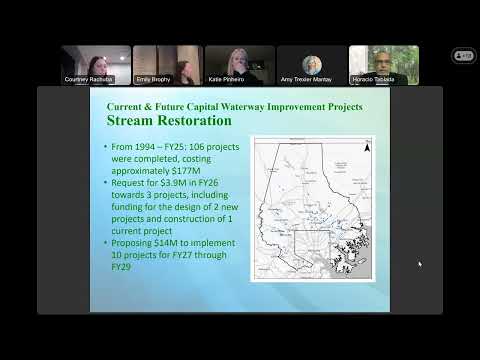
The department described four core capital program areas: stream restoration, shoreline stabilization, stormwater best‑management practice (BMP) improvements and reforestation. According to Tablada, the county has completed 106 stream restoration projects through fiscal year 2025 at a cumulative cost of about $177 million. For FY26 the department requests $3.9 million to fund three projects (two in design, one for construction) and proposes $14 million for 10 additional projects from FY27 through FY29.
Tablada said shoreline stabilization work has completed 42 projects through FY25 at roughly $22 million. The FY26 request for shoreline work is $4 million for two construction projects, with $11 million proposed for additional projects in later years.
On stormwater, Tablada said the county has completed 183 BMP projects at a total cost of about $15 million since FY2013. The FY26 request is roughly $3.6 million to support approximately 11 water‑quality projects, 17 BMP repairs and three annual maintenance efforts; the department said it inspects about 5,000 stormwater systems countywide and directly maintains a subset of roughly 1,500 facilities on a three‑year rotation.
Tablada also highlighted a pilot project deploying floating treatment wetlands in a White Marsh pond. The pilot cost about $144,000; the department is monitoring dissolved oxygen and temperature and plans a second pilot in spring 2025 to evaluate wider use where pond depth and surface area are suitable.
The presentation described reforestation and urban tree‑planting efforts. Tablada said roughly 71,593 acres of preserved land and planting programs have contributed to tree canopy and urban reforestation goals; the department requested $725,000 for FY26 to fund about 30 acres of reforestation and set a target of 50 acres per year in later years, with an estimated annual cost of $1.1 million to $1.5 million.
Tablada outlined an ongoing public‑health and water‑quality effort funded in part by proceeds from a settlement with Monsanto. “As a result of the settlement with Monsanto, the county received approximately $9,500,000,” he said. The settlement money was placed in a dedicated account; the county council recently approved additional contract authority so the department can expand PCB sampling and laboratory testing. Tablada said the work is intended to identify PCB “hotspots” so responsible parties can be required to remediate contaminated sediment and water bodies.
The department also described enterprise‑level sustainability work. Tablada said the sustainability unit managed roughly $2.3 million in capital funds in FY24–25 to benchmark building energy use and invest in studies, including about $250,000 for an EV‑charging study and software to guide charger siting.
Tablada closed by asking the committee for support and noting the department’s capital requests are intended to maintain compliance with the MS4 permit and advance Chesapeake Bay TMDL goals. He then answered questions from board members about the Monsanto settlement funds, landfill testing and tree replacement protocols.
Looking ahead, the department will use the expanded lab contracts and PCB monitoring funding to complete Phase 1 sampling, work with MDE to locate hotspots and pursue responsible‑party remediation where appropriate.